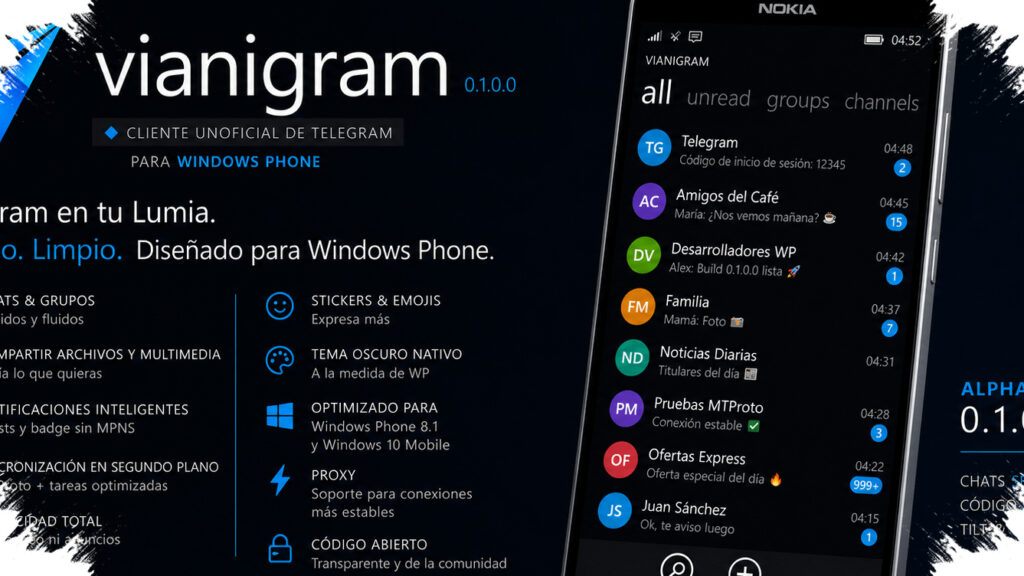
A Telegram client running natively on Windows Phone in 2026 sounds improbable, yet Vianigram makes that claim tangible. More importantly, it does not stop at opening the app shell, but reaches the point where users can log in and send messages.
That is what has drawn attention back to a platform many assumed had long since faded out of relevance. Vianigram shows that the ecosystem still has life, even if that life now depends almost entirely on independent developers and a committed community.
A native Telegram experience on an old platform
Built on MTProto, the communication foundation used by Telegram, Vianigram is presented as a true native client rather than a visual placeholder. It supports a full login flow that includes phone numbers, SMS verification, two-step authentication, QR scanning, and account registration.
Once inside, users can browse chat lists with pagination and live updates. The app also surfaces familiar conversation indicators such as typing status, online status, and read status, which makes the experience feel far closer to a real modern messenger than to a museum piece.
Message rendering has also been pushed beyond the basics. Vianigram already supports text bubbles for text, photos, voice messages, documents, and polls, along with rich formatting such as bold, italic, spoiler text, links, and mentions.
Voice messages receive additional attention through waveform display and scrubbing support. Avatar handling is included as well, with preview and asynchronous HD loading designed to keep the interface responsive.
The hardest part is not the chat screen
The biggest technical problem is notifications, not messaging itself. Push notifications on Windows Phone are essentially dead in 2026, so the developer had to work around a missing system capability rather than simply enabling it.
To compensate, Vianigram relies on periodic maintenance tasks that can run every 30 minutes in the worst case. It also uses near-real-time wake events for VoIP, then combines them with local cache handling to trigger toast notifications and update the live tile.
That approach keeps notifications functional without depending on the old push infrastructure. Even so, alerts can still arrive late when the app has been fully closed, which means the workaround remains imperfect.
Still unfinished, but far from a mockup
The project is not yet complete, and the developer has acknowledged that the call interface and messaging interface still need additional polish. That makes Vianigram different from a polished official client on an active platform, but it does not reduce the significance of what it already achieves.
The fact that Telegram can run natively on Windows Phone in 2026 is itself the main takeaway. It signals that a system widely treated as dead can still produce new software when enthusiasts keep building for it.
Windows Central first highlighted the project after it was shared by Reddit user Legitimate_Post_2701. The attention came after the community had already been talking about 8Marketplace, an unofficial app store for Windows Phone.
Together, those projects reinforce a broader picture of a legacy platform surviving through community effort rather than industry support. For users who have stayed with Windows Phone, Vianigram is available through the Telegram channels PivoraApps or VianiumApps.
Source: www.xda-developers.com