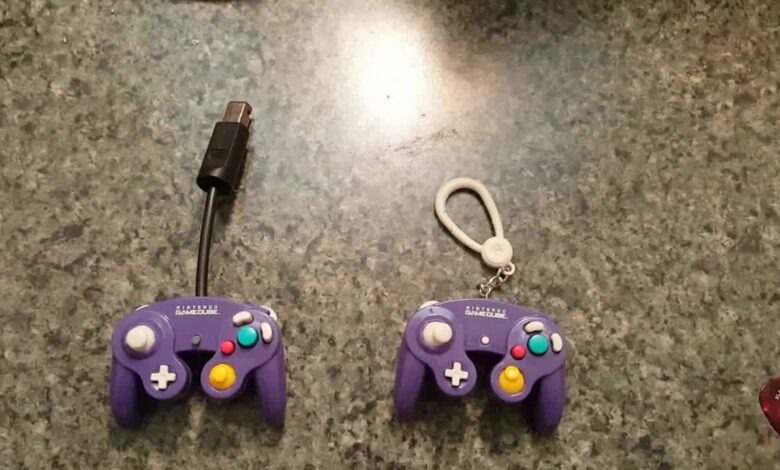
What looks like a tiny GameCube keychain has been turned into something far more useful than a collectible. In a compact build shown by Brux and highlighted by Hackster.io, the miniature shell works as a real controller rather than just a display piece.
The project stands out because it keeps the playful look of a keychain while adding actual gaming input. That combination makes the device more than a novelty, since the tiny body now houses electronics precise enough to send commands to a GameCube.
A shell that had to be hollowed out first
To make the build possible, Brux began by removing the inside of the keychain shell with a rotary motor. The empty space created by that step was necessary to fit new components inside a body that was never designed to hold them.
After the interior was cleared, 3D-printed parts were added to reshape the inside layout. Those custom pieces helped position the buttons and other internal elements with the accuracy needed for such a small enclosure.
Small switches, real input
For the controls themselves, Brux used surface-mount tactile switches placed beneath the buttons. That choice let the project keep physical button input even though the available space inside the shell was extremely limited.
At the center of the build sits the RP2040 microcontroller. Wiring runs from the input points to the RP2040, and then from the microcontroller out to the GameCube, turning the keychain into a functioning controller.
Proof that it works
The finished device was not just built for show. Brux demonstrated it in use, showing the mini controller playing Fortnite and Mario Kart.
It is not meant for serious competition such as Super Smash Bros. Melee. Even so, the project proves that a keychain-sized shell can become a working peripheral when the engineering is tight enough.
Why the project got attention
The appeal here goes beyond the novelty of a tiny GameCube design. Many themed keychains stay decorative, but this one crosses into practical use because it can actually receive and send input.
The build also highlights the challenge of working at this scale. Every component, from the switches to the wiring, had to be placed carefully so the controller could stay functional inside such a small form factor.
More mini controller ideas are already in motion
Brux also showed other keychain concepts near the end of the video. Among them were mini controllers inspired by N64 and SNES designs, along with a very small 3DS concept.
Those additional prototypes suggest the same approach could be applied to other consoles and handhelds. For now, though, the GameCube version remains the most notable because it has already been demonstrated as a working controller.
Source: www.xda-developers.com