


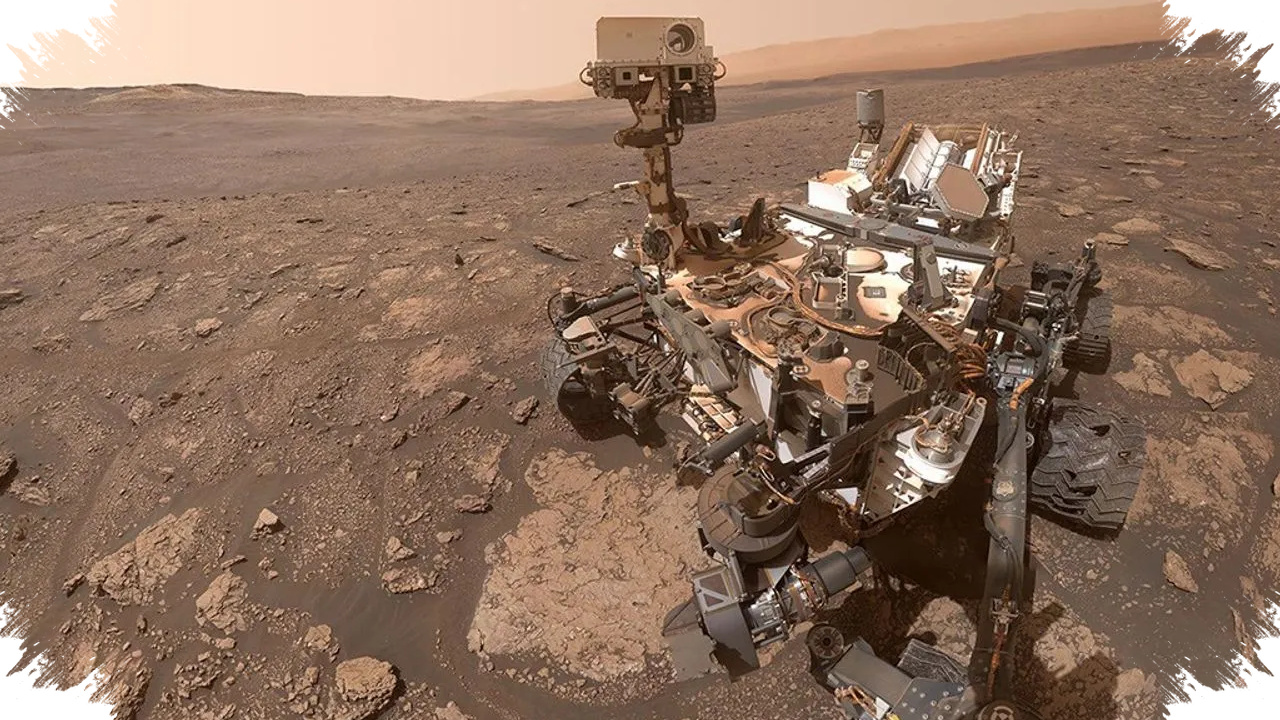
NASA’s Curiosity rover has uncovered the most diverse set of organic molecules ever identified on Mars in a rock sample it drilled and analyzed in 2020. Scientists found 21 carbon-containing molecules in the material, and seven of them had never been detected on the Red Planet before.
The discovery adds fresh evidence that ancient Mars had the chemistry needed to support life, even though the molecules themselves do not prove life ever existed there. Researchers say the compounds could have formed through biological or geological processes, and their survival also shows that some organic material can remain preserved in Martian rocks for billions of years despite radiation that slowly destroys such molecules.
A sample from an ancient watery landscape
The rock sample, called “Mary Anning 3,” came from a region of Mount Sharp that once held lakes and streams. That area went through repeated cycles of flooding and drying in Mars’ ancient past, which helped enrich it with clay minerals that are known to preserve organic compounds well.
Organic molecules are carbon-based compounds and are found throughout the solar system. On Mars, their preservation matters because the planet’s surface has been exposed to radiation for a very long time, making any surviving compounds especially significant for scientists studying the planet’s habitability.
Why the new molecules stand out
Among the newly identified compounds is a nitrogen heterocycle, a ring-shaped structure that includes nitrogen. Scientists consider this type of molecule important because it can serve as a precursor to RNA and DNA, the nucleic acids that carry genetic information.
Amy Williams of the University of Florida in Gainesville, the study’s lead author, said the detection is “pretty profound” because these structures can become chemical building blocks for more complex nitrogen-bearing molecules. She also noted that nitrogen heterocycles had never before been found on the Martian surface or confirmed in Martian meteorites.
Another notable find was benzothiophene, a molecule containing carbon and sulfur. It has been found in many meteorites, and some scientists think meteorites helped spread prebiotic chemistry across the early solar system.
How Curiosity made the discovery
The results came from Curiosity’s Sample Analysis at Mars, or SAM, a minilab inside the rover’s body. The rover first drills rock into powder, then feeds the material into SAM, where an oven heats it and releases gases that instruments can analyze to determine the sample’s composition.
SAM can also perform wet chemistry, which means it adds a solvent to the sample to help break apart larger molecules that might be hard to detect otherwise. For the Mary Anning 3 sample, the team used tetramethylammonium hydroxide, or TMAH, a powerful solvent kept for the most valuable samples.
To check whether the technique works as expected on materials like those on Mars, researchers also tested it on a piece of the Murchison meteorite, one of the most studied meteorites known. The meteorite, older than 4 billion years, contains organic molecules that were present in the early solar system.
That test showed that TMAH could break larger molecules into smaller ones, including benzothiophene, matching compounds seen in the Martian sample. The result strengthens the case that the molecules in Mary Anning 3 may have come from even more complex compounds related to life.
How the finding builds on earlier Mars results
The new paper follows last year’s report of the largest organic molecules ever found on Mars, including long-chain hydrocarbons such as decane, undecane, and dodecane. Together, the two findings show that Curiosity is uncovering a broader and more complex record of carbon chemistry in Martian rocks.
Ashwin Vasavada, Curiosity’s project scientist at NASA’s Jet Propulsion Laboratory in Southern California, said the work reflects the team “at their best.” He added that the collection of organic molecules “once again increases the prospect that Mars offered a home for life in the ancient past.”
A difficult experiment made possible by miniaturized lab work
SAM was built by NASA’s Goddard Space Flight Center in Greenbelt, Maryland, and it is based on larger commercial laboratory equipment. Engineers had to shrink it dramatically so it could fly on the rover and operate with limited power.
Scientists also had to adapt the way they used the oven, heating it more slowly over longer periods to make the experiments work on Mars. Charles Malespin, SAM’s principal investigator at NASA Goddard and a study coauthor, said that just carrying out this chemistry on Mars was itself a major achievement.
He said the team is now better prepared for similar experiments on future missions. NASA Goddard is already contributing components, including a mass spectrometer, to a next-generation version of SAM for ESA’s Rosalind Franklin rover and to the Dragonfly Mass Spectrometer that will study Saturn’s moon Titan.
Curiosity continues to explore Mars, including weblike boxwork ridges formed by ancient groundwater, and the mission team is still analyzing results from its final TMAH cup for a future paper.