Vintage baseball cards often differ little from one copy to another, but Venezuelan Topps issues are a major exception. Topps printed these cards for the Latin American market between 1959 and 1968, and surviving examples can be dramatically scarcer than their U.S. counterparts.
That scarcity has made Venezuelan Topps cards a serious target for collectors. Many were glued into albums in Venezuela, which left surviving copies with paper loss, damaged backs, and far fewer high-grade examples than the original print runs might suggest.
Why Venezuelan Topps cards stand out
The Venezuelan sets were not created as intentional rarities. They were lower-quality parallels of U.S. Topps cards, often printed with Spanish text and distinctive backs, including the black backs seen on some 1964 cards.
That combination of regional production and heavy album use explains their appeal today. For collectors, the challenge is not only finding the right card, but finding one that still shows clean surfaces and intact backs.
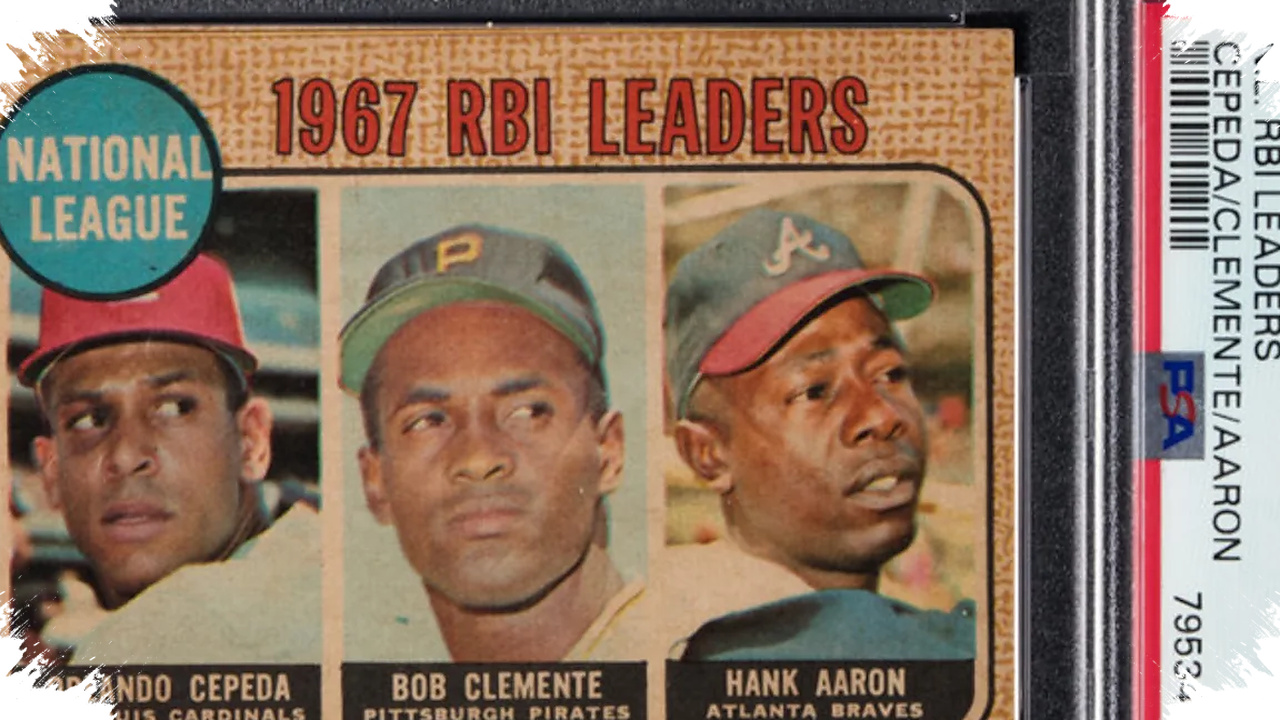
5. Roberto Clemente 1967 Topps Venezuelan #278 — SGC 4- $22,000
Roberto Clemente remains one of the most important names in the hobby, and his Venezuelan Topps card carries added meaning because the back is entirely in Spanish. The card also reflects Clemente’s broader legacy, as he won an MVP award, a World Series MVP, collected 3,000 hits, won four batting titles, and earned 12 consecutive Gold Gloves.
The reference notes a Venezuelan pop count of 27, compared with 8,456 for the standard Topps version. Even in SGC 1.5 condition, this card sold for $7,000, which shows how quickly value rises when scarcity meets a player with Clemente’s stature.
4. 1962 Topps Venezuelan NL Home Run Leaders featuring Orlando Cepeda, Willie Mays, and Frank Robinson — PSA 8.5 $23,189
This multi-player card captures a strong National League power race, with Orlando Cepeda leading the league in home runs in 1961 at 46, followed by Willie Mays at 40 and Frank Robinson at 37. Cepeda, nicknamed “The Baby Bull,” later became the second player from Puerto Rico to reach the Hall of Fame after Clemente.
The card is far harder to find than the standard issue, with a Venezuelan pop count of 54 against 2,066 for the U.S. Topps version. The reference also points out that a PSA 9 of the standard card sold for $750, while the Venezuelan PSA 8.5 brought more than $22,000, underscoring the premium tied to the Venezuelan print.
3. Mickey Mantle 1968 Topps Venezuelan #280 — $31,720
Mickey Mantle’s Venezuelan card from 1968 is one of the clearest examples of how rarity reshapes value. The reference says this card is 612 times rarer than the standard 1968 Topps version, and it shows Mantle in his final season with the Yankees.
The population numbers tell the same story, with 46 Venezuelan examples versus 28,164 standard Topps copies. The key identifier is the backtext reading “Hecho en Venezuela,” which helps distinguish it from the U.S. issue and adds another layer of collecting appeal.
2. Sandy Koufax 1967 Topps Venezuelan Retirado #162 — $37,200
Koufax’s Venezuelan card is notable because “Retirado” means “retired” in Spanish, making it a tribute issued after he left the game. The 1967 Venezuelan set also mattered for another reason, since it was the first designed as a stand-alone Venezuelan release rather than just a lower-quality copy of a U.S. Topps set.
Because Koufax retired after the 1966 season and had no standard card in the 1967 U.S. Topps set, this Venezuelan issue is widely treated as his last card. Its Venezuelan pop count is listed at 88, and the reference does not provide a standard Topps pop count, which only adds to the card’s mystique.
1. Nolan Ryan 1968 Topps Venezuelan Rookie Stars #177 — PSA 5 $100,650
Nolan Ryan’s Venezuelan rookie card leads this group because it combines historical importance with extreme scarcity. The reference describes it as the rarest of the four versions of Ryan’s rookie card, and it says the card is about 500 times rarer than the U.S. Topps version.
The pop counts reflect that gap, with 63 Venezuelan examples against 31,756 standard Topps cards. The card’s image quality is also described as duller than the U.S. version, and the highest PSA grade noted is only 5.5, which makes a mid-grade copy especially difficult to secure.
Venezuelan Topps cards continue to attract attention because they sit at the intersection of player significance, regional baseball history, and true scarcity. With only seven Venezuelan Topps sets known from 1959, 1960, 1962, 1964, 1966, 1967, and 1968, each surviving card carries outsized interest for collectors chasing iconic names in a format that was never meant to become so rare.
Read more at: www.si.com-

-

-

-