


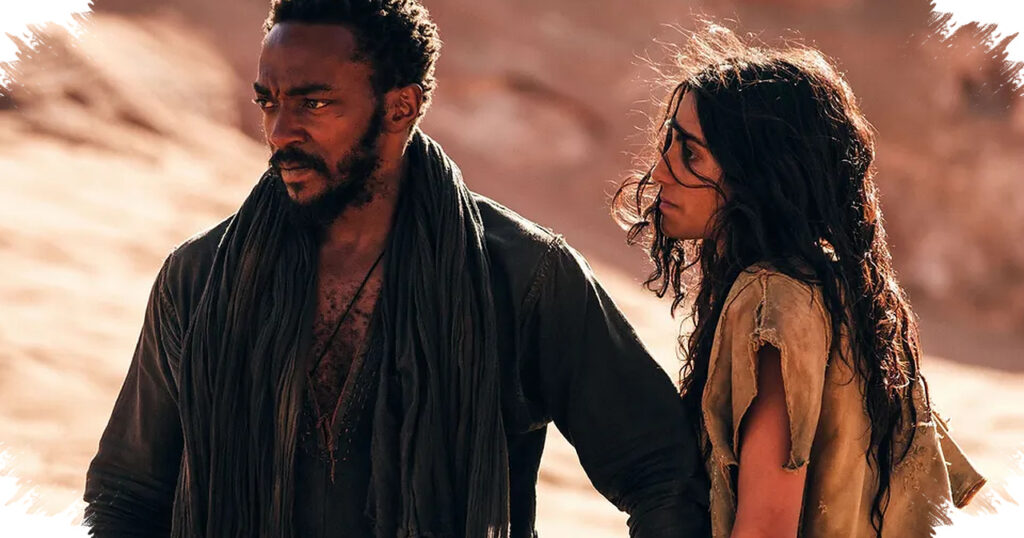
Desert Warrior was meant to be Saudi Arabia’s showcase movie: a large-scale historical action epic built to prove that the kingdom could make a Hollywood-style tentpole with local roots and global reach. Instead, it became a costly example of how ambition can outrun experience, infrastructure, and market reality.
The film opened in North America with limited marketing, landed on 1,010 screens, and grossed just $472,000. That box-office result capped a long production story marked by budget overruns, delayed edits, creative conflict, and a release path that looked increasingly fragile long before audiences ever saw the movie.
A flagship project built for Saudi Arabia’s film ambitions
Desert Warrior was conceived as a first-of-its-kind production under Saudi Arabia’s Vision 2030 push to expand entertainment and tourism beyond oil. It was also designed to be the first Hollywood-style tentpole shot entirely in Saudi Arabia and the first project to use Neom Media, the state-backed studio complex tied to the Neom development on the Red Sea.
The film brought together major international talent. Rupert Wyatt, known for Rise of the Planet of the Apes, directed the movie, while Anthony Mackie played the noble Bandit and Sir Ben Kingsley portrayed Emperor Kisra. The cast also included Aiysha Hart as Princess Hind and Sharlto Copley as a warlord bent on capture and conquest.
A production that had to improvise on the fly
The production started before the local infrastructure was ready for a movie of this scale. Neom’s promised studio space was still unfinished when filming began in September 2021, so the crew built an improvised soundstage in the parking lot of the Grand Millennium Hotel in Tabuk.
That setup had to handle large throne-room scenes, gladiator battles, prisoner torture sequences, and even elephants, all while crew members worked through brutal desert heat. One person on set described the temporary structure as “like an inflatable stadium,” adding that there were no real studios available at the time.
The challenges did not stop there. The production had to bring in thousands of extras, including 12,500 people from as far away as former Soviet Georgia, along with a technical crew drawn from roughly 40 countries. Camera equipment also arrived from across the Middle East, showing how much had to be imported because the local ecosystem was not yet in place.
How the movie was supposed to work
MBC Group, the company behind the film’s studio backer MBC Studios, wanted Desert Warrior to serve as a statement movie for the Saudi film industry and the wider Arab-speaking market. The story was built from a regional setting and reworked with international filmmaking expertise in mind.
Producer Jeremy Bolt, known for the Resident Evil franchise, helped oversee physical production. Screenwriter David Self developed a script set in seventh-century pre-Islamic Arabia, and Wyatt later reshaped the film into a more character-driven story centered on Princess Hind’s resistance journey.
In its final form, the movie follows Hind as she escapes capture, grows into a leader, and joins forces with Bandit to rally fractured Arab tribes against the occupying Persian-Sasanian army. That shift gave the title character more prominence and turned the film into a female-led resistance story rather than a straightforward warrior epic.
The budget kept climbing
MBC’s internal accounting said the original budget stood at $70 million, but later estimates placed spending at at least $150 million, with one insider putting it as high as $170 million. A source close to the production disputed the lower figure and said the movie was “never going to cost less than $100 million.”
The added cost came from several directions. COVID-related disruptions shut production down at times, and Saudi Arabia’s border closure trapped key equipment outside the country for six weeks. More delays followed because the crew had to operate in a place with little existing film infrastructure, which meant building and rebuilding sets and solving problems that Hollywood productions usually take for granted.
As Bolt put it, the shutdown and border closure alone cost about $20 million, and the lack of infrastructure added another $20 million. That kind of spending quickly pushed the project far beyond its original plan.
Creative control became the next crisis
The film’s difficult logistics were only part of the story. After principal photography wrapped in December 2021, Desert Warrior entered a prolonged and messy postproduction phase that drew in competing visions from the director and the studio.
Wyatt’s first director’s cut reportedly received a positive response from MBC leadership, and the studio approved additional pickup shoots. But the situation changed after an executive reshuffle, when new management raised concerns about tone, clarity, emotional connection, and runtime. According to sources, the studio even considered paying Morgan Freeman $2 million for voice-over narration, though that idea was never carried forward.
Then the conflict deepened. Wyatt’s editor was fired, Kelley Dixon was brought in to recut the film without the director’s involvement, and the resulting version screened poorly in Las Vegas. Wyatt later said in public remarks that the studio wanted to change the movie into something different from what he had shot.
A film industry cautionary tale
Several people close to the project described a company that had money and intention but not enough experience to manage a production this complex. One insider said plainly, “Nobody at the company had the experience to make this kind of movie.”
That lack of experience also affected the film’s positioning. One source said there was little market research for a movie originally budgeted at $70 million, and executives struggled to define the audience. The same source argued that some Arab viewers saw it as inauthentic, while Western audiences had little reason to connect with Princess Hind as a lead character.
The internal audit that later surfaced at MBC Group deepened the picture of strain behind the scenes. It described overspending, weak internal controls, unclear strategy, and corporate disorganization. Those problems slowed MBC Studios’ broader ambition to present Saudi Arabia as a serious player in film and television.
From buyer screenings to a delayed release
Even after the film was shown to buyers, the response remained bleak. In February 2024, AGC International held screenings for Netflix, Amazon, and major studios, but none made an offer.
An insider familiar with the process said the reaction was often the same: praise for the visuals and action, followed by the view that the movie had no audience after the Israel-Hamas war. That geopolitical context later made the release timing even more awkward, especially as the film centered on Arab heroes fighting Persian forces.
Wyatt eventually returned to finish the movie after MBC leadership changed again and the studio restored his creative control. He resumed postproduction and delivered another director’s cut, which premiered at the Zurich Film Festival and drew mixed-to-positive reviews. Screen Daily called it visually stunning but also said it could struggle to connect with international audiences.
Vertical Entertainment later acquired U.S. and U.K. rights, and MBC’s Ali Jaafar said the finished release represented the filmmaker’s vision. He described the project as a team effort from start to finish, even after years of setbacks, changing management, and repeated editorial battles.