


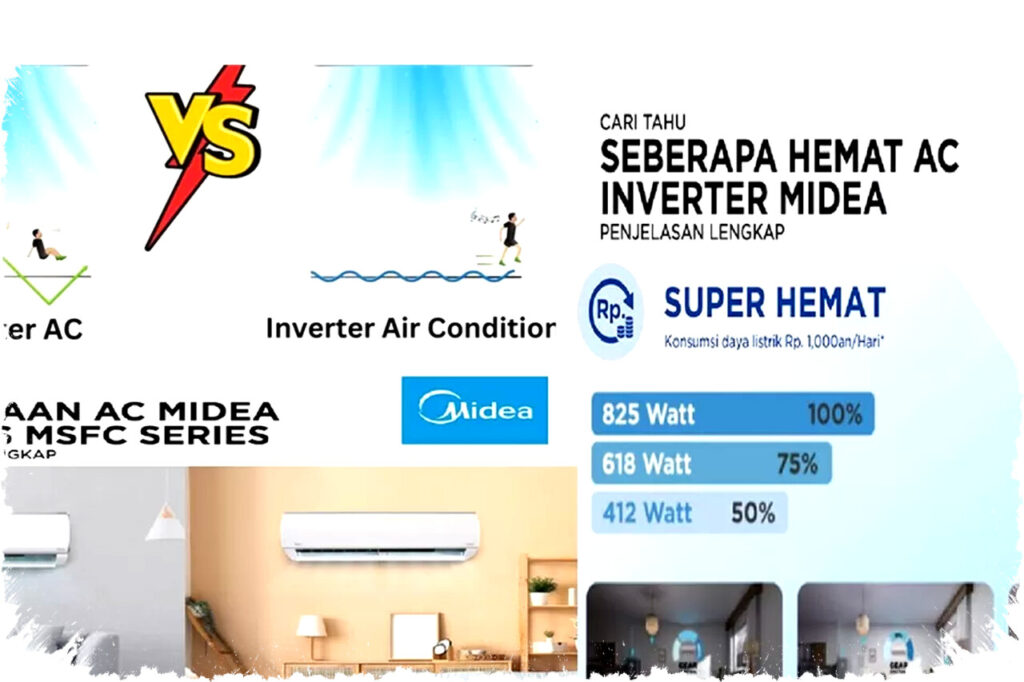
Midea air conditioners (AC) have become a popular choice for cooling solutions amid rising temperatures. Their wide range of models, including both inverter and non-inverter units, caters to diverse needs and budgets. Selecting between an inverter and non-inverter AC requires understanding their differences in efficiency, features, and cost implications.
Understanding Midea’s Non-Inverter AC Models
Non-inverter AC units operate at a fixed speed and cycle on and off to maintain the desired temperature. Midea’s non-inverter lineup includes models starting with the 0.5 PK capacity, such as the MSFCE-05CRN2X and MSAFE-05CRN2X. These models are ideal for small bedrooms or compact workspaces. They use environmentally friendly R32 refrigerant, and their power consumption is approximately 350 watts. Features like Super Cool and Turbo Cooling accelerate the cooling process, while the Double Gold Fin coating protects the evaporator from corrosion, enhancing durability in humid climates.
The 1 PK non-inverter model, MSFC-09CRN2X, suits slightly larger rooms like small living rooms or family bedrooms. It delivers 9,000 BTU/h cooling capacity with an electrical power draw of around 800 watts, fitting spaces ranging from 14 to 18 square meters. Turbo Cooling technology enables rapid cooling, and the Gold Fin layer guards the unit against rust, prolonging its lifespan. Pricing for this model generally ranges around $190 USD depending on packages and sellers.
For larger rooms, the 2 PK non-inverter MSAF-18CRN2X offers higher cooling power. This model is suitable for living areas or office spaces needing more robust cooling. It continues the use of R32 refrigerant and advanced protection coatings due to Indonesia’s tropical weather demands.
Advantages and Considerations of Non-Inverter ACs
Non-inverter ACs have a lower upfront price, making them accessible for users with limited budgets. Their straightforward operation means simpler maintenance and fewer potential repair points. However, because these units operate at full power until the room reaches the set temperature and then shut off, they consume more electricity overall compared to inverter models. This cycling can also generate noise and uneven cooling sensations.
Exploring Midea’s Inverter AC Technology
Inverter ACs adjust the compressor speed to maintain a consistent temperature. This modulation results in significant energy savings and quieter operation. While the initial cost is higher, inverter ACs provide better value over time through reduced electricity bills and enhanced comfort.
Midea offers inverter models with various capacities and features suited for residential and small commercial uses. They typically feature smart controls and eco-friendly refrigerants, aligning with Indonesia’s tropical climate challenges. Advanced sensors and inverter-driven compressors optimize performance automatically, reducing wear and increasing durability.
Key Benefits of Midea Inverter ACs
- Energy Efficiency: By continuously adjusting compressor speed, inverter ACs can reduce power consumption by up to 30-50% compared to non-inverter units.
- Quieter Operation: Lower compressor speeds mean less noise, enhancing comfort in bedrooms or workspaces.
- Stable Temperature Control: The inverter system maintains room temperature more precisely without the temperature fluctuations common in non-inverter ACs.
- Longer Lifespan: Reduced compressor strain can lead to fewer breakdowns and extended equipment life.
Cost Comparison Between Midea Inverter and Non-Inverter ACs
Midea’s non-inverter ACs start at approximately $165 USD for 0.5 PK models, extending to $230 USD for 1 PK variants. Meanwhile, inverter models generally begin around $260 USD depending on features and capacity. Despite the higher purchase price, inverter units often yield long-term savings through lower monthly power expenses.
Factors to Consider When Choosing Between Midea Inverter and Non-Inverter ACs
- Room Size and Usage: Small rooms with limited cooling needs may be adequately served by non-inverter ACs. Larger or frequently used spaces benefit from inverter technology.
- Budget Constraints: Initial purchase price is lower for non-inverter units, suitable for minimal upfront investments.
- Electricity Costs: Inverter AC savings become apparent in regions with high electricity rates or prolonged usage.
- Environmental Impact: Both types use the R32 refrigerant, reducing environmental harm compared to older refrigerants. However, inverter ACs promote energy conservation.
- Durability Requirements: Enhanced coatings like Gold Fin on both models improve lifespan but inverter ACs typically experience less mechanical stress.
Simple Guide for Selecting Midea AC Models
| Capacity (PK) | Model Example | Power Consumption (W) | Room Size (sqm) | Approximate Price (USD) | Key Features |
|---|---|---|---|---|---|
| 0.5 | MSFCE-05CRN2X | 350 | <10 | $165 | Super Cool, Turbo Cooling, Double Gold Fin |
| 1 | MSFC-09CRN2X | 800 | 14-18 | $190 | Turbo Cooling, Gold Fin Protection |
| 2 | MSAF-18CRN2X | Higher (~1500) | 18-24 | $280+ | Corrosion Protection, Turbo Cooling |
| 1-2 Inverter | Various Midea inverter models | Lower than non-inverter | 10-24 | $260+ | Energy Efficient, Quiet Operation |
This table helps consumers understand which model fits their space and budget.
Choosing between Midea inverter and non-inverter AC models involves balancing upfront costs with long-term energy savings. Users prioritizing quiet, efficient cooling in medium to large rooms will benefit more from inverter units. Those with smaller spaces or tighter budgets might find non-inverter models adequate.
Midea continues to innovate in both categories, providing environmentally conscious refrigeration and user-friendly features suitable for tropical climates. As electricity costs rise and environmental concerns grow, inverter ACs are increasingly recommended despite their higher initial price. Non-inverter units remain a practical option for basic cooling needs without compromising durability or safety.