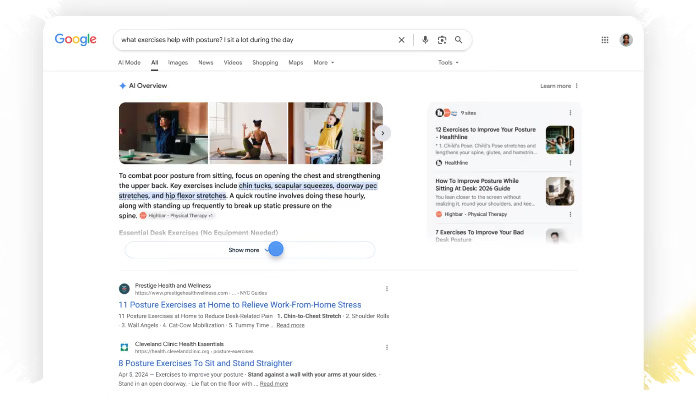
Google Search is moving into a phase where the familiar list of blue links is no longer the main event. The company is redesigning Search to behave more like an AI assistant that can understand intent, context, and follow-up questions with far less effort from the user.
The shift was introduced at Google I/O 2026 in Shoreline Amphitheatre, Mountain View, California, United States. Google’s direction is clear: Search should feel more interactive, more conversational, and more useful in the way people naturally ask for information.
Search is becoming more than a query box
For more than 25 years, Google Search has been closely associated with a simple format: enter a query and receive a page of links. That model is now being stretched into something broader, with AI taking a more active role in how answers are delivered.
Google is introducing an intelligent search box that can handle complex questions without forcing users to choose a special search mode first. The company is also making AI-powered search suggestions more advanced than standard autocomplete, so the prompts feel more specific and more relevant.
In some cases, Search will no longer return just a set of links. Instead, results may appear as interactive visuals, dynamic widgets, or layouts that resemble app pages.
AI Overviews and AI Mode are expanding the experience
Google has already taken a major step with AI Overviews, and those summaries now support follow-up questions through AI Mode. That means users can continue exploring a topic within the search experience rather than moving from one website to another.
The company’s broader strategy is built around making Search a place where people can ask more natural questions and get more complete responses. That approach reduces the need to break down a request into shorter queries or manually open multiple pages to piece together an answer.
This change also points to a future where Search is not just a gateway to information, but a more direct interface for solving everyday information needs.
Agents are taking over routine monitoring
One of the more notable additions is the information agent inside Search. Google says users will be able to create an AI agent that runs in the background for 24 hours to monitor changes across the internet.
The agent can be used to track stock market movements or follow the development of a specific topic automatically. When something important changes, it sends a full summary along with related sources.
Google says the agent can build its own monitoring plan based on the parameters given by the user. That makes the process more practical than older tools that relied mainly on manual checking.
The concept is similar to Google Alerts, which launched in 2003. The difference is that the new agent does more than detect changes, because it also understands context and produces a simple analysis on its own.
What this means for clicks and publishers
As Search becomes more AI-driven, the role of traditional blue links is expected to shrink further. Users may rely more on AI agents and generated answers than on clicking through websites one by one.
That trend builds on the impact already seen from AI Overviews, which has been used by more than 2.5 billion people per month. AI Mode, which launched last year, has also passed more than 1 billion monthly users.
For comparison, ChatGPT had around 900 million weekly active users at the beginning of this year. The figures suggest Google still has an advantage in total AI user reach, while ChatGPT appears to have stronger repeat usage within a week.
Publishers and media companies have reason to pay attention. Website traffic has already been under pressure as AI Overviews reduce the need for users to visit multiple sites, and the addition of agents, generative UI, and mini apps could lower clicks even further.
Search may soon act like a workspace
Google is also combining Gemini technology with its agentic platform, Google Antigravity, to make Search more interactive. Over time, the experience is expected to go beyond static results and move toward dynamic pages with visuals, widgets, and personal project spaces powered by AI.
Users will also be able to ask follow-up questions and see updated views in real time. In this model, Search becomes less of a place to browse links and more of a place to take action.
Google says Search will eventually be able to create mini apps directly from natural-language prompts. These mini apps use Antigravity and will first be available to Google AI Pro and Ultra subscribers.
The apps can be built without coding knowledge. Examples given by Google include a meal-planning app based on a calendar schedule and a fitness app tailored to a user’s workout goals.
The system is being developed with Google DeepMind and uses Gemini Flash 3.5. Google says the AI-based Search experience will begin rolling out gradually for free to Google users starting this summer.
Google’s broader message is that AI should be fast, efficient, and affordable enough to reach a wide audience. Sundar Pichai said the company is focused on making that possible, and Google plans to open more AI features to general users in the future.