


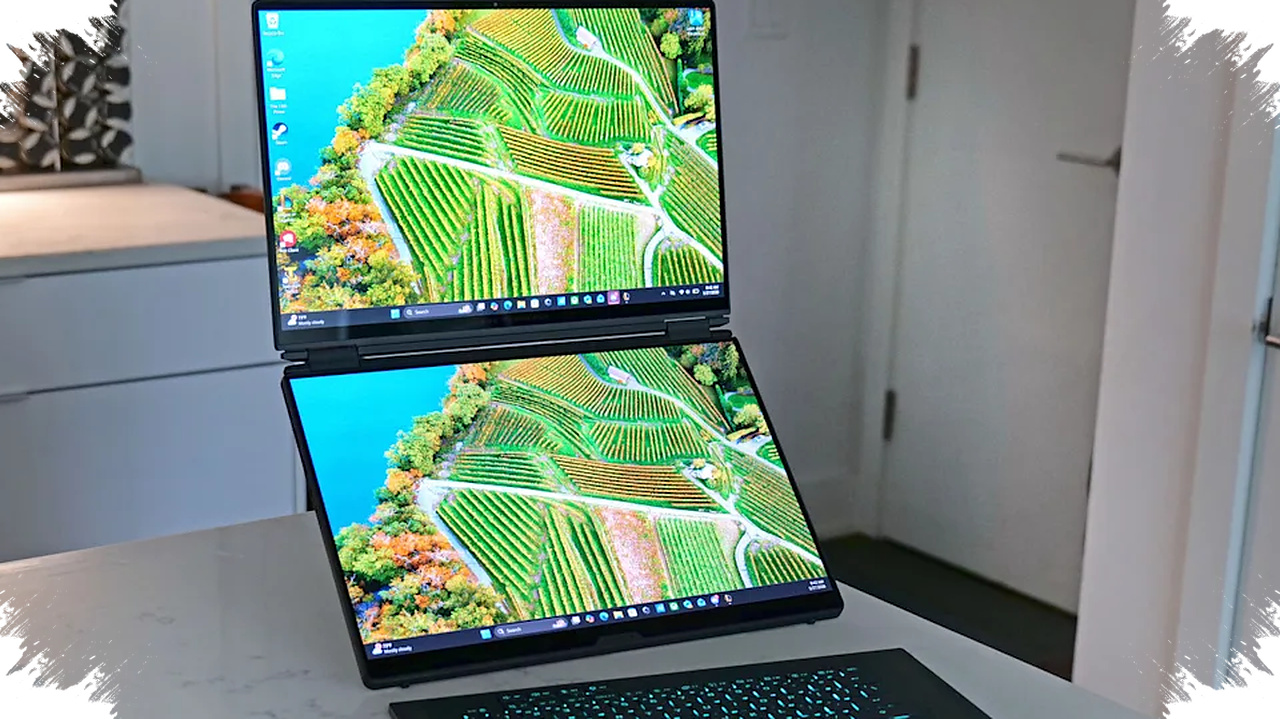
ASUS has built the ROG Zephyrus Duo for buyers who want a gaming laptop that refuses to behave like a normal one. With two OLED displays, a starting price of $4,500, and graphics options that go all the way up to RTX 5090, it is closer to a showcase of ambition than a machine aimed at the mainstream.
The most striking part is not only the hardware on paper, but the way the device changes its purpose depending on how it is used. In one setup it acts like a high-end gaming laptop, while in another it becomes a dual-screen workstation built for games, widgets, browser tabs, and creative tools.
A familiar shell with an unusual twist
When the Zephyrus Duo is closed, it does not immediately look like something extreme. The outer design resembles the Zephyrus G16, with a simple lid, a slanted line on top, and a boxy chassis with softly rounded corners.
It is still a large machine, however, at 0.98 inches thick and 6.2 pounds in weight. The real difference appears only after the magnet-held keyboard is removed, revealing a second 16-inch 3K OLED display sitting beneath the main panel.
Two screens, two different ways to work
The laptop’s clamshell mode is where ASUS clearly expects users to make the most of the dual-screen layout. The main display can handle gameplay, while the lower screen can show widgets, extra browser tabs, or a virtual keyboard and touchpad.
ASUS also includes a gesture that lets users move an app by touching its title bar and dragging it to the other screen in one motion. The detachable keyboard is only 5 mm thick, but it still offers acceptable key travel, and pogo pins on the bottom edge allow it to charge automatically when reattached.
A second mode becomes available when the built-in kickstand is opened. In that position, the lower screen can serve as a second monitor for Discord, game guides, or other apps, while the keyboard sits flat in front of the laptop.
Ports, sound, and limits
ASUS gives the Zephyrus Duo a fairly complete set of connections. The laptop includes Wi‑Fi 7, Bluetooth 6.0, HDMI, a 3.5 mm audio jack, an SD card reader, and four USB ports in total.
Two of those USB ports are Thunderbolt 4, while the other two are USB 3.2 Type-A. The machine still lacks Thunderbolt 5 and does not include a dedicated Ethernet jack, so the port selection is broad but not unlimited.
Audio is also a strength. The six-speaker setup is powerful enough to drown out fan noise when headphones are not in use.
Pricing climbs fast with the top spec
The base ROG Zephyrus Duo starts at $4,500. That version pairs an Intel Core Ultra 9 386H with 32GB of RAM, 1TB of storage, and an NVIDIA RTX 5070 Ti.
Moving to the RTX 5090 costs another $1,000. Even so, that upgrade does not add more memory or storage, which makes the price jump feel less flexible for a machine already positioned at the high end.
Performance that matches the cost
On gaming tests, the Zephyrus Duo delivers the kind of numbers expected from a premium flagship. Cyberpunk 2077 ran at 75 fps at 1080p with the Ultra RT preset, while Control reached 124 fps at 1080p on Epic settings.
At 2,560 x 1,440 with Epic settings, Control still posted 95 fps. That suggests the laptop has enough power to handle resolutions close to its built-in 3K panel without losing much pace.
It is also well suited to creative work. The SD card reader helps with photo and video editing workflows, while the display is Pantone validated and covers 100 percent of the DCI-P3 color gamut.
Battery life is better than expected
A dual-screen laptop with high-end components would normally be expected to struggle away from the charger. The Zephyrus Duo did better than that in testing, lasting 13 hours and 10 minutes in the PCMark 10 Modern Office test with one screen active in Armoury Crate Performance mode.
That result does not carry over to gaming or dual-screen use, where battery life drops. Even so, the 90Wh battery can still support more than two hours of gaming without a charger, depending on the game being played.
The Zephyrus Duo remains a machine for a narrow audience, but that is also what makes it stand out. For users who want a fast gaming laptop with a second OLED screen and a design that is difficult to confuse with anything else, ASUS has created something that feels rare in the market.