AMD’s Radeon RX 9070 GRE is shaping up as one of the more practical options in a market where mainstream graphics cards continue to get more expensive. Early testing suggests it lands close enough to the RX 9070 that the lower price could matter more than the gap on paper.
The card is also notable for a reason beyond performance. RX 9070 GRE is no longer limited to China, and AMD is preparing it for global markets with a suggested retail price of $549, the same figure the RX 9070 carried at launch even though the standard model now starts above $600.
A trimmed version with a different balance
In AMD’s lineup, the RX 9070 GRE sits below the main RX 9070 as a cut-down variant. It carries 12GB of VRAM, compared with 16GB on the RX 9070, and it also ships with fewer compute units and ray tracing accelerators.
AMD offsets part of that reduction with a higher boost clock of 2.79GHz. The RX 9070 is listed at 2.52GHz, so the GRE model leans on frequency to help close the hardware gap.
The naming also fits AMD’s established pattern. GRE stands for “Golden Rabbit Edition,” a label the company typically uses for lower-spec GPUs in China, which makes the global rollout feel like an expansion of a strategy already in use.
Performance that varies by workload
Benchmarks show that RX 9070 GRE does not behave the same way in every test. In 3DMark Speedway, described as AMD’s heaviest benchmark at the moment, the card scored 4,334 points, well behind the RX 9070’s 5,799.
The picture looks tighter in other tests. RX 9070 GRE trailed by around 700 points in Steel Nomad and by only about 200 points in TimeSpy Extreme, which suggests the performance gap is not always as large as Speedway makes it appear.
The card also posted mixed results in Geekbench 6 GPU. In that test, RX 9070 GRE scored 137,663, ahead of the RX 9070’s 113,012, while the RX 9070 XT reached 130,474.
Another set of numbers shows the same uneven pattern. RX 9070 GRE recorded 10,718 in 3DMark TimeSpy Extreme, compared with 10,997 for RX 9070 and 13,060 for RX 9070 XT.
Gaming remains strong at 1440p
Despite the trimmed specifications, the card still looks capable for modern gaming at 1440p. In Forza Horizon 6, it averaged 180 fps at 1440p with the “RT High” preset and FSR4 frame generation enabled.
Turning frame generation off dropped performance to about 90 fps. Even so, the card was still able to handle 4K in the same game at an average of 80 fps with similar settings.
The gameplay experience was described as smooth, with ray tracing reflections and HDR highlights looking good on a QD-OLED panel. The game warned that video memory was nearly full, but no noticeable performance issues appeared during testing.
Cool, quiet, and not trying to be flashy
Thermals were another strong point. Under load, the GPU core reached only 58 degrees Celsius, while the fans remained almost inaudible.
Once heavy work stopped, the temperature quickly dropped to 30 degrees Celsius. That behavior makes the card look well suited to smaller cases and to users who prioritize a quiet system.
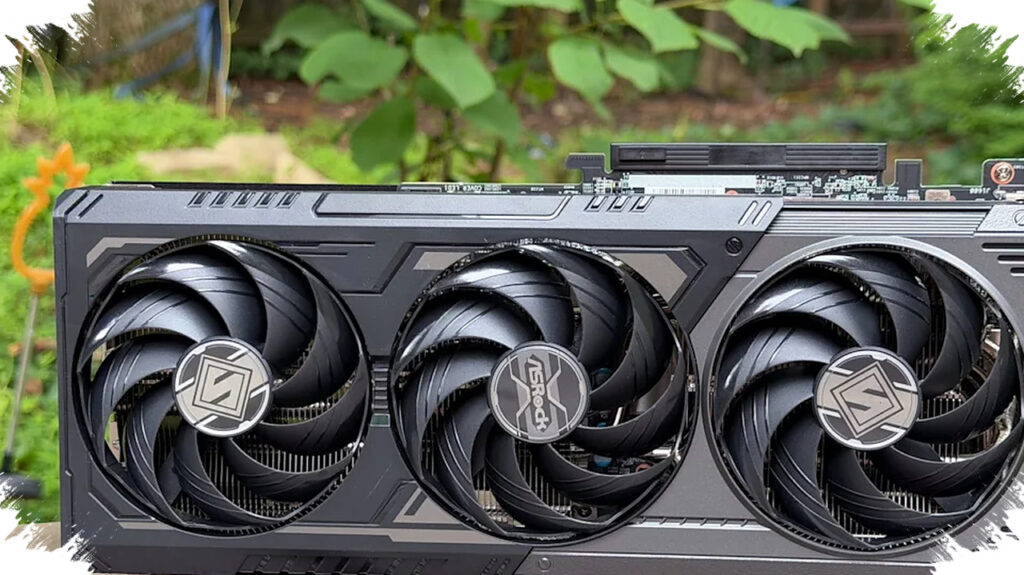
The tested ASRock unit used a simple cooler with three large fans, which matches the card’s overall positioning. It is not presented as an extreme performance product, but as a more restrained option that keeps efficiency and price in focus.
For buyers who want an upgrade now without paying above the current cost of an RX 9070, the RX 9070 GRE lands in a particularly relevant spot. It is not identical to the standard model, but its mix of pricing, gaming performance, and efficiency makes it an easy card to notice in a market that has not been kind to budget-minded players.