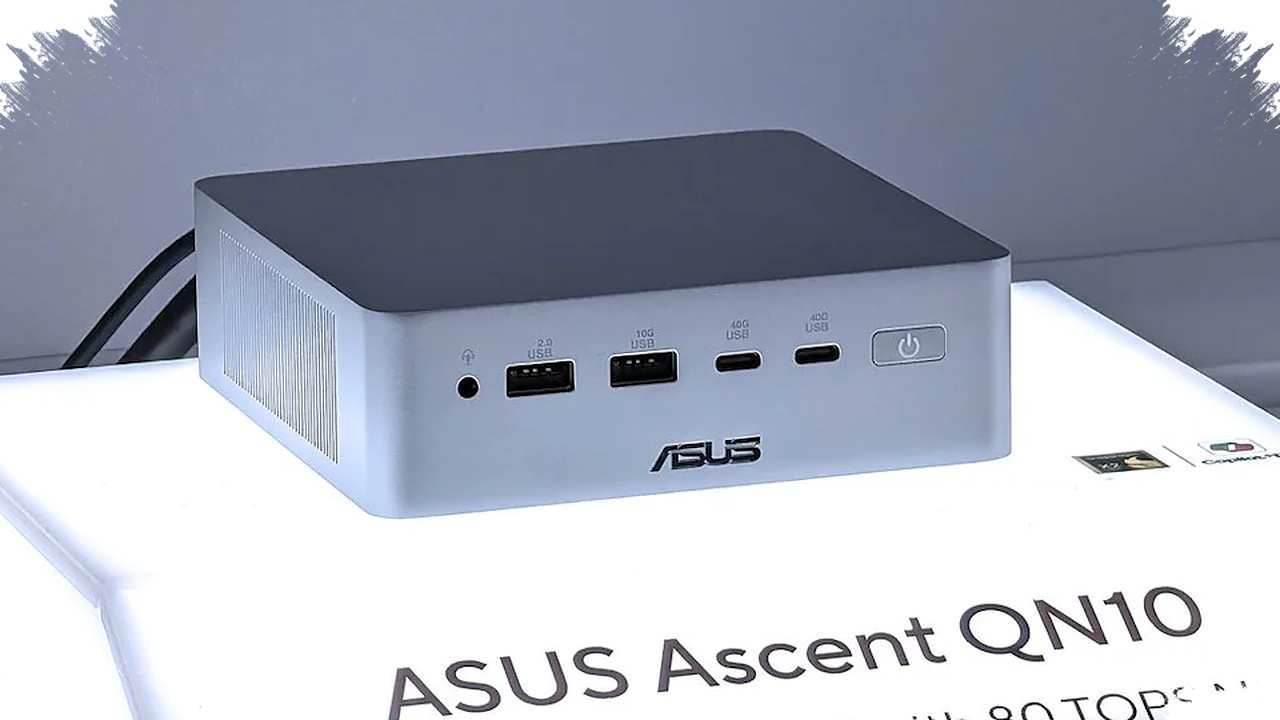
ASUS has turned the compact mini PC category into something much more ambitious with the arrival of Ascent QN10. Instead of positioning it as a simple small-form desktop, the company is pushing it as a compact AI machine built around Snapdragon X2 Elite and a 80 TOPS NPU.
That positioning matters because the device is not only small, but also designed for modern AI workloads while staying easy to place on a desk. ASUS and Qualcomm are clearly aiming to show that high AI performance no longer needs a large chassis.
A mini PC with workstation-style ambition

At the core of Ascent QN10 is Qualcomm’s Snapdragon X2 Elite, paired with a third-generation Qualcomm Oryon CPU featuring 18 cores. The package also includes a Qualcomm Adreno X2 GPU and a Qualcomm Hexagon NPU rated at up to 80 TOPS on INT8.
That combination places the device closer to a mini workstation than a conventional mini PC. ASUS appears to be targeting users who want compact hardware without giving up serious AI capability.
The major trade-off is fixed memory
The most important limitation is memory. ASUS lists support for up to 32GB of LPDDR5x running at 8533 or 9600MHz, and the memory cannot be upgraded by the user.
That ceiling makes Ascent QN10 different from many Intel- or AMD-based mini PCs that still allow SODIMM upgrades. For everyday office work, entertainment, and general AI tasks, 32GB remains practical, but heavier workloads such as larger local AI models may run into that limit.
Storage remains more flexible
While RAM is locked down, storage expansion is still a strong point. ASUS offers 512GB, 1TB, and 2TB configurations, with total storage capacity reaching up to 4TB.
The device uses one M.2 2280 PCIe Gen 5 SSD slot and one M.2 2280 PCIe Gen 4 SSD slot. That setup gives the mini PC room to grow in a segment where compact size often means compromise.
Ports and connectivity are not reduced
ASUS did not strip connectivity to achieve the small footprint. On the front, Ascent QN10 includes two USB4 Type-C ports with DP1.4, PD, 5V/3A, and 40Gbps support, along with two USB-A ports and a headphone jack.
The rear panel adds another USB4 Type-C port, two USB 3.2 Type-A ports, one HDMI 2.1 FRL port, and one RJ45 2.5GbE port. Wireless features also stay current with Wi-Fi 7 and Bluetooth 5.4, while Realtek 2.5G LAN handles wired networking.
Built for Copilot+ and multi-display use
Because it is based on Snapdragon X2 Elite, Ascent QN10 is fully compatible with Copilot+. That places it in the same broader class of new PCs designed for modern AI processing.
ASUS also says the system can drive up to four displays at once through HDMI and three USB-C connections. For a mini PC this size, that makes it suitable for more demanding desktop setups rather than just basic single-monitor use.
Small footprint, complete specification set
Physically, the system measures 130 x 130 x 40 mm and weighs 720 grams. ASUS pairs it with a 180W DC-in power adapter, while noise is listed at a maximum of 53 dBA in full-speed mode and 0 RPM when idle.
The specification sheet also notes an operating temperature range of 0-40°C, storage temperatures from -40 to 60°C, and humidity tolerance from 0% to 92% non-condensing. Certifications include BSMI, CB, CE, FCC, UL, CCC, C-Tick, WiFi, RF, and VCCI.
With its 80 TOPS NPU, fixed 32GB memory limit, and extensive connectivity, Ascent QN10 stands out as one of ASUS’s most aggressive entries in the AI-focused mini PC segment. The remaining detail that users will be watching most closely is its price and market availability.