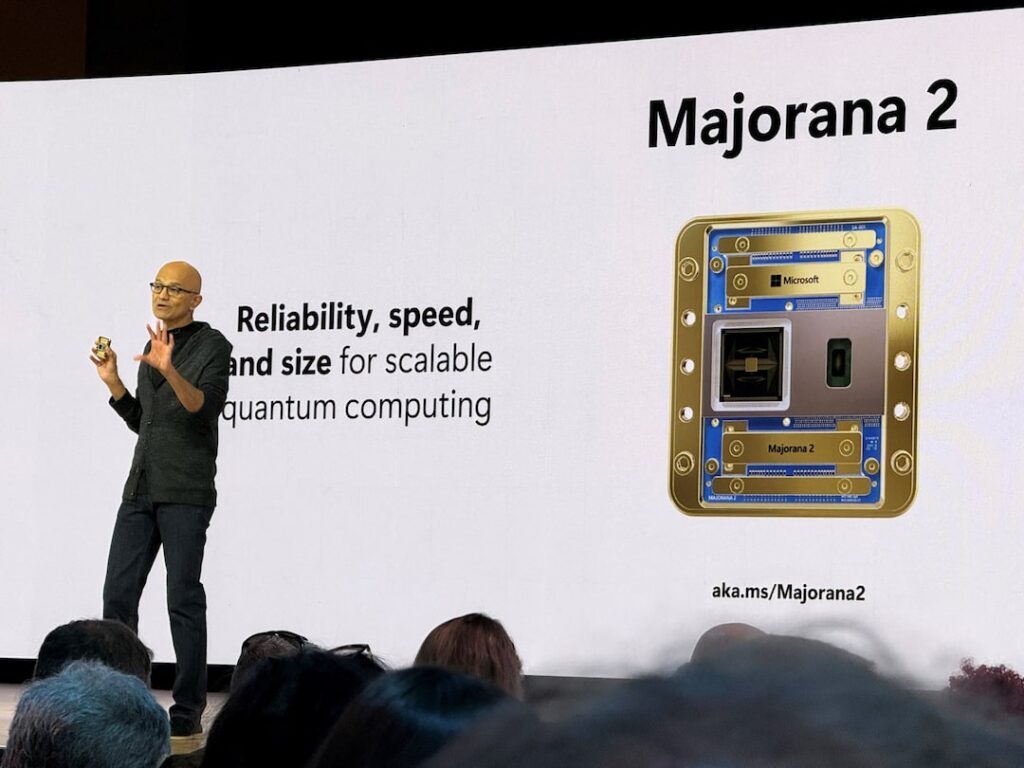
Microsoft’s push into quantum computing is becoming more ambitious, and more unusual, at the same time. Instead of relying only on traditional hardware research, the company is now using AI as part of the engine that drives its next major chip effort.
That shift sits behind Majorana 2, which Microsoft unveiled at Build 2026 alongside a far more aggressive target: a scalable quantum computer by 2029. The announcement immediately sharpened attention on the company’s place in a global race where every technical gain can reshape the competitive balance.
AI is now part of the chip development process
Microsoft says Majorana 2 was built with support from Microsoft Discovery, its agentic AI platform for scientific research. The system was used to analyze data, automate measurements, improve manufacturing processes, and search for possible design flaws.
The company also said AI helped process research data collected over decades. That matters because quantum hardware work is slow, complicated, and full of technical bottlenecks that can delay progress for years.
In Microsoft’s view, AI is not a side tool here. It is meant to speed up experiments, narrow down design choices, and help researchers move toward the next test more efficiently.
Why Majorana 2 matters
Quantum computers do not use ordinary bits. They rely on qubits, which can exist in multiple states at once and may handle certain calculations far more efficiently than conventional machines.
The problem is that qubits are fragile. They can lose their quantum state when exposed to environmental interference, and that instability has remained one of the biggest barriers to practical large-scale quantum computing.
Microsoft is betting on a different route: topological quantum computing. The company has been pursuing that approach for nearly two decades, based on the unusual quantum states linked to Majorana quasiparticles, first theorized by Italian physicist Ettore Majorana in the 1930s.
Microsoft believes this path could produce more stable qubits than the superconducting approaches used by rivals such as IBM and Google. If that stability continues to hold, the company could end up with a distinctly different position in the quantum race.
The technical gains are real, but the scale is still small
Microsoft says Majorana 2 improves qubit reliability by 1,000 times compared with the previous generation. The company also says the chip can keep qubits in their quantum state for an average of about 20 seconds, up from milliseconds before.
In some cases, Microsoft says the qubits can last for as long as one minute. That kind of improvement matters because longer-lived qubits make more complex computations more realistic.
Even so, the chip remains very small by the standards of the field. Majorana 2 has only 12 topological qubits, far below the millions many experts believe will be needed for a commercially useful quantum computer.
So the announcement is better understood as a technical milestone than a finished product. It shows progress, but it does not yet represent a machine ready for broad real-world deployment.
Material choices are part of the competition
One of the most important changes in Majorana 2 is the material itself. While many other quantum processors rely on aluminum-based superconductors, Microsoft has moved to a lead-based material arrangement.
Microsoft says AI helped researchers evaluate material combinations, run simulations, and solve manufacturing challenges related to putting lead into the chip design. That step highlights how much quantum progress depends not only on theory, but also on highly specific engineering decisions.
The chip’s design shows that manufacturing choices can matter as much as the physics. Microsoft is using AI to reduce the time needed to test those choices and to keep the development process moving.
The race around Microsoft is intensifying
The company’s announcement comes during a period of growing competition across the quantum sector. IBM has recently committed billions of dollars to its quantum program, while Google, Amazon, and several research groups in China are also pursuing systems that aim to outperform today’s supercomputers.
Microsoft is framing its own strategy as a combination of quantum hardware and AI-accelerated research. The company sees that pairing as a route toward machines capable of handling complex problems in healthcare, materials science, energy production, and chemistry.
The 2029 goal still leaves a long path ahead, but the direction is clear. Microsoft is not only trying to build a more reliable quantum chip; it is also trying to make AI a central accelerator in the effort to bring quantum computing closer to commercial use.
Source: www.indiatoday.in