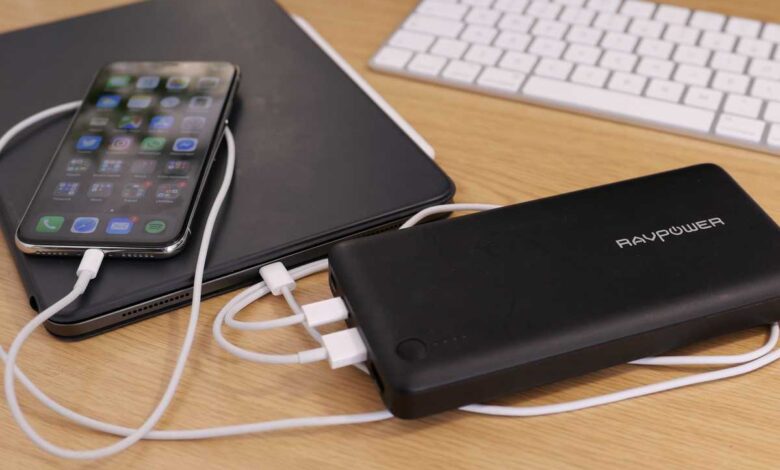
A battery pack is no longer just a backup for a phone. For many users, it now has to keep a laptop alive during travel, recharge a tablet between meetings, and still remain small enough to carry every day.
That is why the most useful model is not always the one with the largest number on the box. Capacity matters, but so do charging speed, port selection, built-in cables, and whether the pack is easy to slip into a bag without adding too much bulk.
Big capacity for heavier workloads
At the top end, Anker’s 165W Laptop Battery Pack is built for people who need more than a basic phone backup. Its 25,000 mAh capacity can fully recharge most laptops at least once, and it adds two built-in retractable USB-C cables, one extra USB-C port, and one USB-A port.
It also charges faster than the average wall charger, which makes it useful for mobile work. A built-in color display helps users track battery level, although some may still prefer a battery pack with detachable cables instead of integrated ones.
A more affordable option in the same broad category is the Anker Zolo Battery Pack 20,000 mAh. It sells for under $50 and includes two integrated USB-C cables and a digital display, but it is not powerful enough for high-end laptops such as a MacBook Pro.
Compact models that still deliver real power
Smaller battery packs can still be practical when the goal is to keep a phone, tablet, or ultraportable notebook running. The Anker Nano 45W Battery Pack fits that role with a 10,000 mAh capacity and a maximum output of 45 watts.
That output is enough for fast charging on phones and tablets, while also extending the runtime of slim laptops such as a MacBook Air. For users who want something cheaper and lighter, the Baseus EnerFill 22.5W Battery Pack comes in under $25 and weighs a little over 7 ounces.
It includes a built-in USB-C cable and two extra ports, and it can bring modern phones to around 50 percent in about half an hour. That makes it a straightforward choice for everyday use when portability matters more than absolute output.
Magnetic and pocket-size choices
Some buyers want a battery pack that feels more like an accessory than a separate device. The Sharge Icemag 3 25WQi 2.2 takes that route with Qi 2.2 support and wireless output of up to 25 watts.
When used with its built-in USB-C cable, output rises to 35W, which is enough for some lightweight laptops. Sharge also adds a sturdy kickstand and a built-in cooling fan, giving it a more distinctive design than many magnetic battery packs that simply sit flat behind a phone.
At the opposite extreme, the Mophie Powerstation Mini Gen 3 is the smallest option in the group. It is only slightly larger than a lipstick tube, so it fits easily into a pocket or clutch, but the tradeoff is slower charging.
Built for rougher conditions
Not every battery pack is meant for a desk, a commute, or a café. The Elecom Nestout 32W Rugged Battery Pack is aimed at outdoor use, with a shock-resistant body, IP67 protection against water and dust, and threaded port covers for extra security when the ports are not in use.
Its 15,000 mAh capacity, three charging ports, and 32W maximum output give it a balanced mix of endurance and flexibility. The Nestout line also includes smaller 10,000 mAh and 5,000 mAh versions, and all of them work with add-ons such as a solar charger and a USB lamp.
What matters most when choosing one
Capacity is still the main factor that determines how much power a battery pack can carry. A 10,000 mAh model is usually enough for users who want something pocket-friendly and only need to charge a phone several times or a small device four times or more.
Once a laptop, digital camera, or multiple gadgets enter the picture, 20,000 mAh or more becomes more sensible. Many products stay within the 100-watt-hour airline limit by landing around 25,000 to 28,000 mAh, which is why that range remains common for higher-capacity packs.
Charging speed matters just as much in daily use. A 45W output is generally sufficient for phones and ultraportable laptops, while lower output can still work well for smaller devices when the goal is simply to keep them going through the day.
Connectivity affects convenience too. Built-in USB-C cables make it easier to charge devices and refill the battery pack itself, while USB-A ports still serve as useful backups on larger models. When several devices charge at once, power usually drops across the board, so the best battery pack is still the one matched to the right workload.