


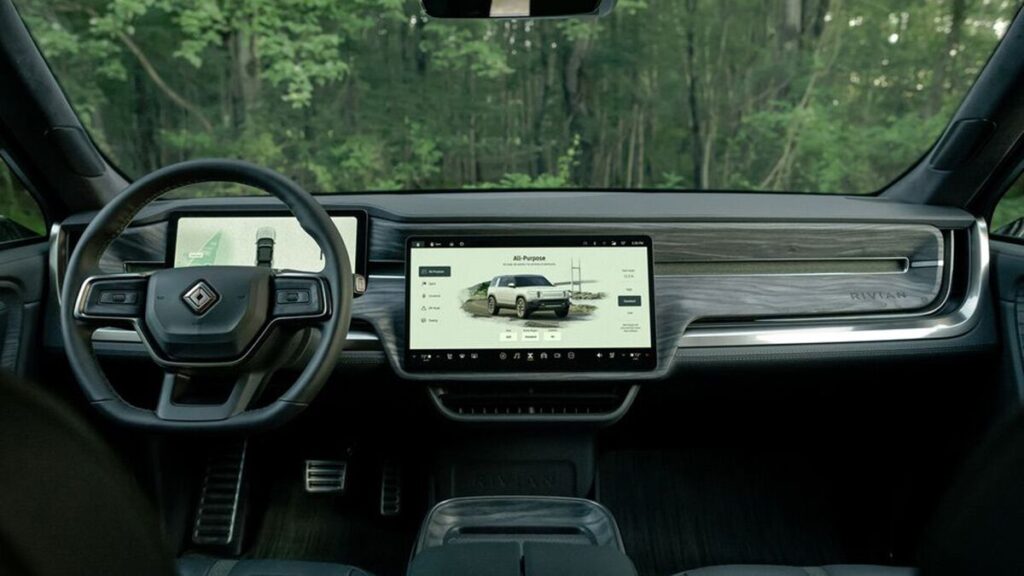
Rivian is taking one of the clearest positions in the car software debate: it does not plan to add Android Auto or Apple CarPlay. Instead, the EV maker is building its own AI-driven in-car experience and is willing to live with the risk that comes with that choice.
That strategy puts Rivian on a very different path from much of the industry. While Android Auto and CarPlay have become the easy, familiar option for many drivers, Rivian is betting that a homegrown system can eventually deliver the same convenience without handing control to Apple or Google.
A deliberate refusal to mirror the phone
Chief Software Officer Wassym Bensaid said Rivian has no plan to integrate the two phone-mirroring platforms. Speaking on The Verge’s Decoder podcast, he said the company is preparing an AI-based system to cover many of the functions drivers usually expect from Android Auto and CarPlay.
The goal is not to copy a phone interface onto the dashboard. Rivian wants a dedicated in-car AI assistant that can handle tasks such as playing music from multiple services and using navigation data to guide drivers to their destinations.
Why Rivian wants control
Bensaid also argued that Apple CarPlay and Android Auto are too invasive. In his view, Apple and Google can gain access to data about vehicle trips and the apps people use, and Rivian would rather keep that information inside its own ecosystem.
That stance makes business sense in a broader way. Modern infotainment systems are no longer just entertainment screens; they are gateways to usage data, driving habits, navigation behavior, and digital services that are becoming more valuable over time.
So Rivian’s decision is about more than the layout of the center display. It is also about ownership of software, access to user data, and control over the digital layer inside the vehicle.
The risk behind the AI bet
The difficult part is that AI is not yet a proven replacement for systems that have already earned driver trust. Rivian wants its software to match the convenience of Android Auto and CarPlay, but delivering an experience that feels equally polished is a much harder task.
Drivers like Android Auto and CarPlay because they are simple, stable, and familiar for everyday use. They provide navigation, music, communication, and other key functions through an interface people already know, without forcing them to learn a brand-specific infotainment system.
That is why Rivian’s approach looks like a real gamble. If the execution falls short, users could end up back with the kind of clunky in-car software that automakers were known for before Apple and Google set a new standard.
What makes the gamble harder
Before Android Auto and CarPlay became dominant, many automaker-built infotainment systems had a poor reputation. They were often buggy, slow to update, and limited in features, which made them frustrating for drivers.
Apple and Google changed that pattern by offering systems that were more consistent and easier to use. Rivian is now choosing a route that echoes the earlier era, but with an AI layer intended to make the experience feel more advanced and more personalized.
That is where the uncertainty remains. AI can help with many tasks, but it can also make mistakes, miss context, or produce unreliable answers, which becomes far more sensitive inside a moving vehicle.
For navigation, music, and other core functions, accuracy matters as much as convenience. Rivian’s vision is attractive if it works: a more integrated system that understands the vehicle, the entertainment experience, and the driver’s needs in one package.
Until that system proves it can work consistently, though, the company’s refusal to support Android Auto and CarPlay will remain controversial. For many consumers, Rivian is asking them to trade a trusted experience for a promising AI system that still has to earn its place.
Source: www.androidpolice.com