


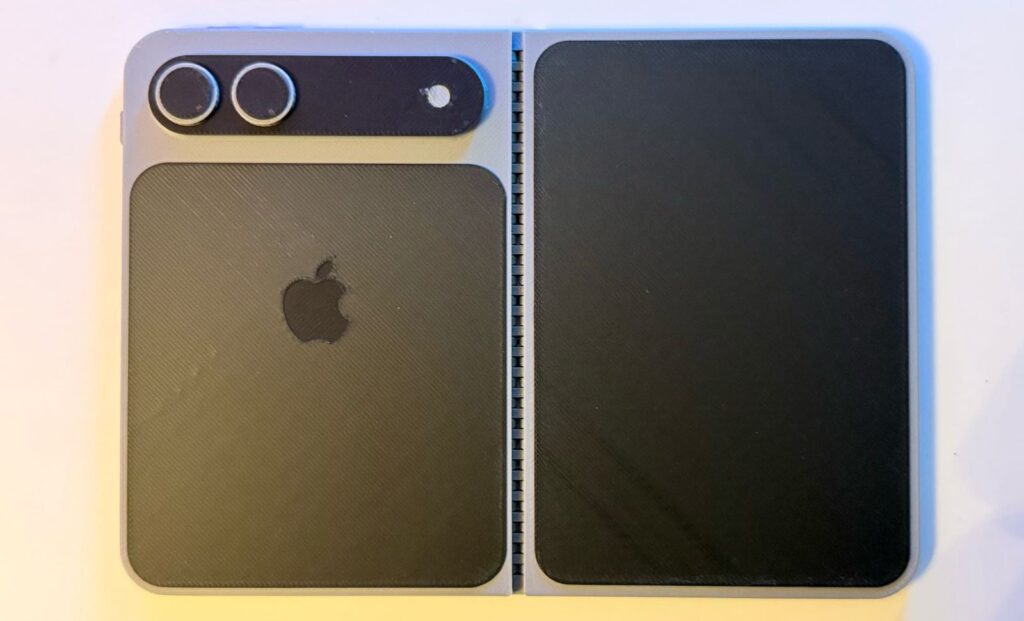
The clearest look yet at Apple’s first foldable phone suggests the company is taking a very different route from many of its rivals. A newly surfaced dummy unit points to a book-style device that folds into a compact, wide body rather than the taller, narrower format seen on several competing foldables.
The model, shared by leaker Sonny Dickson on X, has intensified interest around a product Apple has not officially confirmed. Even so, the steady stream of reports and leaks points to a major launch being prepared for the coming months.
A wide format designed for everyday use
The dummy device appears to use a passport-like shape when closed, reinforcing earlier reports that Apple is favoring a wider foldable layout. That approach would likely make the phone easier to use for work and media viewing when unfolded.
Visually, the design is said to resemble the first-generation Pixel Fold. The overall impression is of a phone that stays compact in the hand while offering a much larger working area once opened.
Sonny Dickson also indicated that the dummy unit shown so far comes in white. No other color variants are visible in the leak, although there is no confirmation that Apple will limit the final product to a single option.
Dual cameras, Touch ID, and a carefully managed layout
The rear side of the dummy unit reveals a horizontal pill-shaped camera module with two lenses. It does not stretch across the full width of the device, which sets it apart from the camera-bar style used by some other phones.
A separate leak from Sahil Karoul adds more detail to the control layout. Volume buttons are said to sit on the upper side of the device, while the power button remains on the side.
Apple is also reportedly planning to place Touch ID on the power button instead of using Face ID. That choice could help preserve internal space, which is especially valuable in a foldable design with more complex components.
Big-screen ambitions inside and out
The most notable feature of the iPhone Fold is its display setup. The inner screen is rumored to use a 7.8-inch OLED panel, which would make it the largest display ever used on an iPhone.
That size brings it closer to the experience of an iPad mini. If accurate, the device would be positioned as a hybrid product that bridges the gap between a smartphone and a tablet.
Images of the inner panel also suggest a punch-hole camera in the top-left corner. Apple is reportedly working hard to reduce the visibility of the display crease, a challenge that remains central to the foldable category.
The outer cover display is expected to measure 5.5 inches and use OLED technology as well. Although smaller than a standard iPhone screen, its wider ratio could still make daily tasks feel comfortable and efficient.
Hardware built for premium pricing
On the camera side, the iPhone Fold is said to feature a 48MP main sensor paired with a 48MP ultra-wide camera. Apple is reportedly leaving out a dedicated telephoto lens to keep the body as thin as possible.
Another report says the device will include two 18MP selfie cameras, with one assigned to the outer screen and the other to the inner display. This arrangement would let each screen have its own front-facing camera support.
Performance is expected to come from an A20 Pro chip built on a 2nm manufacturing process. Early reports also point to 12GB of RAM and storage options reaching up to 1TB.
Apple is also rumored to be preparing vapour chamber cooling. Such a system could help maintain stable temperatures during gaming, multitasking, and AI-related workloads.
The battery is expected to land between 5,400mAh and 5,800mAh, which would make it the largest battery ever fitted in an iPhone. That capacity would be essential for a foldable device with two displays and a high-end hardware load.
Software support and a premium launch window
On the software side, Apple is said to be leaning on iPad ecosystem foundations to build a more mature foldable experience. Future iOS versions are reported to include improved multitasking, split-screen support, and better app optimization for large screens.
That software-first approach may become one of Apple’s biggest advantages in the foldable market. The company appears focused not only on a new form factor, but also on making the larger screen genuinely useful in everyday use.
Several reports say the iPhone Fold could debut alongside the iPhone 18 Pro and iPhone 18 Pro Max at a September event. If that happens, it would enter Apple’s lineup as one of the most premium devices the company has ever sold.
The rumored starting price is around $2,000 and could rise to $2,400 depending on storage configuration. At that level, Apple’s first foldable would compete directly with the most expensive foldables already on the market.