


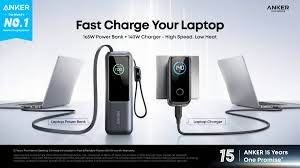
By 2026, the fastest power banks are no longer simple backup accessories. With outputs starting at 200 watts and capacities of at least 20,000 mAh, they now move closer to portable power stations than conventional battery packs.
That shift matters most for people who need to charge laptops, tablets, and phones at the same time. Many of the strongest models now favor USB-C over USB-A, reflecting how modern devices have moved toward USB-C connectivity, including the latest iPhone lineup.
What makes these power banks so fast
The key technology behind high-speed charging is USB Power Delivery 3.1 EPR. It allows up to 240 watts through a USB port, making it possible to power high-demand devices such as laptops and controllers much faster than older standards.
Fast charging has also not been shown to damage larger phone batteries more than standard charging. As a result, buyers are paying more attention to capacity, output speed, port count, and safety when several devices are charging at once.
200W-and-above models for daily use and work
Anker Power Bank 20,000mAh 200W 3-Port delivers a total output of 200 watts, with up to 100 watts per port. Anker says it can charge a MacBook Pro 16-inch to 50% in 40 minutes, then recharge itself in about 1 hour and 15 minutes.
The model includes two USB-C ports and one USB-A port, plus a smart digital display showing battery level and output per port. At Best Buy, it is listed at $139.99 with a 4.6-star rating, and it is compatible with iPhone, Samsung, MacBook, and Steam Deck.
UGreen Nexode Power Bank 200W 25,000mAh is aimed at users who need large capacity in a portable body. With two USB-C ports and one USB-A port, it can deliver 200 watts total and reach 140 watts on USB-C1, enough to charge a MacBook Pro 16-inch to 54% in 30 minutes.
UGreen says the unit can recharge in about 2 hours with a 65-watt charger. Best Buy lists it at $129.99, and buyers have given it a 4.8-star rating, along with a V-0 fire-resistant case, ThermalGuard System, and NTC temperature monitoring.
Jumbo batteries for longer mobility
UGreen Portable Power Station brings a 48,000 mAh battery and five ports, made up of two USB-A ports and three USB-C ports. It has a maximum output of 300 watts, while one USB-C port supports USB Power Delivery 3.1 up to 140 watts for faster charging of larger devices.
In Android Central testing, the power station was able to charge a Pixel 8 Pro, Xiaomi 14 Ultra, Honor MagicBook 16, and another power bank several times. It also uses a LiFePO4 battery that UGreen says can retain 80% of its capacity after 3,000 recharge cycles.
Premium options with the most aggressive speed
Anker Prime Power Bank 26K 300W is built for heavy-duty scenarios such as charging two MacBook Pros and one iPhone at the same time. With two USB-C ports and one USB-A port, it supports 300 watts of output and up to 140 watts from each USB-C port when used with a 5-amp cable.
Anker says the iPhone 16 Pro can reach 50% in 26 minutes, while a full recharge takes about 1 hour. The model is sold for $229.99 in the official store and includes a smart display, power control through the Anker app, and Find Device support via Bluetooth.
Anker Prime Power Bank 27,650mAh 250W offers slightly more capacity with a maximum output of 250 watts. This version is priced at $179.99, carries two USB-C ports and one USB-A port, and supports recharging at up to 170 watts, allowing a full recharge in under 40 minutes.
Extra features that can decide the purchase
Denvix PowerX 4-in-1 Power Bank stands out because it offers four charging methods, including wireless magnetic charging at up to 15 watts. Its total output reaches 250 watts with one port capable of 140 watts, and it claims to charge a MacBook Pro 16-inch to 50% in 28 minutes.
The model has a 25,000 mAh capacity and can charge smartphones, laptops, and even drones. Denvix also includes an AI Temperature Control System, an OLED display that shows runtime and power flow, plus a storage bag, a USB-C to USB-C cable, and a two-year warranty for $179.99.