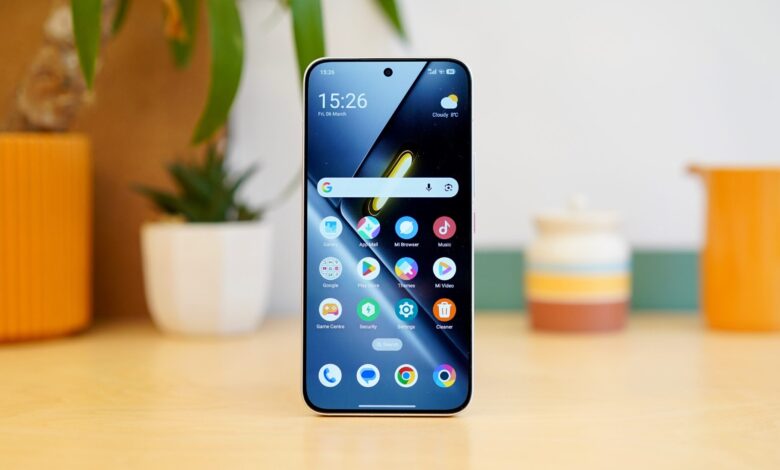
The Poco X8 Pro Max stands out not only for its 120 Hz AMOLED panel, but also for display technologies that are easy to miss in everyday use. On paper, the screen supports HDR10+, Dolby Vision, 12-bit color depth, and PWM dimming up to 3,840 Hz.
That combination sounds impressive, yet it also brings up a more uncomfortable question for some users: can invisible display behavior such as temporal dithering contribute to eye strain? The concern matters because a small group of users report burning eyes, headaches, dizziness, or faster fatigue on certain screens.
What temporal dithering actually does
Temporal dithering is used to simulate extra color gradations. Instead of showing a single shade directly, the display or its pixel control alternates very quickly between two similar color values.
The human eye then perceives a tone between them. This technique helps create smoother transitions and a higher marketed color depth without the panel needing to produce every shade natively.
For most people, the process is completely unnoticed. But temporary changes in brightness and color, including temporal dithering and possible PWM flicker, are increasingly discussed as possible triggers for discomfort in some users.
Why the Poco X8 Pro Max is under scrutiny
High-frequency PWM dimming on the Poco X8 Pro Max is generally seen as relatively comfortable for the eyes. Even so, that does not rule out the possibility of additional temporal color modulation.
Manufacturers usually do not disclose detailed information about this behavior. For that reason, testing the device becomes important to determine whether the announced 12-bit panel is fully native or partly supported by Frame Rate Control, a form of temporal dithering.
Observations suggest that temporal dithering is likely being used. The effect is difficult to spot in YouTube videos because of compression and post-production, but original recordings show alternating flicker on the subpixels more clearly.
What the reports mean for users
Reports of burning eyes, headaches, dizziness, and rapid fatigue still do not have a fully agreed scientific explanation. Even so, anecdotal complaints continue to accumulate and keep the issue in focus.
That means a screen can look highly advanced on paper and still affect users differently in practice. At this point, temporal dithering is not automatically treated as a problem, but it is increasingly associated with visual comfort concerns.
Why high display specs are not the full story
The mix of 120 Hz refresh rate, HDR10+, Dolby Vision, 12-bit color depth, and high-frequency PWM dimming makes the Poco X8 Pro Max appear unusually advanced for its class. But high-end specifications do not always reveal how a screen behaves at the subpixel level.
For users who are sensitive to very fast changes in brightness and color, details like this can be felt immediately. The discussion is therefore shifting beyond refresh rate and color depth alone, toward the way those colors are actually produced behind the scenes.
In other words, the display may impress on a spec sheet, but the experience can still depend on the invisible methods used to create its image.