


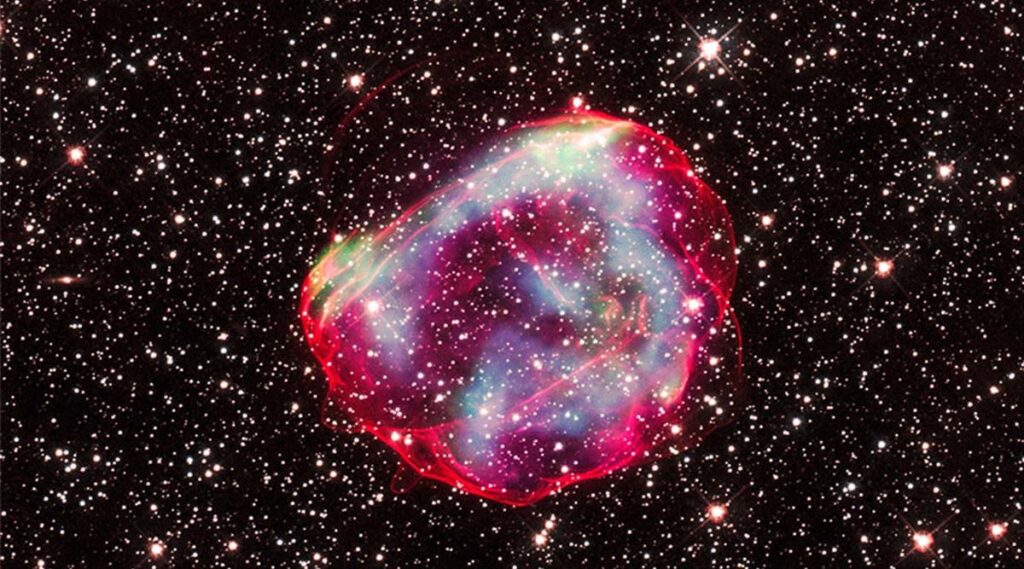
Astronomers may have uncovered a new supernova remnant in the Milky Way, but the object is still unusual enough to keep an alternative explanation alive. It is so bright that some researchers believe it could instead be a massive star cluster.
The latest Chandra X-ray Observatory image is driving that debate. NASA released the picture of a structure inside a gas bubble surrounding a massive star, located about 26,000 light-years from Earth.
A powerful signal hidden in interstellar space
Chandra has long been one of the most capable space telescopes for high-energy astronomy. Since its 1999 launch aboard the Columbia shuttle, it has used instruments such as the Advanced CCD Imaging Spectrometer and the High Resolution Camera to detect X-ray emission that optical telescopes cannot see.
The new image combines X-ray data from Chandra and XMM-Newton with radio observations from MeerKAT. In that composite view, astronomers identified long filaments that appear to have formed from charged particles.
The structure is also thought to be expanding at about 2 million miles per hour. Based on the analysis so far, it may have formed roughly 1,700 years ago.
Why astronomers are paying attention
If the object is confirmed as a supernova remnant, it could help explain how material from an explosion spreads through interstellar space. Supernovae release large amounts of matter into the cosmos, and that material can later become the building block for new stars and planets.
That makes this kind of object especially valuable for astronomers. It offers clues not only about the final stages of massive stars, but also about how galaxies keep creating new generations of celestial bodies.
Even so, the object’s identity remains unresolved. Some astronomers still argue that the bright structure may be a massive star cluster rather than a remnant of a stellar explosion.
Why the star cluster theory remains uncertain
The main reason for doubt is its brightness. According to astronomers’ assessment, the object is about ten times brighter than similar star clusters, making that explanation less convincing.
The current evidence shows why X-ray imaging alone is not enough to close the case. Still, the combination of Chandra, XMM-Newton, and MeerKAT data has given researchers a much sharper view of the dense gas region where the object sits.
For now, the structure remains a strong candidate for a newly identified supernova remnant in the Milky Way. If follow-up analysis confirms that interpretation, it will add an important new example to the list of stellar explosions that leave lasting traces in cosmic material.