


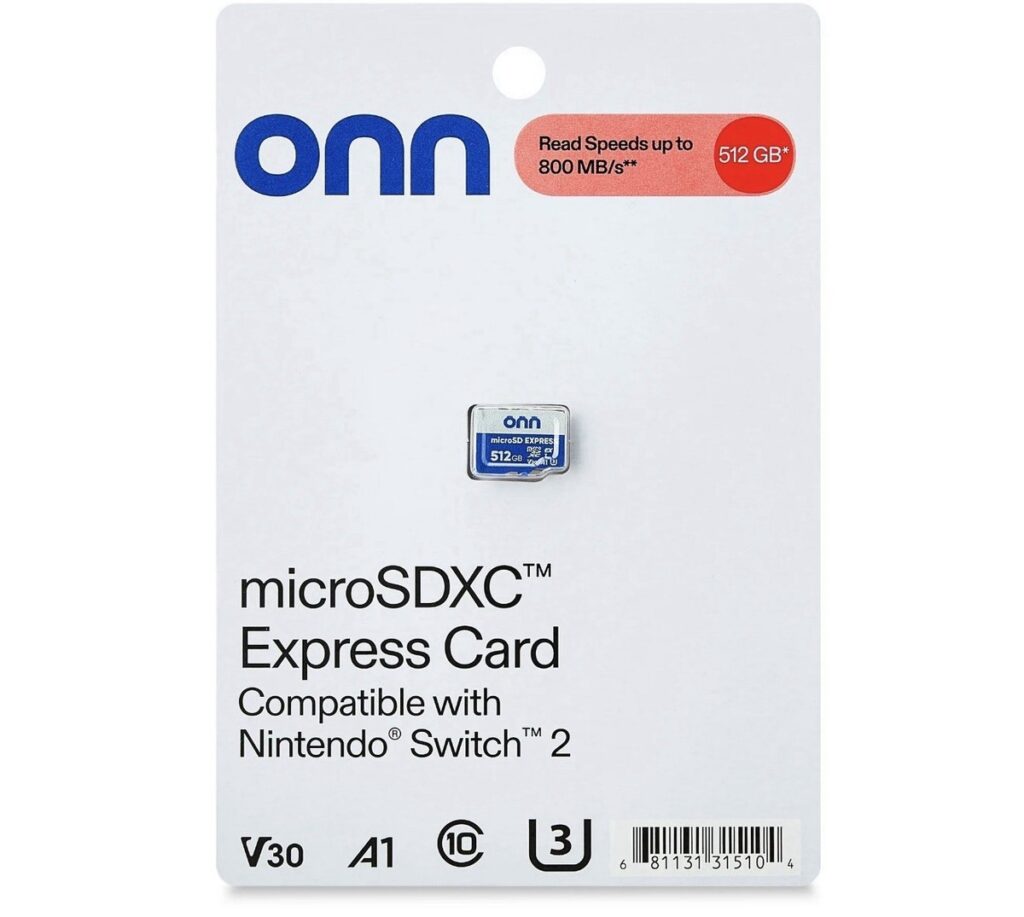
Memory card buyers are facing an unusual reversal in the market. In Europe, some of the fastest microSD cards based on UHS-II now cost roughly twice as much as microSD Express, even though Express offers far higher speeds.
The contrast is most striking at 256 GB, the most popular capacity. microSD Express cards at that size are commonly sold for around 50 to 60 euros, while comparable UHS-II models have climbed to about 115 to 120 euros, and sometimes more.
UHS-II is becoming an expensive niche
Acer drew attention at Computex with the Predator Atlas 8 gaming handheld, which uses microSD UHS-II. That format is now looking increasingly niche, because fewer products remain available and prices have continued rising over the past year.
At Geizhals, the Nexstorage UHS-II 256 GB is listed at around 120 euros. The Lexar Professional Gold sits slightly lower at 115 euros, while the Sabrent Rocket is a little above 120 euros.
At that level, the UHS-II market is essentially exhausted for shoppers who want a handheld with this type of card support. Storage costs can rise sharply even when the capacity is still only 256 GB.
microSD Express is setting a new price benchmark
microSD Express is now the more compelling reference point for pricing. In the 256 GB segment, the format is already widely available thanks to Nintendo Switch 2, and its prices have stayed in the 50 to 60 euro range.
MediaMarkt shows that range on the Nintendo-branded card made by SanDisk, as well as on a separate SanDisk card displayed in the Nintendo section. With such a large gap, microSD Express now appears more sensible for many buyers, even though its compatibility differs from older UHS-II use cases.
Capacity gaps grow wider at 512 GB
The difference becomes even more pronounced at 512 GB. In the Express segment, the market already offers around five cards up to roughly 130 euros, while later arrivals can jump to the 200 to 300 euro range.
That spread shows how quickly pricing can diverge once capacity increases, especially in a segment where demand is still developing and product availability remains uneven.
Speed comes with a compatibility catch
SD Express delivers much higher performance, but older usage scenarios still create limitations. Users with UHS-II readers cannot take advantage of full SD Express speeds, because SD Express readers are still very rare and some are already sold out.
In compatibility mode, an Express card falls back to UHS-I speeds. As a result, performance depends heavily on the reader being used, not only on the card itself.
There is now talk that SD Express readers capable of handling UHS-II may arrive later this year. Until now, that was not technically possible.
Broader adoption could shift the market again
The current pricing picture may not last. More laptops are expected to adopt SD Express, and Asus has already brought microSD Express support to its new gaming handheld.
Asus is said to support SD Express in a nearly invisible way, but the signs of broader adoption are already appearing. Alongside the launch of RTX Spark at Computex, there are also indications that more manufacturers will bet on SD Express, including full-size formats.
ADATA is currently the only supplier of full-size SD Express cards. For standard fast microSD cards using UHS-I, models from major brands are also approaching microSD Express pricing at 256 GB, and the SanDisk gaming card styled after Nintendo is now almost just as expensive.
That card has even edged down slightly in recent weeks. Still, pressure in the memory card market has not stopped at basic microSD products, and pricing trends could move again if SD Express adoption continues to widen.