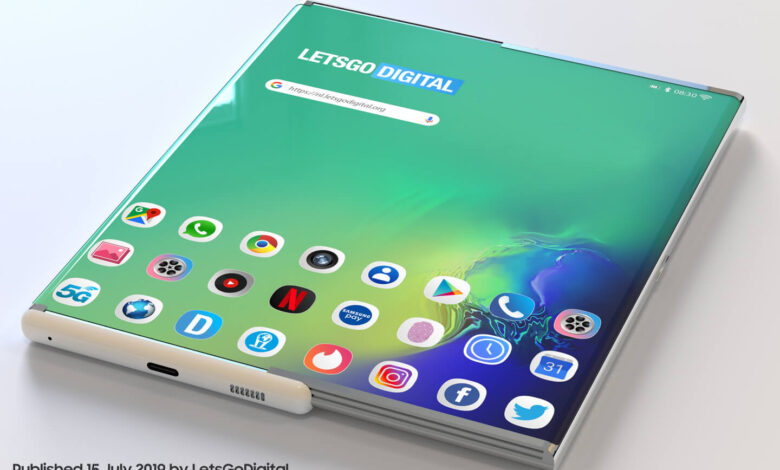
Samsung’s rumored Galaxy Z Roll 5G is shaping up as one of the most ambitious answers yet to the biggest complaint in foldables: visible screen creases. The concept promises a 12.4-inch rollable display with no crease at all, but the engineering behind that promise may prove far more difficult than the design itself.
The device is being described as a premium experiment rather than a simple upgrade. Reported specifications include a 324MP camera, a Snapdragon 8 Elite Gen 6 Pro chipset, and an 8,000mAh battery, all packed into a form factor that replaces the familiar foldable hinge with a much more complex rolling system.
The motor becomes the first major weak point
Unlike a conventional foldable that opens manually in one motion, the Galaxy Z Roll 5G would depend on a micro-motor to extend the screen. That shift changes the entire user experience, because the display no longer just folds out, but must be guided by precise internal mechanics every time it expands.
Speed and durability are now tied together in a way that leaves little room for error. If the motor moves too quickly, the flexible display layers may be stressed; if it moves too slowly, the device risks feeling delayed during everyday use.
Early industry testing suggests that a three- to four-second unfolding delay could feel sluggish for tasks such as showing a photo or opening a document. Even the leaked timing estimates still point to roughly two to three seconds of delay compared with the manual opening experience of a foldable.
Wear is another concern that cannot be ignored. Micro-gears and internal rails would need to survive hundreds of thousands of cycles without losing precision, shifting out of place, or wearing down over time.
There is also a more serious scenario to consider if the device is dropped while fully extended. In that case, software would need to trigger rapid emergency retraction before impact, since the stretched panel would be far more vulnerable than a conventional protected screen.
Dust could be more dangerous than on a foldable
Foldables already struggle with dust entering hinge areas, but a rollable design introduces a different kind of exposure. As the screen slides back into the body, it can act like a moving belt that drags particles from the outside directly into the internal chamber.
Even a single grain of sand trapped inside the rolling mechanism could cause lasting damage. Repeated extension and retraction may let that particle scratch the flexible display from the inside, creating damage that worsens over time.
Leaks suggest Samsung is working on advanced nano-coating protection and an IP68 rating for resistance against dust and water. Still, sealing a moving rail and motor assembly to that level remains a difficult engineering problem, because dynamic parts are always harder to isolate than static surfaces.
That is where foldables still retain an advantage. Their main screen is protected when closed, while a rollable concept leaves part of the display path more exposed to pockets, dust, and the surrounding environment.
Big battery, limited space, uneven weight
The internal layout may be the hardest puzzle of all, especially with reports pointing to a dual-cell silicon-anode 8,000mAh battery. On paper, that chemistry can offer higher energy density in a smaller footprint than traditional lithium-ion cells.
But a rollable phone does not have two rigid halves to distribute large components evenly. One side serves as the fixed core, while the extending section is essentially a hollow frame that moves on rails when the display expands.
That means Samsung would need to place the processor, the 324MP main camera, the S Pen slot, the motor, and a large battery inside the one section that does not move. The result could be a noticeable weight imbalance when the screen is fully extended.
The challenge grows again when the other reported high-end specifications are considered. The Galaxy Z Roll 5G is also said to use a Grade 5 titanium frame, 12GB or 16GB of LPDDR6 RAM, up to 2TB of UFS 5.0 storage, 100W wired charging, and 25W wireless charging.
Why Samsung may still pursue the risk
The payoff is clear if the hardware works as intended. A rollable screen could deliver a zero-crease design, a more uniform thickness closer to a standard smartphone, and a display ratio that changes dynamically as the panel expands.
Other leaked display details are equally aggressive, including a 12.4-inch Rollable Dynamic AMOLED 2X panel, adaptive 1Hz to 144Hz LTPO refresh rates, and a peak brightness of 3,000 nits. The camera setup is also said to include a 50MP periscope telephoto lens with 10x optical zoom, a 12MP ultrawide camera with macro support, and a 12MP under-display front camera.
The reported launch window points toward late 2026, when the premium device race is expected to be even tighter. Huawei has already pushed ahead with tri-fold devices, while Apple continues to file patents for flexible-display technology as it waits for hardware to mature.
That competitive backdrop explains why Samsung may want to move first. If the company can build a rollable system that is fast, durable, dust-resistant, and balanced in daily use, the Galaxy Z Roll 5G would not only remove the crease problem but could also influence the next wave of large-screen phone design.
Early pricing is said to start at around $2,799 USD, placing the device firmly in experimental flagship territory. At that level, buyers would be paying not just for a larger screen, but for confidence that the entire moving mechanism can withstand real-world daily use.