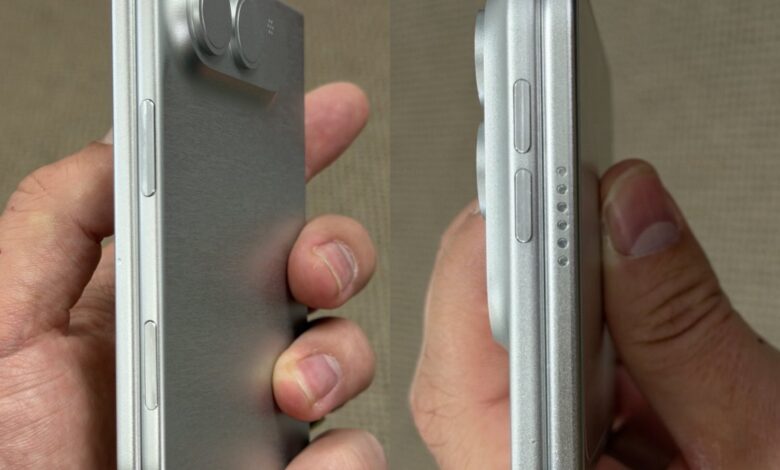
The first hands-on video of an iPhone Fold Ultra dummy has given the clearest look yet at Apple’s first foldable phone. If the leaks prove accurate, the device is shaping up to be one of the company’s most ambitious iPhone projects.
The biggest surprise is not only the folding form factor, but Apple’s apparent focus on an ultra-thin body, a large display, and a minimal design language. That combination could make the iPhone Fold Ultra a serious new contender in a market long dominated by other foldables.
A book-style foldable with an iPad-like feel
According to the leaked model and the hands-on video shared by Talks Daily Tech, the iPhone Fold Ultra is expected to use a book-style folding design. When opened horizontally, it reportedly presents a 4:3 aspect ratio that gives it an iPad mini-like character.
The outer display is said to measure around 5.3 to 5.5 inches. Once unfolded, the inner panel expands to 7.6 to 7.8 inches, creating more room for multitasking, gaming, and media consumption.
The inner screen is also said to feature a 2713 x 1920 resolution with Flexible LTPO+ OLED technology. The cover display is reportedly an OLED panel with a 2088 x 1422 resolution, offering a shorter but wider layout than a standard iPhone.
One of the most striking claims concerns the fold itself. The inner panel is said to have an almost invisible crease, made possible by an ultra-thin structural glass mid-frame and a special optical adhesive.
Apple is also expected to keep the overall look clean. Early color options include white, with black or gray also possible.
Thin body, premium materials
Thickness appears to be a major design priority. The iPhone Fold Ultra is rumored to measure about 4.5 mm when open and around 9.5 mm when folded.
The materials point to a premium build. The outer frame is said to use a titanium alloy, internal components may rely on aluminum for heat dissipation, and the hinge mechanism is rumored to use liquid metal or an amorphous alloy.
That approach suggests Apple is trying to balance structural strength with thermal efficiency. In the foldable category, that material mix could become a major selling point if it arrives as described.
Camera layout and biometrics
The rear camera system is said to use a horizontal dual-camera module. The setup reportedly includes a 48MP wide main camera and a 48MP ultra-wide camera, along with an LED flash and microphone.
There is also no telephoto lens in the current leak set. The reported reason is the tight space constraints of the early design, which appear to have pushed Apple to prioritize a thinner profile.
For the front side, the device is said to carry two selfie cameras. The outer display may use an 18MP or 24MP punch-hole camera, while the inner screen is expected to use a 24MP under-display camera for a cleaner look.
Biometric authentication may also change. Face ID is said to be absent because the panel is too thin for a TrueDepth array, so Touch ID is reportedly returning in the side power button.
The device is also said to skip the action button seen on newer flagship iPhones. That choice would fit a simpler control layout and help preserve internal space in a foldable chassis.
Performance, battery, and connectivity
On the performance side, the iPhone Fold Ultra is rumored to run on the A20 Pro chip built on TSMC’s 2nm process. The chip is said to use Wafer-level Multi-Chip Module technology to improve efficiency.
Memory is reported to reach 12GB of LPDDR5 RAM, with storage options of 256GB, 512GB, and 1TB.
The battery is expected to land between 5,400 mAh and 5,800 mAh in a split-cell design. That would make it the largest battery ever used in an iPhone, while the left side of the device is reportedly cleared of buttons to make room for the cells.
Connectivity leaks point to Apple’s custom C2 5G modem, Wi‑Fi 7, and full satellite data support. The satellite capability is said to go beyond basic Emergency SOS functions.
Pricing and market impact
The iPhone Fold Ultra is expected to become Apple’s most expensive iPhone. The leaked starting price sits between $1,999 and $2,200, placing it firmly in the premium tier.
Third-party accessory makers are already said to be preparing for the device, which suggests strong market anticipation even before any official announcement. If Apple launches the model in September 2026 alongside the iPhone 18 lineup, it would enter a foldable market already shaped by Samsung and Huawei.
That entry could shift the competitive landscape, especially if Apple delivers a thin foldable with a nearly crease-free display and a more polished user experience. For now, the dummy video has done what Apple has not yet done publicly: shown how serious its foldable push may be.