


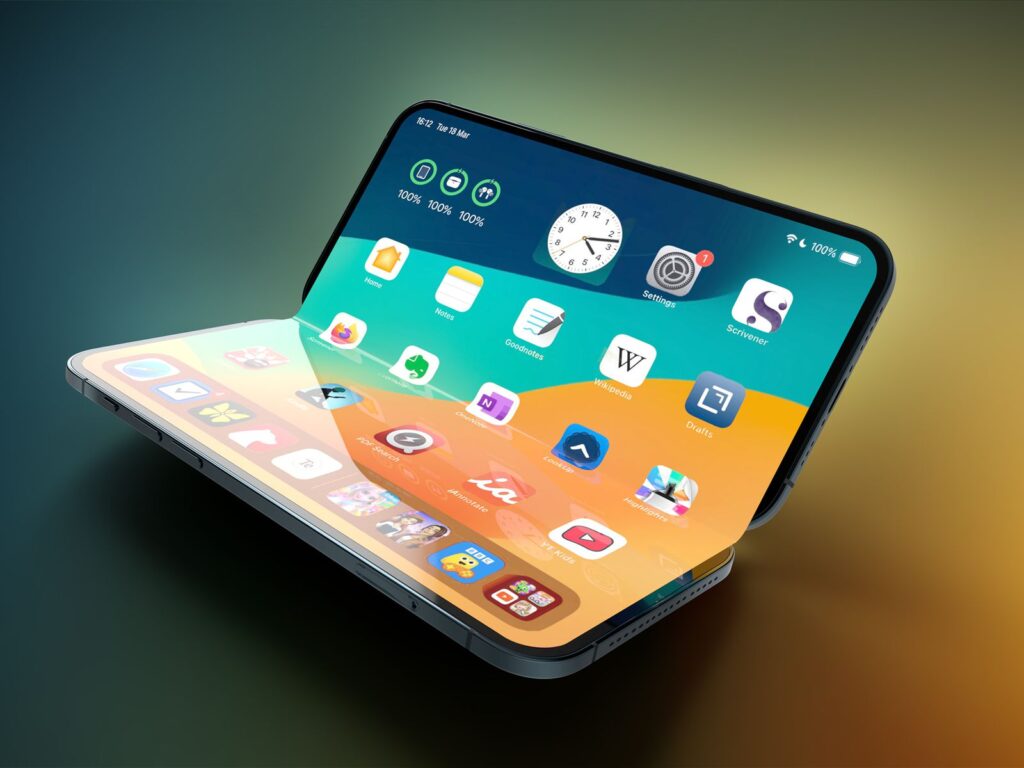
Apple’s first foldable iPhone is shaping up to be more than a novelty. The rumored iPhone Ultra is expected to blend pocket-friendly portability with a screen experience that moves closer to an iPad Mini, placing it firmly in the ultra-premium category.
That positioning is reinforced by the reported starting price of $1,999 for the 256 GB version. If accurate, the device would become one of Apple’s most expensive products yet, aimed at buyers who want a very different kind of iPhone.
A foldable design built around two experiences
The most important leak points to a book-style folding design. When closed, the outer display is said to measure about 5.3 to 5.5 inches, making it suitable for quick tasks and more conventional phone use.
Open it, and the inner screen reportedly expands to between 7.6 and 7.8 inches. That size moves the device into mini-tablet territory and explains why many observers are comparing it to the iPad Mini.
One of the most closely watched details is Apple’s effort to remove the visible crease on the inner panel. If that approach proves accurate, the foldable display could feel far smoother and more polished than many current alternatives.
The body is also expected to use titanium along the edges. That material choice would help Apple keep the device durable while still controlling weight, which is especially important for a foldable product.
In its folded state, the device is said to resemble two stacked iPhone Air units. That visual comparison underscores Apple’s focus on thinness, portability, and a premium finish.
Cameras are being adapted for both sides of the device
Camera hardware is also rumored to reflect the foldable format. The rear system is said to include a 48 MP main camera and a 48 MP ultra-wide camera, giving the phone a high-resolution dual-camera setup.
There is no mention of a telephoto lens, but the reported configuration still covers the shooting needs most users rely on day to day. Apple appears to be balancing camera capability with the design demands of a folding chassis.
The front side may be even more unusual because the device has two displays. Leaks suggest Apple is preparing two 18 MP front cameras, one for each screen, so both folded and unfolded use cases can be covered.
Those front cameras are also said to support Center Stage. That would help keep subjects framed during video calls, which makes sense for a device designed to switch between multiple viewing angles.
Apple may also replace Dynamic Island with a hole-punch design. If true, that would create a cleaner, less interrupted display when the device is open and being used for media or calls.
Performance is being scaled for a larger screen
Under the hood, the iPhone Ultra is expected to use the A20 Pro chip built on a 2nm process. That combination should improve both performance and energy efficiency, two areas that matter more in a device with a large foldable screen.
Rumors also point to 12 GB of RAM and LPDDR5 memory. Together, those components would help the device manage multitasking more smoothly and keep performance stable across heavier workloads.
Apple is additionally said to be preparing a C2 modem. While details remain limited, the inclusion of a newer modem suggests the company is trying to strengthen connectivity alongside the rest of the hardware stack.
iOS 27 may be the real difference-maker
Hardware alone would not be enough to justify a foldable iPhone, and Apple appears to know that. The iPhone Ultra is rumored to run iOS 27 with software features tailored specifically for foldable use.
One of the most practical additions is the ability to run two apps side by side. The idea borrows from iPadOS, but the goal is still to keep the experience familiar to iPhone users.
The interface is also expected to be optimized for document editing, video streaming, and general app management. That should help turn the larger inner display into something more functional than a simple enlarged phone screen.
Touch ID could return in a familiar form
Another notable change is the possible return of Touch ID. The fingerprint sensor is said to be integrated into the power button, which would give users a fast and familiar way to unlock the phone and approve transactions.
That move may also reflect the practical limits of foldable design, where Face ID may be harder to implement cleanly. For many users, Touch ID in the power button would provide a straightforward alternative without complicating the hardware layout.
With a foldable body, crease-free inner display ambitions, dual rear cameras, two 18 MP front cameras, the A20 Pro chip, 12 GB of RAM, the C2 modem, and software made for multitasking, the iPhone Ultra is being positioned as Apple’s most ambitious experiment in the smartphone category. At $1,999, it is clearly aimed at early adopters willing to pay for a new kind of iPhone experience.