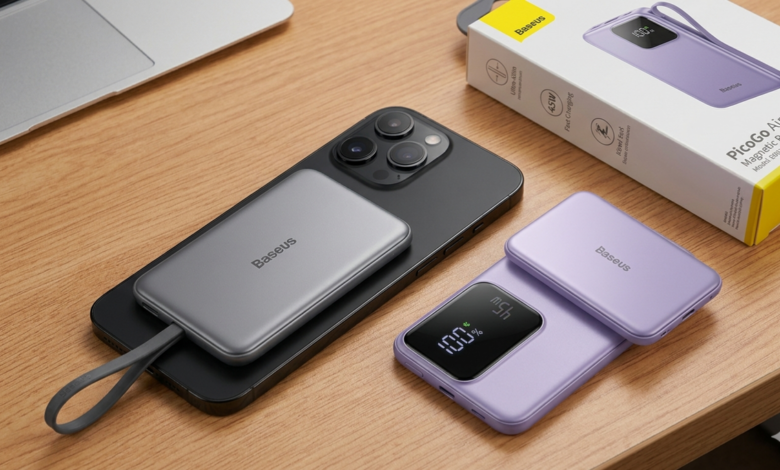
Baseus has introduced the PicoGo Air AM71, a magnetic power bank that stands out for one striking number first: 6.9 mm. At that thickness, the device enters a segment where portability can matter as much as battery capacity, especially for users who want backup power without adding bulk to a phone.
The model is built around a 5,000 mAh battery and supports wired fast charging up to 22.5W. It also offers magnetic wireless charging up to 15W, placing it in direct competition with other ultra-thin options, including Xiaomi UltraThin Magnetic Power Bank.
A body that aims to disappear in use
Baseus uses an aluminum unibody design paired with glass fiber on the PicoGo Air. The edges are curved to improve grip and reduce the chance of scratching a smartphone while attached.
The 6.9 mm profile is the main selling point. It gives the device a card-like feel and makes it easier to carry than conventional power banks that are usually thicker and heavier.
That form factor is also meant to support daily movement. The magnetic attachment allows the power bank to stay on the back of a phone without requiring an extra cable when wireless charging is the preferred option.
Charging options cover both cable and wireless use
For wired charging, the PicoGo Air delivers USB-C output up to 22.5W. Its USB-C input is listed at 5V/3A and 9V/2.2A.
Wireless charging support ranges from 5W to 15W, including 7.5W and 10W modes. That makes it compatible with MagSafe-supported iPhone models and other devices that follow the Qi standard.
The battery capacity is 5,000 mAh, or 19.4 Wh, with a total output rating of 5V/3A. In practical terms, the device is tuned for short, efficient top-ups rather than long multi-device charging sessions.
Baseus also includes Smart Trickle Charge Mode. Once the battery reaches 80%, the charging power is reduced automatically to help protect the connected device over time.
NFC adds a rare layer of convenience
One of the most unusual features on the PicoGo Air is NFC Battery Monitoring. By placing a smartphone near the power bank, users can see battery level, charging status, and device condition through a companion app.
This feature gives the product a more practical edge than many thin power banks that rely only on minimalist hardware design. For users who want a quick check on remaining charge, NFC removes the guesswork.
In a crowded magnetic power bank market, that kind of detail can matter. Baseus is not relying on thinness alone, but also on a smart feature set that is useful in everyday use.
Cooling and safety are built around the thin frame
Ultra-thin products often face heat management challenges, and Baseus addresses that with a Triple-Loop Cooling Structure. The system is combined with graphene and aerogel materials to improve heat dissipation during charging.
The company says this helps keep temperatures under control whether the device is used through a cable or wirelessly. A smart temperature monitoring sensor also works in real time to help prevent overheating.
Safety protection is broad as well. The PicoGo Air includes protection against overcharge, overdischarge, overvoltage, overpower, overcurrent, short circuits, excessive heat, and electromagnetic interference.
Price and availability
The PicoGo Air is compatible with the iPhone 12 series through the iPhone 17 series, AirPods, and other devices that support Qi wireless charging. That wider compatibility keeps it from being limited to one ecosystem, even if iPhone users remain the main audience.
The device has been introduced in China for about 299 yuan, which is approximately Rp 680 ribuan. Baseus has not announced availability for Indonesia.
With its 6.9 mm body, 22.5W wired charging, 15W wireless support, and NFC Battery Monitoring, the Baseus PicoGo Air positions itself as a serious challenger in the premium magnetic power bank category.