


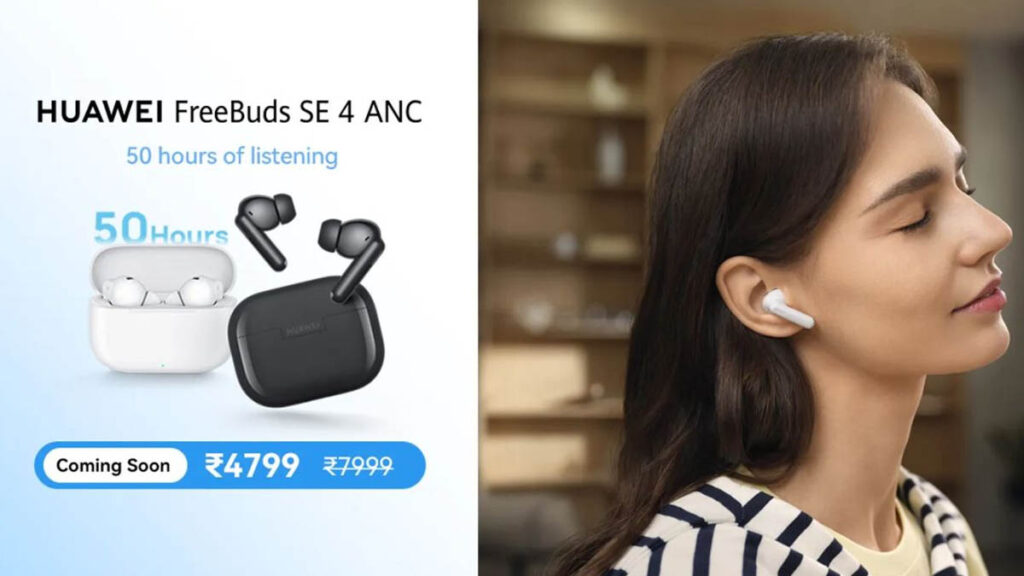
Huawei has widened its true wireless stereo lineup with two new models that serve clearly different needs. The FreeBuds 7i is aimed at users who want a more premium audio experience, while the FreeBuds SE 4 ANC is designed for buyers looking for a more affordable all-round option.
The contrast between the two models is striking because Huawei is pushing not only active noise cancellation, but also audio quality, battery endurance, and everyday practicality. That combination gives each model a distinct role in the market.
Two models, two priorities
The FreeBuds 7i sits higher in the new lineup and is built around Intelligent Dynamic ANC 4.0. The system can automatically adjust noise reduction levels depending on the surrounding environment.
Huawei says the system works in real time to keep listening comfortable across different settings. That makes the FreeBuds 7i more adaptive than TWS models that rely on fixed ANC behavior without automatic tuning.
The FreeBuds SE 4 ANC takes a different route. It still brings Active Noise Cancellation with multiple modes, but it is positioned for consumers who are more sensitive to price.
Even at that lower tier, Huawei says the model can reduce noise by up to 24 dB. The approach shows the company is trying to appeal to both premium-oriented users and value-focused buyers at the same time.
What the FreeBuds 7i brings
For audio performance, the FreeBuds 7i uses 11 mm quad-magnet drivers. The hardware is meant to deliver stronger bass while keeping vocals clear.
Its most notable feature is support for spatial audio with head tracking technology. That makes the listening experience more immersive for music and films alike.
Huawei also equips the model with three microphones for calls. The microphone system is paired with AI-based noise reduction so voices remain clearer in busy environments.
Additional features include dual-device connectivity, audio sharing, Bluetooth 5.4, and gesture controls. These extras make the FreeBuds 7i more flexible for people who switch between devices throughout the day.
Why the FreeBuds SE 4 ANC looks more practical
The FreeBuds SE 4 ANC uses 10 mm dynamic drivers to cover everyday listening needs. Huawei still includes a useful set of features for its price segment.
The model supports Bluetooth 5.4, a low-latency gaming mode, and preset EQ options. That gives it a broader function set than many entry-level TWS products.
Comfort is also part of the pitch. Huawei says the design was developed from research on the human ear structure so it can stay comfortable over longer listening sessions.
That ergonomic focus matters for a model intended for a wider audience. In this segment, users usually want something simple, comfortable, and practical for daily use.
Battery life and durability separate the two
Both new Huawei TWS models carry an IP54 rating. That means they are protected against dust and splashes, making them suitable for daily activities and light exercise.
Battery life is one of the biggest differences between them. The FreeBuds 7i offers up to 35 hours of total music playback with the charging case.
It also supports fast charging. Huawei says a 10-minute charge can provide up to four hours of use.
The FreeBuds SE 4 ANC goes further in total endurance. With the charging case, it can last up to 50 hours, which should appeal to users with heavier mobility demands.
Colors and pricing
The FreeBuds 7i comes in Black, White, and Pink. Huawei lists the launch promo price at 8.799 Rupee, with a regular price of 13.999 Rupee.
The FreeBuds SE 4 ANC is offered in Black and White. Its introductory promo price is 4.799 Rupee, while the regular price is 7.999 Rupee.
The pricing gap makes the positioning very clear. The FreeBuds 7i is built for users who want Intelligent Dynamic ANC 4.0, spatial audio, and a triple-microphone setup, while the FreeBuds SE 4 ANC focuses on ANC, 50-hour battery life, and low-latency gaming support.