


Matthew Willsey’s path into brain surgery began in an electrical engineering lab at MIT, not in a medical classroom. That unusual route now places him among the doctors helping implant brain chips in humans, a field that could one day help patients with severe neurological disorders communicate again.
The work sits at the intersection of neurosurgery and brain-computer interfaces, a fast-moving area where engineers and surgeons are increasingly working on the same problem from different angles. Willsey’s career shows how technical training can translate directly into operating-room practice.
According to Business Insider, Willsey earned both his bachelor’s and master’s degrees in electrical engineering from the Massachusetts Institute of Technology. He studied digital signal processing under Alan Oppenheim, one of the field’s early pioneers.
That background became especially relevant as he moved toward brain-computer interface work. Signal processing is about extracting useful information from complex signals, and that idea is central to systems that read neural activity and turn it into digital commands.
A career shift triggered by a demonstration
A major turning point came around 2009, when he watched a demonstration of a person controlling a computer cursor and a robotic arm through electrodes implanted in the brain. The experience pushed him toward medicine and eventually toward neurosurgery.
After shadowing a neurosurgeon in Texas, he saw an opportunity to combine engineering and surgery in a way that could make a direct difference for patients. He later continued his medical training at Baylor College of Medicine.
Willsey completed his neurosurgery residency at the University of Michigan and earned a PhD focused on brain-computer interfaces. Today, his clinical practice centers on functional neurosurgery, including deep brain stimulation and epilepsy treatment, while his laboratory continues to study BCI technology.
How brain-computer interfaces can help
BCIs are designed for patients whose brains still function but whose connection between the brain and body has been disrupted. In those cases, a person may be unable to speak or move even though they still know what they want to say or do.
For patients with ALS and similar conditions, the technology aims to bridge that break in the communication pathway. The system records neural activity, identifies patterns linked to intent, and converts them into commands that can be used to type text, move a cursor, or control robotic devices.
The field is attracting global attention because several companies and governments are racing to bring it into broader use. Neuralink, the company founded by Elon Musk, is running human trials in the United States, while China has approved a brain-chip system called NEO that has been described as the first commercially available system of its kind.
Willsey is now involved in the implantation of a BCI developed by Paradromics. The company is building a fully implantable system designed for long-term use inside the body.
That approach differs from earlier research devices that relied on cables passing through the skin and connecting to an external computer. Paradromics is aiming for a system that works entirely from within the body, reducing the need for patients to remain physically attached to outside equipment.
What the surgery involves
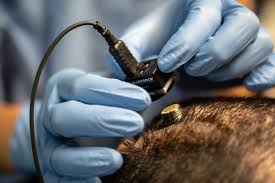
The procedure begins with a craniotomy, in which part of the skull is temporarily opened so the surgical team can reach the brain. Using imaging systems and navigation tools, the team identifies the correct implantation point.
The electrode array is then placed into the brain’s cortex. After the implant is secured, the protective layers around the brain are closed again and the bone is returned to place.
The system is not limited to the head. A transceiver is also implanted in the chest and connected to the brain implant through cables placed under the skin.
The full operation takes about four hours. Willsey says the process is not fundamentally different from procedures neurosurgeons already perform.
That familiarity matters if BCI is to move beyond a small number of specialized centers. The easier it is for neurosurgeons to adopt the technique, the more realistic wider use becomes.
Willsey believes surgeon adoption will be critical to scale. If BCI is to grow broadly, he says neurosurgeons must be able to learn the technique very easily.
Innovation, but with patient safety first
Even after years in the field, Willsey says there are moments in the operating room when the significance of the technology becomes hard to ignore. When the implant is placed in a patient’s brain, the scale of what is happening can feel unmistakably new.
Still, the operating room remains focused on safety above all else. Any thoughts about a breakthrough are set aside so full attention can stay on the procedure itself.
Only after a patient recovers well does the significance become fully clear. Willsey describes that moment as a point when medicine reaches a new stage, with someone having received a truly new kind of brain-computer interface implant.
His work highlights a broader shift in modern medicine, where signal processing, implantable devices, and neurosurgery are converging in practical ways. For patients who have lost speech or movement because of damaged neural pathways, that convergence is no longer just a laboratory idea.