


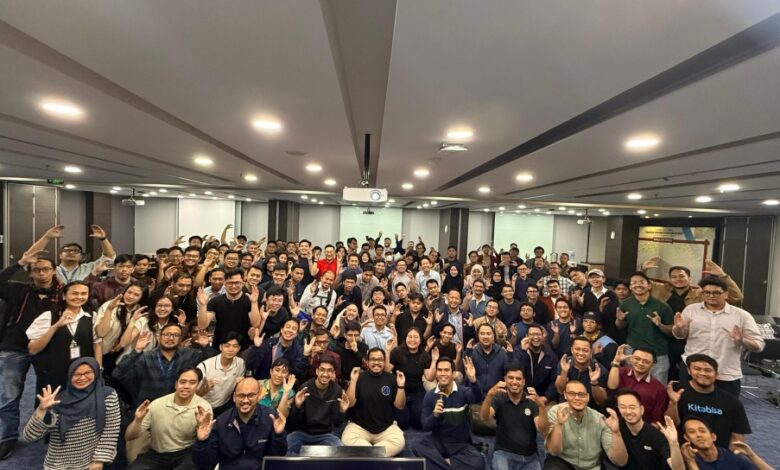
Agentic AI is no longer being discussed only as a future concept in Indonesia’s technology circles. The latest OpenClaw Meetup Jakarta #4, held at Lintasarta in Jakarta, drew more than 500 registrants and reflected a clear shift toward practical implementation.
The gathering showed that interest in AI has moved past exploration and toward tools that can improve productivity and operational efficiency in real work environments. For many participants, the central question is no longer whether AI Agents matter, but how they can be deployed safely and effectively.
A more practical AI conversation
OpenClaw Meetup Jakarta #4 focused on topics such as AI automation and multi-agent systems. The discussion centered on how these technologies can address real business problems across industries, rather than staying at the level of theory.
That direction matters because the local AI ecosystem appears to be maturing. More developers, practitioners, and technology leaders are now looking for hands-on spaces to understand how AI Agents can be built and operated in the workplace.
Global forecasts are adding momentum
The push in Jakarta aligns with Gartner’s projection that about 33 percent of enterprise software applications will adopt Agentic AI by 2028. In 2024, adoption of the technology was still below 1 percent, which highlights how early the market remains.
Gartner also expects around 15 percent of daily operational decisions in companies to be handled autonomously by AI Agents. That forecast suggests Agentic AI is moving from a lab experiment into a broader operating model for business.
Infrastructure is becoming the deciding factor
Gidion Suranta Barus, Chief Cloud Officer at Lintasarta, said large-scale AI adoption needs a strong digital foundation. He noted that success depends not only on advanced technology, but also on the infrastructure that supports it.
Lintasarta is strengthening its Intelligent Core as a foundation that brings together connectivity, cloud, cybersecurity, and AI in one ecosystem. The approach is meant to support industry needs in a secure, integrated way while aligning with corporate data sovereignty requirements.
Collaboration is the missing piece
OpenClaw and Lintasarta both stressed that sovereign AI adoption cannot be driven by one party alone. They pointed to the need for collaboration among developer communities, infrastructure providers, academics, and government regulators to make implementation more structured.
Sofian Hadiwijaya from OpenClaw said open discussion spaces help mature technology ideas before they reach the workplace. He added that AI Agents have the potential to change how organizations operate, but turning that potential into reality requires knowledge sharing and implementation experience.
Support for local talent and startups
The effort to strengthen the AI ecosystem is also tied to developing more local digital talent through intensive training programs. At the same time, startups are encouraged to build digital solutions for strategic sectors.
In this setting, communities like OpenClaw act as a bridge between industry demand and workforce readiness. They give technology players a place to understand market needs and shape AI solutions so they are more practical and applicable.
The partnership between OpenClaw and Lintasarta highlights a broader point: Agentic AI adoption depends on a connected ecosystem, from communities to infrastructure. If that collaboration continues to grow, Indonesia could develop AI use that is more inclusive, secure, and relevant to industry needs.