


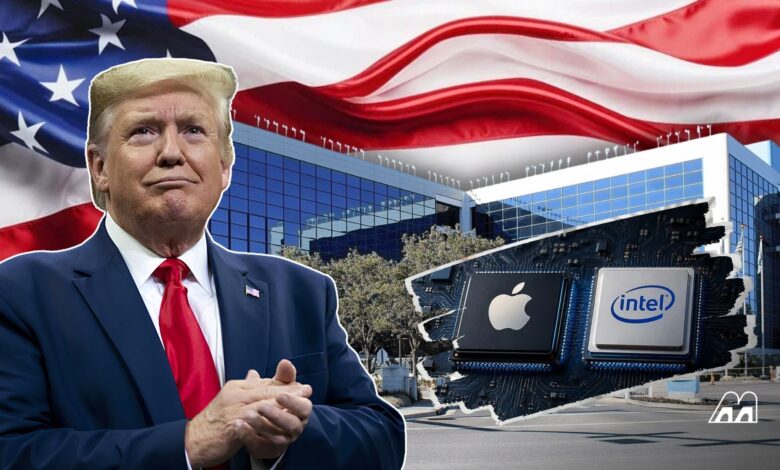
Donald Trump has reignited debate over America’s semiconductor strategy after claiming that Apple and Intel have agreed to design and manufacture chips in the United States. He made the statement on Truth Social on 18 June 2026, and it quickly raised fresh questions about where Apple’s chip future may be headed.
The claim has not been officially confirmed by either Apple or Intel. Even so, it aligns with long-running speculation that Apple may be considering a renewed role for Intel in its supply chain.
A Possible Shift Away From TSMC
If such a partnership becomes reality, Apple would take a major step toward reducing its dependence on TSMC. The Cupertino company currently relies heavily on the Taiwan-based manufacturer for chips used in the iPhone, Mac, and iPad.
That dependence has become more complicated as global demand for AI chips continues to rise. Apple is also competing with major players such as NVIDIA and AMD for access to semiconductor production capacity.
Bringing Intel back into the mix would give Apple a more diversified manufacturing base. It could also help the company reduce supply risks at a time when chip competition is intensifying across the industry.
Why Intel Stands to Gain
For Intel, a deal with Apple would carry major symbolic and commercial value. The company has spent recent years under heavy business pressure, but it has recently shown signs of recovery in the chip market.
Intel has introduced its 18A manufacturing technology, which is viewed as an important step for next-generation chip production. At the same time, demand for Intel processors is said to be improving, giving investors and industry watchers a more optimistic outlook.
A contract with Apple would send a powerful signal to the market. It could strengthen Intel’s position as it works to rebuild its reputation as a leading chip manufacturer.
Trump’s Broader Message on Domestic Production
In his post, Trump stressed the need to bring chip manufacturing back to the United States. He argued that the country has relied too long on other nations, especially Taiwan and China, for semiconductors.
He also referenced “Intel Inside” as a reminder of a period when American technology carried stronger global prestige. In his view, tariffs and domestic investment are the key tools for reviving the national semiconductor industry.
Trump went further by writing that Apple had agreed to work with Intel to design and build chips in America. The U.S. government had previously promised around US$10 billion to help Intel expand its domestic production capacity.
What It Could Mean for the Global Supply Chain
If Apple and Intel production shifts to the United States, the effect could extend well beyond the two companies. The move could create new jobs and encourage additional investment in a strategically important sector.
It would also reduce U.S. dependence on Asian semiconductor supply chains. That issue has become more urgent as geopolitical tensions involving the United States, Taiwan, and China continue to shape the chip industry.
For Apple, the potential arrangement would bring greater supply flexibility. For Intel, support from Apple could become one of the company’s biggest business wins in years.