Valve’s Steam Machine is designed as a compact living-room gaming box, but ETA Prime has turned it into something far more extreme. After adding 64GB of RAM and a 4TB NVMe SSD, the total cost of the build climbed to around $3,247, far above the original $1,428 base unit.
The result is less about raw performance testing and more about what the hardware allows. The teardown showed that Valve made several key parts relatively serviceable, even if the internal layout becomes crowded once the larger components are in play.
What changed inside the machine
The unit ETA Prime worked on was the 2TB Steam Machine bundle that includes the Steam Controller and runs SteamOS. Valve ships it with 16GB of system RAM and 8GB of GDDR6 VRAM, although the graphics memory is not user-upgradeable.
The machine uses an AMD RDNA 3 Navi 33 GPU with 28 compute units, while Valve describes the CPU and GPU pairing as semi-custom. For the memory upgrade, ETA Prime replaced the stock modules with two Crucial DDR5-5600 SODIMM 32GB sticks, a configuration he called overkill for the device.
| Component | Standard Setup | Modified Setup | Notes |
|---|---|---|---|
| RAM | 16GB | 64GB | Upgraded with two 32GB Crucial DDR5-5600 SODIMM modules |
| Storage | 2TB | 4TB | Replaced with a Kingston Fury Renegade NVMe SSD |
| Total Cost | $1,428 | About $3,247 | Includes the base unit and both upgrades |
How difficult the teardown actually was
Reaching the RAM required opening the outer shell, but the process was not as intimidating as the compact design suggested. ETA Prime started with two T8 screws on the back, then removed four more hidden beneath the rubber feet before prying open the front cover with a rubber spudger.
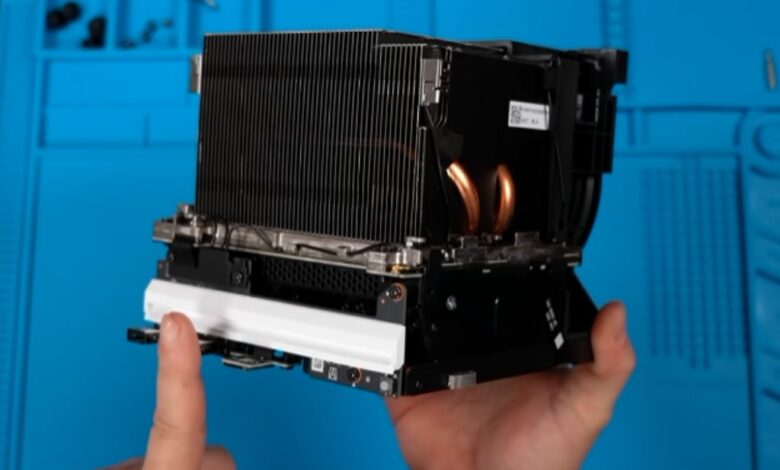
From there, he removed additional screws around the custom fan assembly before lifting the internal frame out of the housing. The motherboard was the most awkward part to handle because it sat tightly between a large copper-and-aluminum heatsink and the power supply.
He also disconnected several Wi-Fi and antenna lines and removed a few I/O boards before separating the fan and heatsink from the PSU. Even so, he did not need to remove the heatsink from the CPU or reapply thermal paste just to reach the memory slots.
Storage upgrade was the easier part
The SSD swap was noticeably simpler. ETA Prime only needed to remove a single panel and install the new drive into an M.2 adapter, with no major teardown required.
He said Valve left enough room for a full-size M.2 2280 SSD inside the chassis, which should make future storage upgrades easier than on many other compact systems. The replacement drive was a 4TB Kingston Fury Renegade valued at $999, rated for read and write speeds of up to 7,300 MB/s.
To avoid reinstalling SteamOS, ETA Prime cloned the original drive onto the new one before reassembly. Once the system was back together, SteamOS recognized 62GB of usable system memory and the full 4TB of NVMe storage.
The finished build shows how far Valve’s compact gaming machine can be pushed without turning the upgrade process into a complete rebuild. What began as a living-room system ended up as a much more aggressive SteamOS rig with significantly more headroom than the standard configuration.
| Upgrade | Part Used | Key Detail |
|---|---|---|
| Memory | Crucial DDR5-5600 SODIMM 32GB x2 | Total 64GB installed |
| Storage | Kingston Fury Renegade 4TB | Up to 7,300 MB/s read and write speed |
| System Software | SteamOS | Cloned from the original drive |