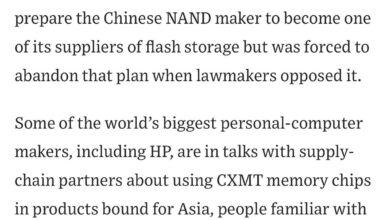
Apple is reportedly asking the Trump administration for permission to buy memory chips from CXMT, a Chinese supplier listed on the Pentagon’s 1260H roster. The move underscores how a tightening memory shortage is squeezing Apple from both the supply and cost sides at once.
According to a Financial Times report, Apple discussed the request with the Commerce Department about a month ago. CXMT is considered by the Pentagon to have links to the People’s Liberation Army, which means any approval could draw immediate political scrutiny in Washington.
Apple’s supplier search is being driven by a broader memory shortage
Apple currently sources memory from Micron, Samsung, and SK Hynix, but those suppliers are also under pressure from booming demand for AI data centers. That demand has pulled supply away from consumer electronics and helped push the market into a tighter position.
Counterpoint Research said memory prices have risen fourfold over the last three quarters. Adding CXMT would give Apple a fourth supplier and could reduce its dependence on a supply chain that has been under strain for months.
| Current Memory Suppliers | Role in Apple’s Supply Chain | Pressure Point |
|---|---|---|
| Micron | Existing supplier | AI data center demand |
| Samsung | Existing supplier | AI data center demand |
| SK Hynix | Existing supplier | AI data center demand |
| CXMT | Potential fourth supplier | Pentagon 1260H listing |
Tim Cook has already warned that memory constraints are likely to last for several more months. The issue is expected to carry over to his successor, John Ternus, who is scheduled to take over on September 1.
Political risk could be as important as supply relief
Technically, Apple is not barred from buying from CXMT because the 1260H restriction applies to the Department of Defense rather than directly to private companies. Even so, proceeding without government approval could create risk for Apple’s federal contracting relationships.
Congress has already signaled resistance. John Moolenaar, who leads congressional efforts to examine China’s geopolitical influence, told the Financial Times that such a move would be a major mistake.
CXMT is sensitive precisely because it appears on a Pentagon list that links the company to China’s military. That leaves Apple weighing a practical supply-chain fix against the possibility of a broader political backlash.
Price increases have added more strain
The report comes just two days after Apple raised prices across its Mac and iPad lines in what was described as the company’s broadest price increase in the modern era. The MacBook Neo rose from $599 to $699, while the 13-inch MacBook Air increased from $1,099 to $1,299.
The iPad Pro also went up by $200, and Evercore analyst Amit Daryanani said the increases were equivalent to roughly 17% to 25% on base configurations. Apple shares fell 6.1% that same day, erasing about $265 billion in market value.
Apple has not commented on the CXMT report, and the Trump administration has not said whether the request will be approved. For now, the company’s memory strategy remains caught between supply pressure, higher costs, and geopolitical risk.