


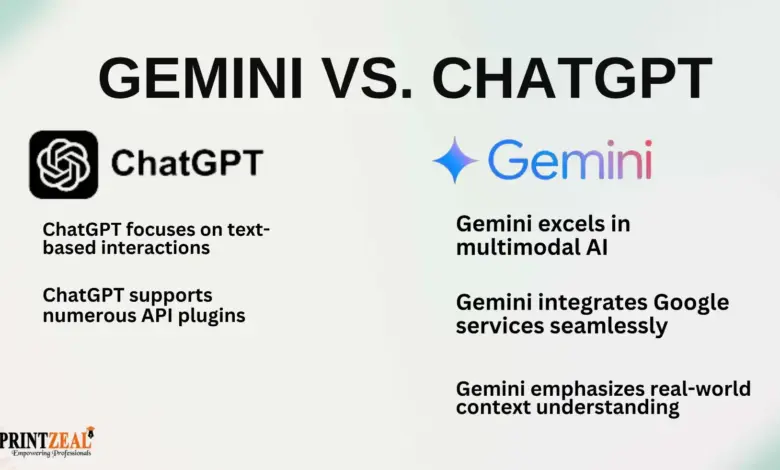
By 2026, the rivalry between Google Gemini and ChatGPT has become less about which AI is more famous and more about which one fits a user’s daily workflow. Both tools can write, summarize, search, and support study or work, but their strongest areas are not the same.
That difference is what now shapes the decision for many users. In practice, the better choice is often determined by the ecosystem a person already uses, the kind of tasks they handle, and how much they rely on conversation-based assistance.
ChatGPT remains strongest as a thinking partner
ChatGPT continues to stand out as one of the most widely used AI assistants in the world. OpenAI has kept expanding its abilities for answering questions, drafting articles, summarizing documents, generating creative ideas, and helping with programming.
Its main advantage is the way it handles complex instructions. That makes it useful for students, professionals, researchers, and business users who need an AI that can follow detailed prompts without losing the thread of the task.
In writing tasks, many users find ChatGPT produces text that flows more naturally. It is often used for articles, letters, reports, presentation scripts, and other professional documents that need flexible tone control.
It is also frequently chosen for long discussions and deeper brainstorming. In that role, ChatGPT works as a productivity partner that helps users develop ideas, organize analysis, and explore topics from multiple angles.
For programming, ChatGPT is widely used to explain code and help identify mistakes. It can also generate sample programs in a range of programming languages.
Gemini gains an edge through Google integration
Google Gemini, meanwhile, has a major advantage in its connection to Google services. Google designed Gemini to work alongside Gmail, Google Docs, Google Drive, Google Maps, Google Calendar, and Google Workspace.
That integration lets users complete more tasks without switching between apps. For people who already live inside Google’s ecosystem, the convenience can be a clear productivity boost.
Gemini is also particularly effective when it comes to finding current information. Its link to Google’s search strengths makes it a strong option for web-based research and up-to-date queries.
It is also competitive for office productivity. Users can draft documents, summarize email, prepare presentations, and manage schedules in a more streamlined way.
For companies already relying on Google Workspace, Gemini’s value becomes even more visible. The close integration helps simplify daily workflows and reduce friction across services.
In software development, Gemini offers similar capabilities to ChatGPT, but its support is reinforced by its connection to Google Cloud-related needs.
Both platforms are becoming more multimodal
In 2026, multimodal capability has become a key development focus for both services. ChatGPT and Gemini can now understand combinations of text, images, and different types of documents.
Users can upload photos, screenshots, or files for analysis, and the results are generally more complete than what earlier AI generations could provide. That broader input support has made both tools more useful in everyday work and study.
Industry reports show that AI adoption continues to grow quickly across companies, schools, organizations, and individual users. The pace of use reflects how deeply these platforms are now tied to digital productivity.
The competition between OpenAI and Google has also pushed innovation forward. Both companies continue to release improvements that make their AI systems more capable and more mature over time.
The real difference is use case, not popularity
Many technology observers now argue that neither AI is universally superior. Instead, the two have developed clear strengths that suit different kinds of users.
Those who depend on Gmail, Google Drive, Google Meet, and other Google services will likely get more out of Gemini. Users who want an AI for ideation, discussion, and flexible writing often prefer ChatGPT because of its conversational versatility.
In education, both tools are being used to summarize lessons, explain complex concepts, and support initial research. At the same time, institutions continue to remind users that AI output should be verified with trusted sources.
The same caution applies to businesses and content creators. AI can save time in marketing ideas, drafting, data analysis, and communication, but the final quality still depends heavily on human judgment and creativity.
Security and privacy remain major concerns as well. OpenAI and Google continue updating their AI policies, but digital security experts still advise users not to enter confidential or highly sensitive information without understanding the privacy rules.
As of mid-2026, both platforms remain central to digital transformation. Gemini stands out through Google ecosystem integration and current web search strength, while ChatGPT is better known for writing, discussion, idea generation, and conversational productivity.
For many users, that means the smarter choice is not the most popular name, but the one that matches the way they already work.