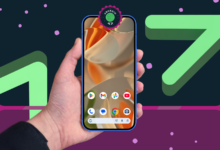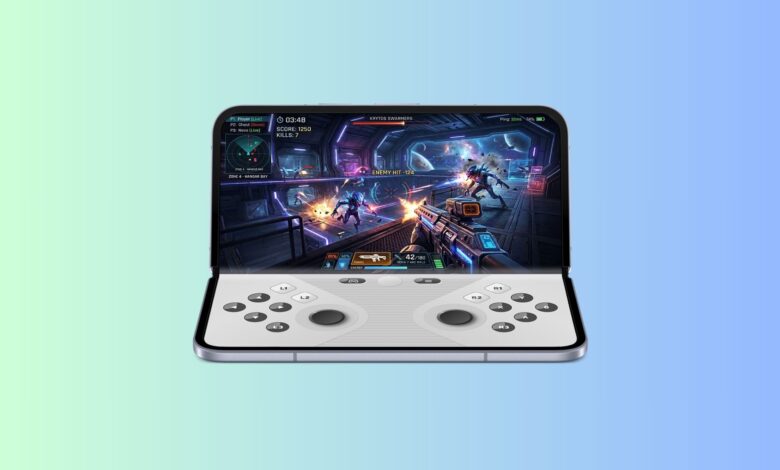
Android 17 is shaping up to give foldable phones a far more convincing role in gaming. Instead of forcing players to cram gameplay and touch controls into the same limited space, Google is preparing a 50/50 split that places the game on the top half of the screen and a virtual gamepad on the bottom.
That design matters because comfort has long been one of mobile gaming’s weakest points. When a small display has to handle both visuals and controls at once, sessions can feel cramped, and hands can tire quickly.
A layout built for foldables
Google first hinted at the feature during the Android 17 announcement on June 16. A clearer look later emerged after Android Community Engagement Manager Mishaal Rahman shared details and images in the Android Gaming subreddit in a post titled “Sneak peek at foldable gaming mode in Android 17!”.
The concept is straightforward. The upper portion of the display is reserved for gameplay, while the lower portion turns into a controller surface.
Google describes the approach as a 50/50 layout optimized for foldables. The goal is to give players more room to view the action while preserving a separate area for input.
The setup also evokes classic dual-screen handheld systems. On a foldable, that split-screen style feels more natural for gaming than using a large phone as a traditional touch-only device.
Virtual controls go well beyond basic buttons
Rahman said that any game supporting physical controllers should be able to use the new setup on Android 17 foldables. In practice, the virtual gamepad acts as an alternative to a real controller when one is not connected.
The control set is broad enough for more demanding games. It includes a D-pad, left and right thumbsticks, A, B, X, and Y buttons, plus L1, L2, L3, R1, R2, R3, and a Start button.
That makes the mode more than a novelty for casual titles. It is built to support games that need a fuller console-style input scheme.
Android 17 also leaves room for manufacturers to tailor the gamepad to their own devices. Since foldable displays vary in size and shape, that flexibility should help keep the controls usable without shrinking the game area too much.
Players can customize the feel
The system offers two layouts for the virtual controller. The default option is called “Twin stick, Inline,” while “Twin stick, Staggered” shifts the left thumbstick, D-pad, and shoulder buttons.
Users can also choose between small, medium, and large gamepad sizes. That should make it easier to balance comfort with screen space, depending on hand size and the dimensions of the device.
Visual options are part of the package as well. Android 17 includes light and dark themes for the gamepad, along with a setting to turn haptic feedback on or off when buttons are pressed.
| Android 17 Foldable Gaming Option | Available Choices |
|---|---|
| Layout | Twin stick, Inline; Twin stick, Staggered |
| Size | Small, Medium, Large |
| Theme | Light, Dark |
| Feedback | Haptic feedback on or off |
Those settings suggest Google is trying to make the feature feel practical rather than experimental. Small details such as button size and vibration can make a major difference in whether virtual controls feel responsive or merely distracting.
Not forced on every game
The gamepad is not always visible. If a player launches a title that only uses touch controls, the virtual controller stays hidden.
It can also be dismissed manually through the menu. That gives players control over when the split-screen gaming mode is useful and when it is not.
Support for external accessories remains in place too. When a controller is connected via Bluetooth or USB, Android disables the virtual gamepad automatically.
That approach keeps the feature from replacing physical controllers. Instead, it adds a convenient fallback for moments when a player is using a foldable without any external accessories attached.
The foldable gaming mode is expected to arrive as part of the final Android 17 release in the coming months. If the implementation is smooth across supported devices, foldables may finally begin to look like a serious handheld gaming option rather than just larger phones that happen to bend.