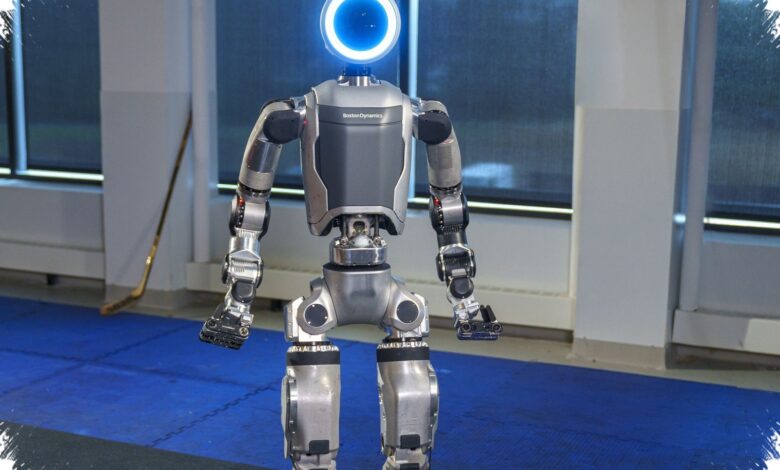
Boston Dynamics is pushing Atlas toward a far more commercial future by stripping away much of the complexity that once defined the humanoid robot. The company says the latest generation is now nearly an order of magnitude simpler to build, a change that could matter as much as its acrobatic movements.
That simplification is not a minor engineering tweak. Alberto Rodriguez, Director of Robot Behavior for Atlas, said the new robot has far fewer parts, especially unique components, which makes manufacturing faster, easier, more reliable, and ultimately cheaper.
A robot built for scale, not just spectacle
Atlas has long been known as one of the most advanced humanoids in the world, but also one of the most expensive. Historical estimates have placed its cost above $200,000, a level that has helped keep humanoid robots out of broad commercial use.
The new approach appears designed to reverse that problem at the core. By reducing the number of parts and unique parts, Boston Dynamics can shorten supply chains, lower failure points, and simplify assembly at volume.
| Atlas Generation Focus | Earlier Version | New Version |
|---|---|---|
| Complexity | Very high | Nearly one order of magnitude lower |
| Parts | More components and more unique parts | Fewer parts and fewer unique parts |
| Manufacturing | Harder to build at scale | Faster, simpler, more reliable, and cheaper to produce |
Rodriguez said the company has shown the same, or even higher, performance with a robot that is fundamentally much simpler. For the humanoid market, that is an important sign that the product may be moving closer to mass manufacturing rather than remaining a high-cost demonstration platform.
Hyundai’s role gives the plan industrial weight
Hyundai now holds the remaining 20% of Boston Dynamics, and its manufacturing scale adds a crucial business dimension to Atlas. The company plans to keep most or all Atlas production this year for internal needs before building at least 30,000 Atlas humanoid units per year and opening sales to other buyers.
That target places production capacity at the center of the story. Hyundai Motor Group, along with Kia and Genesis, sells around seven million vehicles a year and is among the three largest automakers in the world, giving Boston Dynamics access to a production culture built for high volume.
Rodriguez said that kind of manufacturing background is a real advantage in the humanoid race. Companies that already know how to build at scale are likely better prepared for the demands of producing robots in large numbers.
Software is still the limiting factor
Hardware alone is not enough to turn Atlas into a useful work robot. Rodriguez stressed that real capability comes from the combination of hardware and software, and that software is now the main boundary limiting how much value can be extracted from existing machines.
Boston Dynamics divides its AI stack into two layers. The first is physical intelligence, which covers balance, agility, jumping, reaching, and moving objects quickly.
The second is reasoning intelligence, or the ability to understand tasks, break them into steps, and make judgments such as whether an object is heavy or light. Rodriguez said the company is placing more emphasis on reasoning because that is what opens the door to generality.
Built to adapt on the factory floor
One of the biggest problems in industrial robotics is how quickly robots can adjust when work routines change. Manufacturers do not want to spend months reprogramming and validating a robot every time a workflow shifts.
Rodriguez said the ideal robot should learn through experience or demonstration in a more natural way, similar to how a new human worker learns from colleagues or supervisors and then adapts when conditions change.
Boston Dynamics already has relevant industrial infrastructure through Stretch, its warehouse robot, which uses a fleet management system across hundreds of customers. That system handles route inspection and task coordination across multiple robots without requiring individual programming for each unit.
Why legs still matter in tight industrial spaces
Rodriguez also challenged the common assumption that wheels are always the simpler answer for factories, warehouses, and logistics operations. He said the mechanical complexity of a two-legged robot is not far from that of an omnidirectional wheeled base that typically uses four wheels and two actuators per wheel.
Legs also offer practical advantages. A walking robot can reach more places, including areas such as the gap between a loading dock and a trailer or access to mezzanines, while staying slimmer in tight spaces.
Boston Dynamics says balance and locomotion are no longer the overwhelming barriers they once were. The company believes it has found the right formula for making those systems reliable, even as many humanoid startups continue to struggle at the same point.
Atlas also recently appeared in Hyundai’s School of Football campaign, part of the “Next Starts Now” program for the FIFA World Cup 2026. In the five-part social film, Atlas learned to play football and performed the “Ghost Rabona” movement with timing, balance, and high-level motion control, all without CGI.