


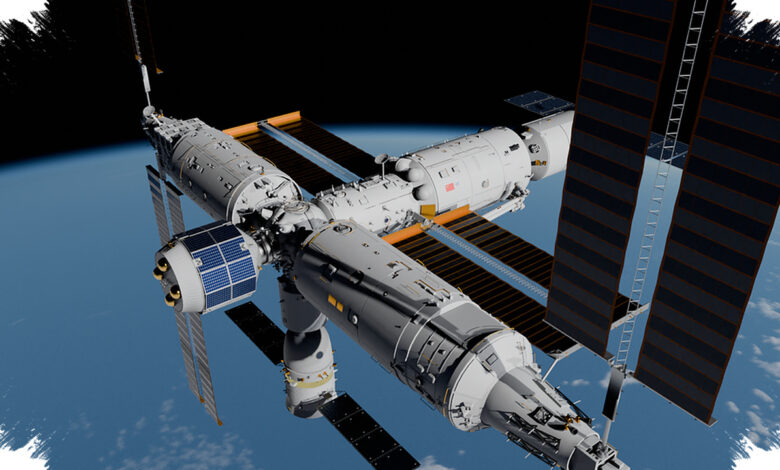
China’s Qingzhou test spacecraft is being positioned as more than a cargo vehicle. The latest batch of in-orbit results points to a broader strategy that links logistics, medical monitoring, biological research, and lower-cost operations in space.
The update, announced on Monday, follows an earlier batch of results released on 15 April. IAMCAS, the Chinese Academy of Sciences’ Innovation Academy for Microsatellites, said the findings should support the next phase of development and improve the operational safety of China’s space station.
Lower-cost systems for work in orbit
One of the most notable developments is a vapor-compression space refrigerator designed to remain stable in microgravity. Researchers refined the system to address the challenge of separating gas and liquid in orbit.
If developed further, the technology could help create a more economical cold-chain transport solution for future space missions. Qingzhou also carried a diagnostic camera intended for maintenance and emergency rescue work, and that device has completed in-orbit verification and is operating normally.
Health monitoring for astronauts
The medical side of the project includes a myoelectric detector using a domestically developed neural chip. The system can collect data continuously and transmit extremely weak muscle signals in real time while in orbit.
A handheld device for blood cell analysis also passed testing. Together, these tools could make astronaut health checks faster and less dependent on large medical systems or support from Earth.
Biology experiments and life in extreme environments
Qingzhou has also supported life-science work in orbit. A low-cost, industrial-standard biological support cabin completed its first test run, creating a reusable platform for future experiments in space biology.
The spacecraft was also used to test the survival of Syntrichia caninervis, a plant known for tolerating extreme conditions. The results showed that it could withstand microgravity, radiation, and drought.
Why Qingzhou matters for China’s logistics plan
Launched in March this year, the test craft is designed for up to three years of operation. It has a mass of 4.2 tons, a single integrated cabin design, an airtight cabin volume of about 27 cubic meters, and 40 cargo slots.
Those specifications show that Qingzhou is built for substantial logistics work, but its real value in orbit tests lies in how many supporting systems it can validate at once. After the main technology checks are complete, the first operational Qingzhou cargo spacecraft is scheduled to launch in 2027 to provide uplink cargo transport services to China’s space station.