


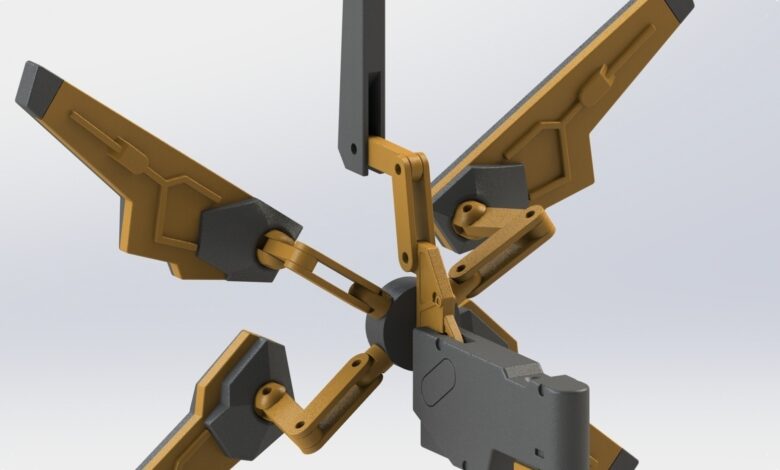
A fan-made Odradek from Death Stranding has moved beyond display-piece status and become a working device that can detect Bluetooth signals. The project stands out because it blends the game’s recognizable design with local AI processing to identify devices in the real world.
What makes the build especially unusual is its target: people wearing AI glasses. In practice, the device is designed to point toward someone who is quietly broadcasting a Bluetooth identity through a wearable device.
Built Around Raspberry Pi 5 and Local AI
The project was shown by Reddit user brenpoly in the Raspberry Pi community. It uses a Raspberry Pi 5 8GB, a Camera Module v3, and an AI HAT+2 based on Hailo-10H, with a local AI agent handling the system’s control logic.
That setup matters because it keeps the intelligence on-device rather than relying on remote services. It also allows the replica to react quickly when it detects a signal and needs to orient itself toward a target.
| Component | Role |
|---|---|
| Raspberry Pi 5 8GB | Main computing and control unit |
| Camera Module v3 | Visual input for local processing |
| AI HAT+2 based on Hailo-10H | On-device AI acceleration |
| XIAO ESP32-C6 | Controls actuators, motors, lights, and Bluetooth scanning |
The head section uses a XIAO ESP32-C6 module. That part handles the actuators, motors, lights, and Bluetooth scanning needed to locate the target device.
From Game Fiction To A Real Signal Tracker
In Death Stranding, Odradek is used by Sam Bridges to detect BTs, the invisible entities that threaten him. In the real-world version, the concept is translated into another kind of “BT” hunt: Bluetooth identifiers.
The build scans for Bluetooth signals from AI glasses using an approach described as similar to a Nearby Glasses app. Once the signal is found, the Odradek turns toward the source, making it look as if it is actively marking a person.
That shift gives the replica a different meaning from most fan-made props. Instead of stopping at visual accuracy, it performs a function that still mirrors the game’s original idea of tracking something hidden.
Why The Build Stands Out
Many game-inspired replicas focus only on appearance, but this one adds movement, lights, scanning, and AI-driven behavior. The result is a device that feels closer to a working interpretation than a static collectible.
The decision to aim it at AI glasses also makes the project feel timely. As wearable devices become more capable, the question of who is recording, observing, or processing nearby activity becomes harder to ignore.
For that reason, the Odradek works not only as a technical showcase but also as a small commentary on modern wearables. It signals when a Bluetooth-capable device is nearby and visually points toward it, turning a game mechanic into a real-world demonstration.
For Raspberry Pi enthusiasts and DIY builders, the project is also notable because its construction process can be followed further on YouTube. That makes it a useful example of how a fictional object can be translated into an electronic and mechanical system that actually performs a task.
Among many fan creations, brenpoly’s version stands out for combining form, motion, sensors, lights, Bluetooth scanning, and local AI in a single build. It is a rare case where a fictional tool does not just look authentic, but also behaves in a way that matches its original purpose.