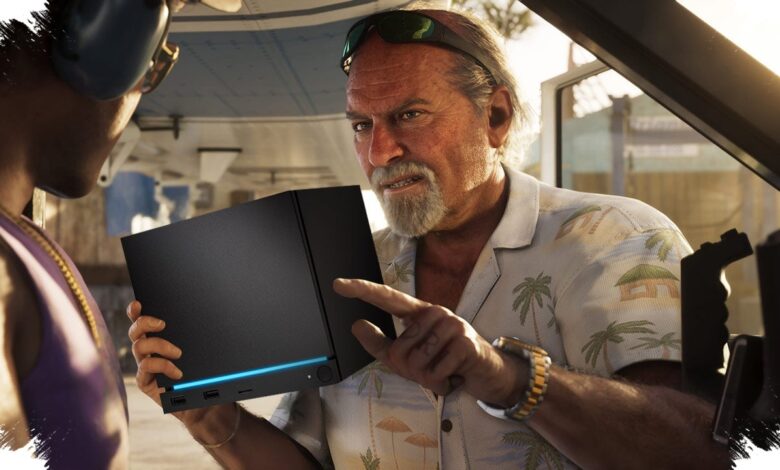
GTA 6 is already drawing attention for two different reasons on PC: whether hardware like Valve’s Steam Machine can run it, and whether the eventual PC version will arrive late enough to frustrate players waiting for the game.
The bigger concern is not just raw performance. Compatibility with SteamOS, the likely weight of Rockstar’s open-world design, and the possibility of anti-cheat limits in online play are now part of the same discussion.
Steam Machine still appears to have a chance
Early analysis suggests the Steam Machine could run GTA 6, although the result will depend heavily on optimization. The device sits between a console and a mid-range gaming PC in terms of computing power.
In several workloads, its performance is described as slightly below the PS5. Even so, it retains a PC-style advantage through flexible graphics settings and upscaling support such as FSR.
That combination has led many observers to believe GTA 6 could scale well across different hardware tiers. Rockstar has a strong track record of building games that can adapt to a wide range of system specifications.
Red Dead Redemption 2 is often used as the clearest example. The game runs across many hardware configurations with adjustable settings, which raises expectations that GTA 6 may follow a similar approach.
The real issue is not whether it runs, but how well
If GTA 6 launches on PC with broad graphics options, the Steam Machine would likely handle it at lower settings. The expectation is not ultra performance or console-level visual parity, but a stable experience through compromises in resolution and effects quality.
Upscaling technology is expected to matter greatly. Tools such as FSR or similar approaches could help preserve performance as GTA 6 becomes more demanding visually.
Story mode should also be easier to manage than online play. Open-world simulation, AI, and online synchronization can place much heavier pressure on systems with limited CPU headroom.
At the same time, the Steam Machine may still struggle with high-end ray tracing effects or a very dense world simulation. Future GTA Online updates could add even more performance pressure.
Rockstar’s release pattern keeps the PC version uncertain
Another reason the conversation remains tense is Rockstar’s long-standing release strategy. The company has often delayed PC versions of its biggest games.
GTA 5 reached PC two years after the console launch. Red Dead Redemption 2 followed a similar path, with PC arriving later rather than alongside the console release.
Industry reporting suggests Rockstar and Take-Two Interactive usually prioritize consoles first. The strategy is seen as a way to serve the core audience before expanding to the PC market.
That said, PC now accounts for a major share of global game revenue. This could mean future release gaps may not be as long as they were in earlier generations, although there is still no official confirmation for GTA 6 on PC.
Online mode may be the most difficult part on SteamOS
Even if the main game runs, the hardest problem may come from online features. The issue centers on anti-cheat compatibility with SteamOS and Linux.
GTA Online currently uses BattlEye as its anti-cheat system. Systems like this often require kernel-level access, while support for SteamOS and Linux remains limited.
As a result, GTA 6’s online mode could face compatibility restrictions on SteamOS. In that scenario, single-player mode may still work normally while online access becomes the most problematic area.
The problem is also tied to Linux’s relatively small user base on Steam. With a limited audience, the incentive for developers to fully optimize support for that platform is still considered modest.
Rockstar looks better prepared than in the GTA 4 era
Concerns about PC optimization are not new for Rockstar, but the current outlook is different from the launch of GTA 4, which was widely criticized for poor PC performance.
In recent years, Rockstar has shown better scalability in its game engines. Red Dead Redemption 2 offered deep graphics customization, while GTA 5 Enhanced Edition is known for running efficiently across different GPUs.
Vulkan API support is also seen as helping performance on many systems. That is why expectations for GTA 6 on PC remain positive even though the game is likely to be very demanding.
Industry analyst Digital Foundry previously estimated that GTA 6 may target 30 FPS on consoles. The reasons include heavy CPU demands, more advanced AI, and a complex world simulation.
If that estimate proves accurate, the PC version could become the most flexible edition. PC would likely unlock variable frame-rate options and more performance modes, as long as the final optimization is strong.
| Key Point | What the Source Says | Implication |
|---|---|---|
| Steam Machine power | Slightly below PS5 in some workloads | Possible, but likely at lower settings |
| Graphics support | PC-style settings and FSR upscaling | Better scalability for demanding scenes |
| Online risk | BattlEye may limit SteamOS/Linux compatibility | Single-player is safer than online play |
| Release pattern | Rockstar often delays PC releases | PC launch timing remains uncertain |
Rockstar has also confirmed GTA 6 pricing through pre-order. The Standard Edition is listed at around $79.99, while the Ultimate Edition is around $99.99, with premium content including vehicles, outfits, weapons, and GTA Online-related bonuses.
So the picture is becoming clearer. The Steam Machine may well be capable of running GTA 6, but the smoothness of the experience will depend on optimization, upscaling, and whether Rockstar can resolve anti-cheat barriers for online access on SteamOS.