


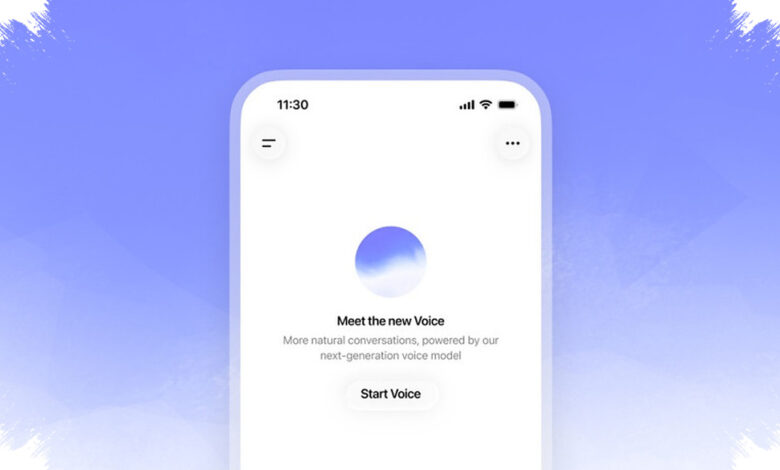
OpenAI has introduced GPT-Live, a new voice model designed to make ChatGPT Voice feel less mechanical and far more conversational. The system now powers the feature’s latest experience, replacing the older turn-based style that often made back-and-forth exchanges feel rigid.
The biggest shift comes from its full-duplex architecture. That setup allows GPT-Live to listen and speak at the same time, which helps conversations flow more smoothly and makes replies feel faster and more natural.
A more responsive way to talk to AI
In practice, GPT-Live can give short listening cues such as “mhmm” or “got it” while the user is still speaking. It also allows users to interrupt the AI, ask it to slow down, or pause it without triggering awkward breaks in the conversation.
OpenAI says the model is also better at hearing users in noisy environments. Heavy traffic and other background sounds are less of a problem because the system stays focused on the main speaker.
| Aspect | GPT-Live | Advanced Voice Mode |
|---|---|---|
| Architecture | Full-duplex | Turn-based speech |
| Interaction style | Listens and speaks at the same time | More rigid and alternating |
| Reasoning and search | Outperforms in GPQA and BrowseComp | Below GPT-Live |
| Conversation feel | More organic and enjoyable | Less fluid |
Complex tasks still go to other models
Even though it is built for smoother conversation, GPT-Live is still positioned as OpenAI’s smartest voice model so far. When a request needs deeper reasoning, web search, or other complex work, the system hands the task to a larger model running in the background, such as GPT-5.5.
While that background model prepares the answer, GPT-Live keeps the exchange alive so the conversation does not stall. OpenAI says internal evaluations show the new model beats the earlier Advanced Voice Mode on expert-level scientific reasoning in GPQA and on difficult information retrieval in BrowseComp.
Safety controls are built in
Because voice conversations happen in real time, OpenAI has also added dedicated safety protections. GPT-Live can detect unsafe responses while it is speaking and redirect the conversation to a safer path, or end the session if the risk is too high.
The company also limits the system so it does not imitate real people’s voices beyond the standard voice options already available. That restriction is part of its effort to keep the feature controlled as voice use becomes more natural.
GPT-Live is now available globally for ChatGPT users on iOS, Android, and the web. For ChatGPT Plus, Pro, and Go subscribers, the service will automatically use the main GPT-Live-1 model.
Free users will be powered by GPT-Live-1 mini. With that rollout, ChatGPT Voice moves closer to a natural speaking experience while keeping stronger safety and usage limits in place.