


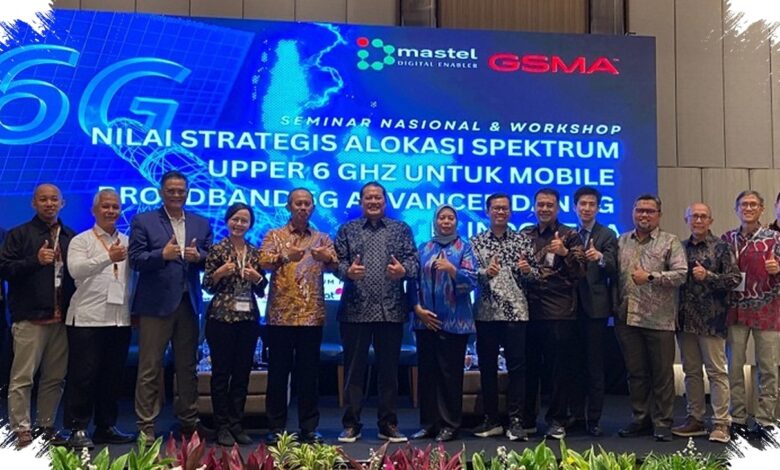
Indonesia’s next telecom battle may come down to one question: whether the country secures Upper 6 GHz for future mobile broadband. MASTEL is now pressing that issue to the forefront, arguing that the band could shape the path to 5G-Advanced and 6G.
The discussion matters because mid-band spectrum is widely seen as essential for faster digital transformation. In MASTEL’s view, the Upper 6 GHz range could become the foundation for stronger connectivity, broader network expansion, and more room for digital industry growth.
A frequency band with long-term consequences
Upper 6 GHz covers the 6425–7125 MHz range and is being treated as a strategic spectrum block for future networks. Its eventual use in Indonesia is still being debated, but the outcome is expected to influence investment decisions and the country’s long-term digital roadmap.
MASTEL said the issue should not be approached casually, because the choice will affect not only mobile broadband but also innovation and the broader Vision Digital Indonesia 2045. The group wants the conversation to be based on data and on a shared understanding of ecosystem readiness.
Chairman Sarwoto Atmosutarno warned that Indonesia should not repeat the delays seen in the early 5G era. He pointed to limited spectrum and ecosystem readiness as lessons that should guide the country’s next move.
Why the forum was built around many stakeholders
To sharpen that discussion, MASTEL brought together representatives from government, regulators, telecom operators, technology vendors, academia, industry groups, and digital ecosystem players. The forum was designed to create common ground before policy moves forward.
Among those present were Marsda TNI Dr. Eko Dono Indarto from Kemenko Polkam, Adis Alifiawan from Komdigi, and Andreas Bondan Satriadi from Bappenas. The forum also included international and national panelists such as Yishen Chan from GSMA and Marwan O. Baasir from ATSI.
The industry and academic side was represented by Telkomsel, XL Axiata, Indosat Ooredoo Hutchison, Huawei, Qualcomm, ITB, Telkom University, Unpad, and UI. Their presence reflected how closely spectrum policy is tied to both commercial deployment and research capacity.
| Tokoh / Perwakilan | Institusi | Peran dalam Forum |
|---|---|---|
| Sarwoto Atmosutarno | MASTEL | Ketua Umum |
| Marsda TNI Dr. Eko Dono Indarto | Kemenko Polkam | Peserta diskusi |
| Adis Alifiawan | Komdigi | Peserta diskusi |
| Andreas Bondan Satriadi | Bappenas | Peserta diskusi |
What MASTEL wants the government to take from the forum
The event was not meant to end with discussion alone. MASTEL said it is aiming for concrete outputs that can be handed to the government as policy input.
Those outputs include a joint industry declaration supporting the use of Upper 6 GHz for mobile broadband, an executive summary, and a formal MASTEL policy recommendation document. The forum also discussed creating a dedicated working group to follow the development of 5G-Advanced and 6G spectrum policy.
That push places Upper 6 GHz at the center of Indonesia’s telecom planning at a time when regional competition is intensifying. For MASTEL, the point is simple: Indonesia needs a stronger frequency base if it wants to keep pace with the next generation of connectivity.
Source: www.medcom.id