


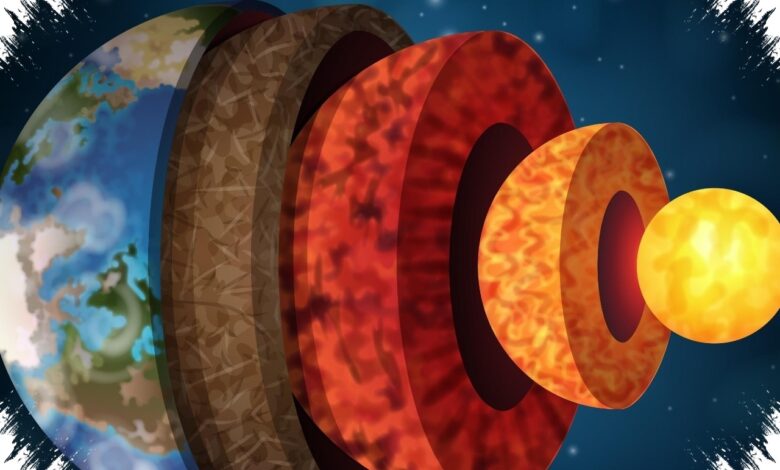
Earth’s inner core appears to have changed direction relative to the planet’s surface, but the development is not considered a threat to life above ground. Scientists say its measurable effect may be limited to a tiny variation in the length of a day.
That variation is estimated at only a fraction of a millisecond. It is far too small to be noticed in daily routines and can only be detected with highly precise scientific instruments.
A Relative Change, Not a Sudden Reversal
The phrase “reversing direction” can create a misleading impression of a dramatic event inside Earth. What researchers observed is a change in the inner core’s rotational speed relative to the surface, rather than a complete and abrupt reversal of the whole core.
Seismic-wave analysis from hundreds of earthquakes indicates that the inner core began slowing around 2009–2010. It then appeared to stop relative to the surface before seeming to move in the opposite direction.
The observation concerns one of the least accessible regions of the planet. Earth’s inner core lies more than 5,000 kilometers below the surface, making seismic data a key tool for examining its movement.
| Key fact | Detail |
|---|---|
| Location | More than 5,000 kilometers below Earth’s surface |
| Composition | Iron and nickel |
| Observed movement | Slowed, appeared to stop relatively, then appeared to move oppositely |
| Estimated onset | Around 2009–2010 |
Why the Core Can Change Its Relative Motion
The inner core is composed of iron and nickel and sits within a far more complex planetary interior. Its movement is shaped by processes that operate over long periods rather than by sudden changes visible at the surface.
Nature Geoscience attributes the possible shift to interactions involving the magnetic field of the liquid outer core and the gravitational force of Earth’s mantle. These forces are part of a broader geophysical system that affects how the planet’s deepest layers move.
The change is therefore understood as part of a natural cycle that may unfold over decades. The speed and direction of the inner core do not change randomly, even though the underlying processes remain difficult to study in full detail.
No Evidence of a Disaster Trigger
Research has not found evidence that the slowing or relative directional change of the Earth’s inner core can trigger earthquakes, volcanic eruptions, or other natural disasters. The phenomenon should not be treated as a warning of an imminent disturbance at the surface.
The scale of the movement also helps explain why its direct impact is so limited. A fractional-millisecond change in the Earth’s rotation does not alter how people experience an ordinary day.
Even so, the subject remains important because the inner core is closely connected to the liquid outer core. That outer region plays a role in generating Earth’s magnetic field.
Earth’s magnetic field acts as a natural shield against harmful radiation from the Sun. Longer seismic records could help clarify links among the inner core’s rotation, the Earth’s magnetic field, and subtle changes in the planet’s overall rotation.
MediaIndonesia.com reported that continued study may also deepen understanding of Earth’s evolution. The apparent reversal underscores that the planet’s deepest regions remain active in ways that are far more complex than what can be observed from the surface.