
Charging an electric vehicle at home is convenient, but the wrong routine can place unnecessary strain on the battery and household electrical system. Low-quality chargers, damaged cables, and unsuitable wiring are among the issues owners should address before making home charging a daily habit.
For routine use, many manufacturers advise keeping the battery at roughly 80 to 90 percent when a long journey is not planned. Avoiding frequent drops to a very low charge level can also help preserve battery performance over time.
Daily Charging Does Not Always Need a Full Battery
Modern electric vehicles use a Battery Management System, or BMS, to control the current and voltage entering the battery. The system also supports automatic charging cut-off once the battery reaches the limit selected by the vehicle or charging setup.
That protection does not mean charging habits no longer matter. Keeping the battery away from repeated extremes, including very low charge states, remains a practical step for everyday ownership.
Fast charging can be useful when a long trip requires a quick top-up. At home, however, an AC wall charger is generally more suitable for regular charging because it produces less heat than high-power rapid charging.
| Home Charging Area | Recommended Practice | Practice to Avoid |
|---|---|---|
| Charging equipment | Use an official or manufacturer-recommended charger | Using equipment outside the required specification |
| Electrical installation | Check power capacity, MCB, cables, and grounding | Charging during an electrical fault |
| Charging cable | Keep insulation and connectors in good condition | Using torn, sharply bent, or crushed cables |
| Battery level | Maintain about 80 to 90 percent for daily use | Frequently leaving the battery at a very low level |
Official Equipment Helps the BMS Work Properly
An official charger or one recommended by the vehicle manufacturer is designed to communicate with the vehicle’s BMS. This coordination helps manage incoming current and voltage according to the battery’s requirements.
Uncertified or poor-quality charging equipment should be avoided because it may disrupt the charging process. Equipment that does not match the required specification can also increase the risk of component damage.
Guidance referring to Indonesia’s Ministry of Energy and Mineral Resources, PT PLN (Persero), and several electric vehicle manufacturers calls for a home electrical inspection before a wall charger is installed. The available power capacity, Miniature Circuit Breaker or MCB, cabling, and grounding system should match the charger’s needs.
Extension Cords Are Not a Substitute for Proper Wiring
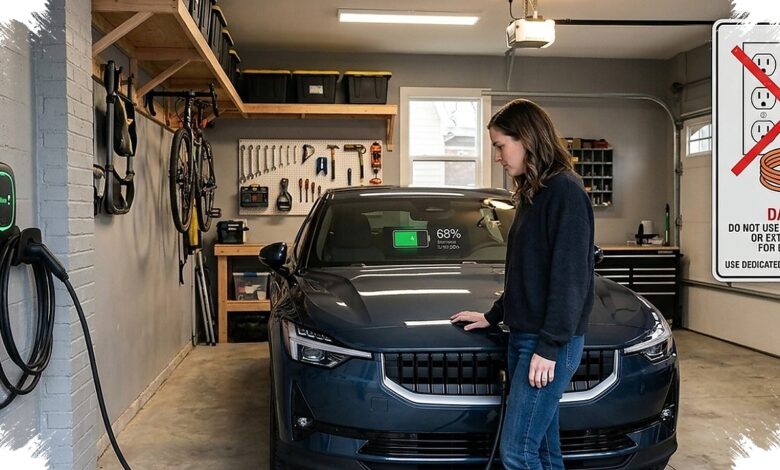
Extension cords and stacked power outlets are not considered a safe option for charging an electric vehicle. These accessories are generally not designed to carry high current continuously and may overheat.
Cable condition deserves attention before each use. Cracks, tears, loose connectors, and damaged insulation can increase electrical resistance and generate heat while charging is underway.
A cable should not be wound up immediately if it is still hot after use. It should also be kept away from vehicle wheel paths and protected from sharp bends, which can damage its insulating layer.
Overnight Charging Requires a Safe Environment
Overnight charging is generally safe when official equipment is used and the home installation meets the required standard. The charging area should have good air circulation and be protected from standing water and direct rain.
Charging should be postponed when household voltage is unstable, even if modern chargers include protection systems. Vehicle software updates should also be installed when available, as some models use them to improve charging efficiency, battery management, and BMS operation.