


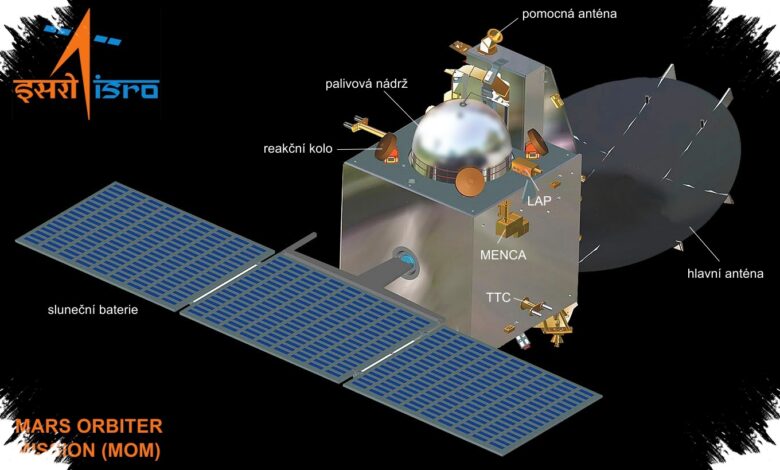
India’s first mission to Mars achieved a result that many space programs had failed to secure on their initial attempt. Mangalyaan entered Martian orbit successfully and continued operating for nearly eight years, far beyond its planned lifetime.
The spacecraft was initially expected to work for only six to ten months. Its extended operation turned a technology demonstration into a longer-running mission that returned scientific data and detailed images of Mars.
A first-attempt achievement
Mangalyaan is the popular name for the Mars Orbiter Mission, or MOM, India’s first mission to Mars. The mission made India the first country to reach Mars successfully on its first attempt.
It also made India the first Asian country to place a spacecraft in orbit around Mars. The United States, the former Soviet Union, and the European Space Agency each required more than one attempt to achieve a comparable result.
ISRO launched the spacecraft on 5 November 2013 from the Satish Dhawan Space Centre. A PSLV-C25 rocket carried Mangalyaan on its journey to Mars.
| Mission Stage | Date | Details |
|---|---|---|
| Launch | 5 November 2013 | Launched from Satish Dhawan Space Centre aboard PSLV-C25 |
| Mars orbit insertion | 24 September 2014 | Completed after a journey of about 300 days |
| Communication lost | April 2022 | Occurred after nearly eight years of operation |
A low-cost mission with wider goals
Mangalyaan cost about 450 crore rupees, equivalent to US$73–74 million at the exchange rate of the time. That figure was substantially lower than the budgets of several Western Mars missions, which can reach billions of dollars.
The lower budget did not mean the mission had limited ambitions. India designed the Mars Orbiter Mission to test precise navigation, deep-space communications, and complex orbital maneuvers.
The spacecraft carried five scientific instruments for observations from Mars orbit. These instruments examined the planet’s surface, atmosphere, mineral composition, and possible methane content.
| Observation Focus | Scientific Purpose |
|---|---|
| Topography and surface | Study the shape and characteristics of the Martian surface |
| Atmosphere | Observe the composition of the Martian atmosphere |
| Mineralogy | Study mineral content on Mars |
| Methane | Seek information about methane content |
Legacy beyond the mission
The spacecraft’s long service life increased the mission’s scientific value and demonstrated the durability of its systems. It also strengthened ISRO’s position as an important participant in the global space industry.
The experience gained through Mangalyaan became a foundation for India’s later space ambitions. One visible outcome was Chandrayaan-3, which successfully landed near the Moon’s south pole.
Communication with Mangalyaan ended in April 2022, but its significance remained intact. The mission is remembered for combining a first-attempt Mars orbit success with a highly competitive cost and an unexpectedly long operational life.