


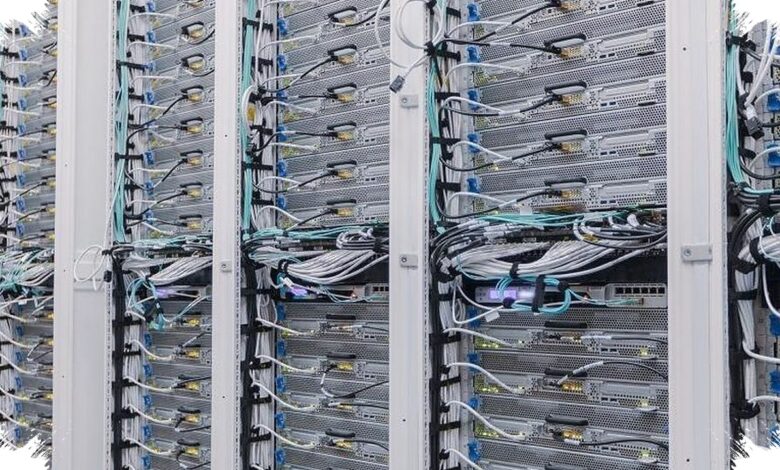
England’s planned expansion of AI data centres could push their daily drinking-water demand from 6.6 million litres to 19.8 million litres by 2030. The projected increase follows the government’s goal of tripling data-centre capacity, even as water supplies are under strain in key regions.
Water UK has warned that the water requirements of data centres have not been included in government demand forecasts. The industry body represents water companies in England and Northern Ireland and has raised the concern with members of Parliament.
Demand Could Rise Threefold
| Scenario | Daily Water Need | Context |
|---|---|---|
| Current UK data centres | 6.6 million litres | Water UK estimate |
| Capacity tripled by 2030 | 19.8 million litres | In line with the government target |
| Some proposals in the Affinity Water area | Up to 3 million litres | About 3,500 homes at peak demand |
Data centres require substantial volumes of water to manage heat generated by servers. Water is used in cooling systems, chillers and humidity controls, while heavy electricity use adds indirect water demand.
The issue is particularly acute because more than three-quarters of the country’s data centres are located in southern and eastern England. Those areas already face high water stress and have seen hosepipe restrictions during periods of heat and low rainfall.
Slough Faces a Concentration of New Proposals
The Affinity Water service area includes Slough, which has the largest concentration of data centres in England. The company said that about 125 data centres are being proposed or built across its service area.
Some developers have requested as much as 3 million litres of water a day. At peak demand, that amount is equivalent to the water needs of roughly 3,500 homes.
Water UK argues that additional data-centre development in areas with stressed supplies will be difficult without policy changes. The group is seeking clear government rules on which users should take priority when drought conditions occur.
Without that guidance, water allocation could require difficult trade-offs between households, industry and newly built data centres. The warning places the rapid growth of AI infrastructure alongside a broader concern over public water security.
Long-Term Supply Gap Adds Pressure
A House of Lords report in May estimated that England could face a shortfall in public water supplies of up to 5 billion litres a day by 2055. That outlook makes future demand from digital infrastructure a more significant planning issue.
Water UK also criticised the national water resources framework published by the Environment Agency in June 2025. According to the organisation, the framework did not estimate water demand from data centres despite the government’s plans to expand capacity for AI.
“There appears to be an assumption that the country will always have enough water to meet its economic needs. The reality is far from that,” Water UK said in a statement quoted by The Guardian.
Government Cites Sustainable Growth Plans
The UK government said AI growth must proceed alongside sustainable development. It said it would protect water supplies while supporting the economy and consider alternatives to reduce data centres’ impact on water use and waste.
The government also said it is pursuing major infrastructure investment to secure supplies as demand rises. Its measures include plans to build nine new reservoirs.