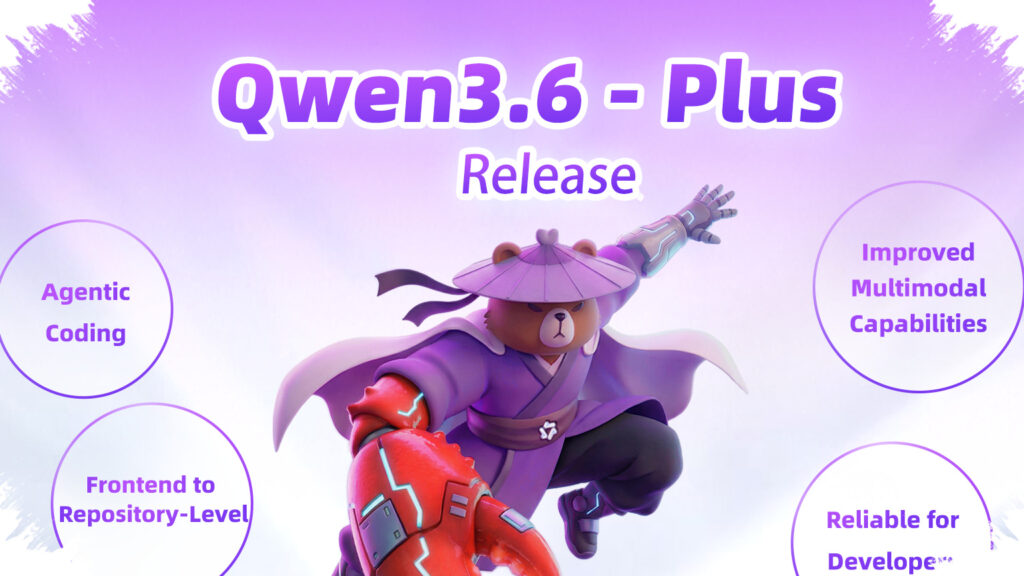
Alibaba is pushing its Qwen line beyond ordinary chat capabilities with Qwen3.6-Plus, a new AI model designed to help users complete technical tasks with less manual effort. Its standout feature is visual coding, which lets the system turn screenshots, wireframes, sketches, or other images into functional frontend code.
The move reflects a broader shift in AI development, where models are expected to reason, plan, and act instead of only generating text. For developers and product teams, that means faster prototyping, quicker website builds, and fewer repetitive steps in early-stage software work.
What Qwen3.6-Plus Brings to the Table
Alibaba describes Qwen3.6-Plus as the latest evolution in its large language model family. Unlike earlier systems that focused mainly on text, this model combines language understanding with visual interpretation and action-oriented output.
The company frames this design around a “Capability Loop,” a workflow that links perception, reasoning, and acting in one system. In practical terms, the model can read input, infer intent, and carry out tasks without requiring step-by-step instructions for every move.
Turning Images Into Code
Visual coding is the headline feature that has drawn the most attention. Users can upload a screenshot of a user interface, a hand-drawn layout, or a rough product wireframe, and the model can translate that input into frontend code.
That capability matters because early product development often starts with visuals rather than clean technical documentation. By bridging design and implementation, Qwen3.6-Plus can help reduce delays between idea creation and a working prototype.
- Upload a screenshot, sketch, or wireframe.
- Let the model interpret layout, structure, and interface intent.
- Generate frontend code based on the visual input.
- Refine, test, and duplicate components as needed.
- Move faster from design concept to deployable product.
Built for Larger and More Complex Work
Qwen3.6-Plus also stands out for its large context window, which Alibaba says reaches up to 1 million tokens. That scale allows the model to process very long documents or handle extended video analysis while keeping more of the original context in view.
Its multimodal capability is not limited to object recognition. Alibaba says the model can support deeper use cases such as automated inspection and consumer behavior analysis in retail settings, which suggests a broader role across business and operational workflows.
Why the Capability Loop Matters
The shift from passive response to agentic behavior is an important part of Alibaba’s strategy. A model that can perceive information, reason through it, and act on it can reduce the need for constant human prompting in repetitive technical tasks.
This matters in software development because many production workflows involve repeated steps that do not always require creative judgment. If an AI can handle some of those steps reliably, teams can spend more time on design decisions, debugging, and product strategy.
Alibaba’s Broader AI Ecosystem
Alibaba is also connecting Qwen3.6-Plus to its wider ecosystem, including Wukong, an AI-native platform for work automation, and Qwen App for general-purpose use. The model is also described as compatible with third-party coding assistants such as Claude Code, OpenClaw, and Cline.
That compatibility may help developers adopt the model without rebuilding their existing workflows from scratch. For enterprises, integration with current tools often matters as much as raw model performance.
Access for Developers and General Users
Qwen3.6-Plus is available through Model Studio on Alibaba Cloud for companies and developers. General users can also try it through Qwen Chat, giving the model reach beyond enterprise environments.
Alibaba is also keeping support for its open-source ecosystem by preparing Qwen3.6 versions in multiple parameter sizes. That approach gives independent developers more flexibility to test lighter models for different devices and use cases.
What This Means for AI Competition
Qwen3.6-Plus arrives at a time when AI companies are racing to move from chatbots to more autonomous systems. The emphasis is no longer just on generating answers, but on helping users complete real work from image to code, and from concept to execution.
If Alibaba continues refining that direction, the Qwen line could become a stronger contender in practical AI tooling, especially for teams that need multimodal understanding, large-context analysis, and faster frontend development in one system.