


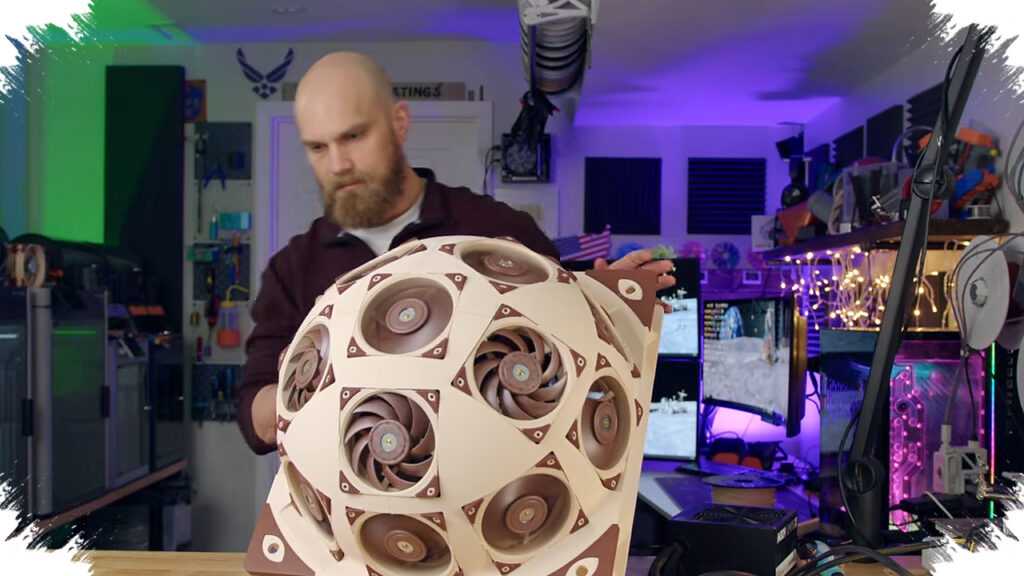
Major Hardware, a YouTube PC builder known as James, has returned with another oversized cooling experiment that has captured attention across the custom PC community. His latest project, called Superdome, replaces a normal side panel with a custom structure built from 15 Noctua 120 mm fans.
The result is not only unusual to look at, but also surprisingly effective. During gaming tests, system temperatures reportedly dropped from 86.3°C without the panel to 66.9°C with the fan-filled side panel installed.
A side panel turned into a cooling wall
Superdome began as a simple idea that sounded almost like a joke on paper. Instead of using a standard case panel, Major Hardware designed a dome-like frame that holds 15 fans together as one large intake structure.
The project followed his earlier fan-based creation, The Fanjattan Project, which also used multiple small fans arranged to work as a larger airflow solution. That earlier work helped establish the same experimental style that now defines Superdome.
At first, the concept looked expensive for a novelty build. Major Hardware estimated that buying 15 Noctua fans alone would cost more than $500, which made the project hard to justify without extra support.
Noctua stepped in to support the build
Major Hardware reached out to Noctua for help, and the Austrian cooling brand responded by supplying the needed fans and 3D printing materials. That support made the ambitious side-panel concept much more practical to build.
The company’s involvement also helped the project stay visually consistent with Noctua’s familiar brown-and-beige identity. That detail mattered because the build was not meant to be a rough prototype, but a polished custom part that could actually sit on a PC case.
How the Superdome was built
To shape the panel, Major Hardware started with a 3D model of the side of a Lian Li O11 Dynamic XL case. From there, he redesigned the surface into a large dome structure that could hold all 15 fans in a stable layout.
Once the design was complete, the parts were printed in 3D and assembled around the fan array. The fans were then fixed into place, creating a rigid structure that could function as a side panel rather than a loose stack of parts.
Cable routing became one of the biggest challenges in the build. With 15 fans tied together, the wiring grew messy quickly, and Major Hardware described the process as a “bit of a disaster” because it required several Y-connectors to keep the setup manageable.
Key details from the Superdome project
| Item | Details |
|---|---|
| Fan count | 15 Noctua 120 mm fans |
| Case base | Lian Li O11 Dynamic XL model |
| Support from Noctua | Fans and 3D-printing material |
| Wiring setup | Multiple Y-connectors |
| Dust protection | No dedicated dust filter |
The table shows how far the build goes beyond a standard enthusiast mod. It combines off-the-shelf cooling parts, 3D-printed structure, and a case-specific layout into a single experimental airflow system.
The cooling result was stronger than expected
What makes Superdome notable is not only the design, but also the performance it delivered. Major Hardware said the panel was “honestly, pretty quiet,” and even suggested that the desktop PC nearby sounded louder than the fan wall itself.
Power use told a different story, however. A standard Noctua A12X25 fan draws 6.1 watts, the earlier Fanjattan project used 8.1 watts, and Superdome reached 27.6 watts. That makes the new build far more demanding, even if it also moves a much larger volume of air.
In Battlefield 6 testing, the temperature difference was especially clear. Without the Superdome panel, the system reached 86.3°C during gameplay, but after the panel was installed, temperatures fell to 66.9°C.
Why the build is not perfect for everyday use
The cooling improvement does not mean the concept is ideal for every PC owner. Major Hardware noted that the system was not fully optimized, partly because the top and bottom radiators were set to exhaust to highlight RGB lighting on the fans.
The build also lacked a dust filter, which means air and particles could enter more freely than in a standard enclosed setup. That makes the design more of an experimental showcase than a practical mainstream upgrade.
Still, the project proved that a side panel packed with fans can do more than look absurd. Major Hardware also shared the Superdome blueprint online, opening the door for other builders who have a compatible Lian Li case, a 3D printer, and enough fans to attempt their own version.