


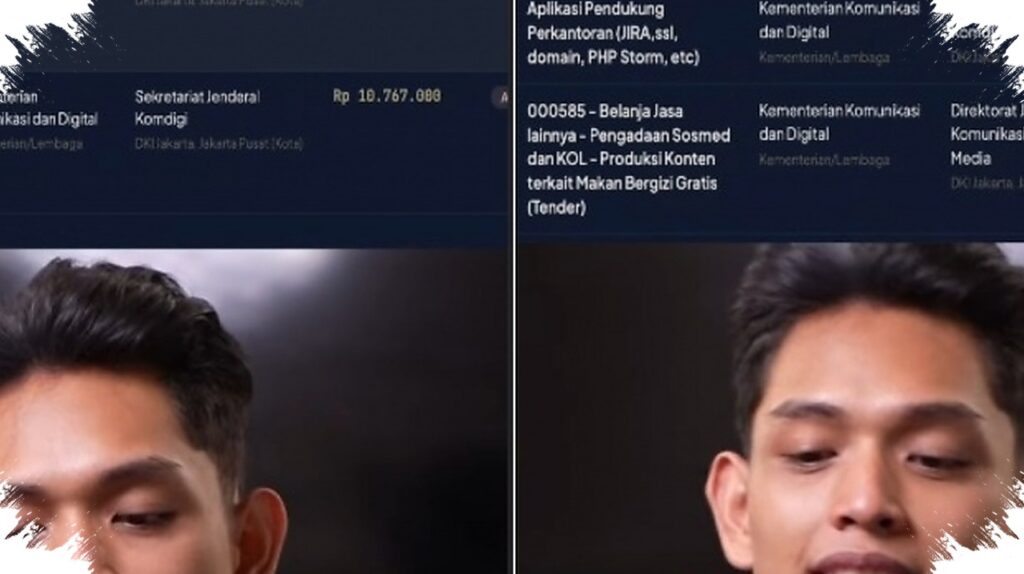
An AI-powered early warning dashboard has put unusual government spending back in the spotlight, this time by flagging procurement items inside Komdigi that appear far removed from core public service duties. The system, shown by Abil Sudarman, identified several decorative and facility-related expenses that reached billions of rupiah.
Among the items highlighted most strongly was the rental of ornamental plants for the 7th floor of the Komdigi building, the Deputy Minister’s office, and the Minister’s official residence. The value reached Rp1,17 miliar for 12 months, a figure that drew attention because it was linked to office decoration rather than essential operational needs.
AI flags non-priority spending
The AI system described by Abil was presented as capable of scanning procurement patterns from regional offices to ministries. In the dashboard display, the system marked certain items as unusual because they did not appear to support the main functions of the institution.
The flagged expenses were mostly tied to aesthetics and comfort in the workplace. That distinction became important in Abil’s explanation, since the system was not merely listing large budgets, but identifying items it judged to be weakly connected to core government services.
Indoor garden and ornamental facilities also appear
The ornamental plant rental was not the only item that stood out. The AI also flagged a rental for an indoor garden within the ministry complex, valued at Rp1,14 miliar per year.
Other decorative maintenance costs appeared in the same set of findings. One of them was aquarium maintenance on the 7th floor of the main building, in the leadership work area, which reached Rp153 juta. The system treated this as another example of spending that looked ornamental rather than functional.
Komdigi was also recorded as allocating Rp126 juta for koi pond maintenance over 12 months. In the AI’s reading, that type of spending was placed in a category that could trigger public discomfort because it looks decorative while budget efficiency remains a concern.
Room fragrance rental also draws scrutiny
Another procurement item that entered the list was room fragrance rental, with a value of Rp360 juta. The AI regarded that amount as excessive for a basic office need.
Taken together, the flagged items formed a pattern that the system interpreted as non-essential spending. The dashboard’s automatic reading did not only focus on the size of the figures, but also on whether the items aligned with the ministry’s main responsibilities.
Abil’s presentation of the AI dashboard framed the issue as an example of how technology can help detect unusual government procurement behavior. In the case of Komdigi, the items under scrutiny were dominated by decorative and comfort-related expenses, prompting closer public attention to how such budgets are used.
Source: www.suara.com