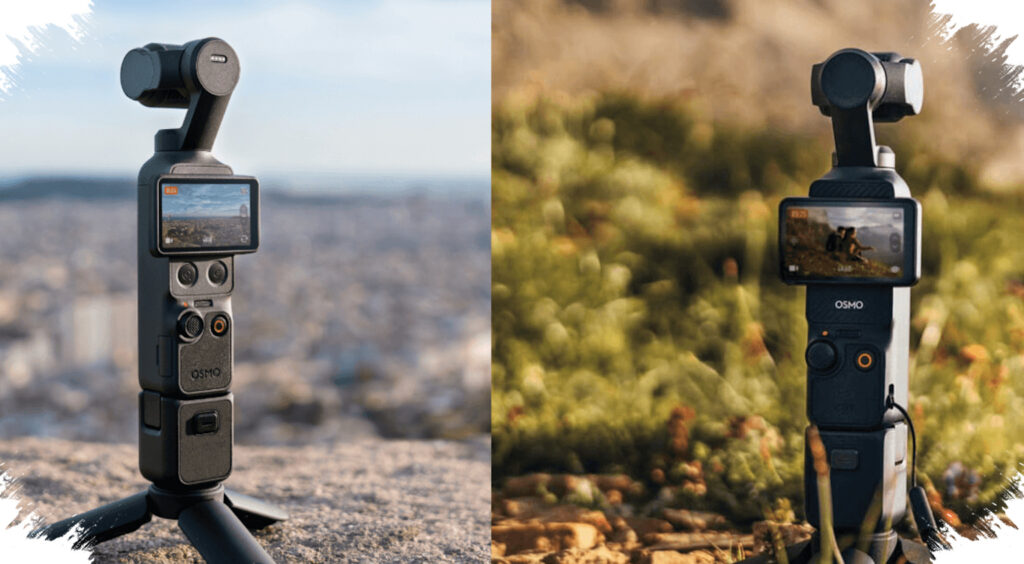
DJI Pocket 4 is shaping up to be a much more ambitious update than a routine refresh. The biggest shift appears to come from the camera sensor, which moves to 1 inch and gives the device a stronger foundation for image quality than Pocket 3.
That change matters because it directly targets the areas that often limit compact cameras: detail, dynamic range, and low-light performance. For creators who care about footage quality first, Pocket 4 is positioned less like a convenience upgrade and more like a serious leap in capability.
A larger sensor changes the core image output
According to The Drone Creative, the new sensor in Pocket 4 delivers 14 stops of dynamic range, which is two stops higher than Pocket 3. In practical terms, that gives the camera more room to preserve detail in bright and dark areas at the same time.
This kind of improvement becomes most visible in difficult lighting, such as when moving from sunlight into shadow or recording city scenes at night. Pocket 4 should have a better chance of keeping image information intact instead of losing it too quickly.
The camera also gains support for an ISO ceiling of 25,600. That adds to its low-light potential and makes the device more suitable for environments where small cameras often struggle.
Resolution rises sharply and opens more room for editing
The sensor upgrade is paired with a major jump in resolution, moving from 9.4 megapixels on Pocket 3 to 37 megapixels on Pocket 4. That increase is not only useful for still images, but also for creators who need flexibility in post-production.
A higher-resolution file gives more room for cropping, reframing, and approaching close-up shots without the result feeling as limited. For content work that depends on sharper output, that extra detail can make the final image look cleaner and more usable.
This also reinforces the idea that DJI is focusing on the camera’s output rather than just polishing the body or interface. In a compact product line like this, the imaging system is often the most important factor, and Pocket 4 clearly leans into that.
Slow motion gets a major step forward
One of the most notable changes is in high-frame-rate recording. Pocket 3 was limited to slow motion at 1080p, while Pocket 4 is said to support 240 frames per second at 4K.
That shift is significant for sports, fast action, and dramatic motion shots where smooth slow motion matters. The footage should not only look more fluid, but also retain stronger detail because it is captured at a much higher resolution.
For standard recording, Pocket 4 still supports 4K at 60fps. There is, however, one limitation to keep in mind: vertical video on the device only goes up to 3K.
Tracking and stabilization remain central to the experience
DJI also updates subject tracking with ActiveTrack 7.0. The feature is meant to follow moving subjects more consistently, including when 2x zoom is used.
That makes the camera more practical for walking shots, sports clips, and subjects that do not move in a predictable way. When paired with the three-axis mechanical gimbal, the Pocket series still keeps one of its main strengths intact.
The mechanical three-axis stabilization helps maintain smooth footage while moving with the camera. In that sense, the new tracking system and the upgraded sensor work together rather than serving as separate gains.
The body also gets practical refinements
Pocket 4 brings an OLED display that grows to 2 inches and reaches a peak brightness of 1,000 nits. That should make framing easier outdoors, especially under strong ambient light.
DJI also adds a zoom button and a customizable button that can be assigned to different functions. A redesigned joystick is included as well, with the aim of giving users more precise control over framing and camera angle.
There is also a protective cover for the MicroSD slot, a small but useful detail for a device that is likely to be carried and used quickly in changing conditions. These changes do not reshape the product as dramatically as the sensor upgrade, but they do support more practical field use.
Battery life and storage increase, while color options narrow
Battery life is listed at up to 240 minutes, which is said to be more than an hour longer than Pocket 3. Fast charging is also supported, with the battery reaching 80 percent in 18 minutes.
Internal storage increases to 107GB, reducing immediate reliance on external memory for some shooting scenarios. DJI also adds gesture control and a magnetic fill light accessory with adjustable brightness and color temperature.
A Creator Combo is available too, bundling a mini tripod and carrying case for broader production needs. Even so, there is a notable trade-off: DLOG M has been removed, leaving only DLOG and normal mode for color profiles.
That means Pocket 4 looks stronger in image quality, handling, and shooting versatility, but some professional users may see the reduced color-grading flexibility as a limitation.
Source: www.geeky-gadgets.com