


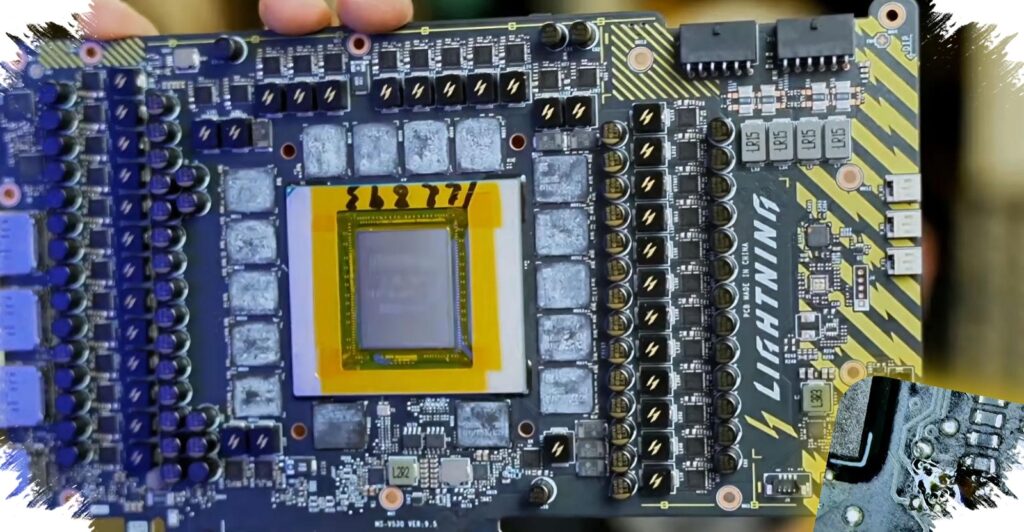
A rare MSI GeForce RTX 5090 Lightning Z reached a state usually feared by any hardware owner: it would not power on and failed to POST after a self-made resistor modification went wrong. The card carries a retail price of $5,100, but what made the case stand out was not only the cost, it was the extreme rarity of the model itself.
Only 1,300 units of the MSI RTX 5090 Lightning Z were made worldwide, which turned a failed experiment into a high-stakes repair job. The graphics card was eventually revived by California-based electronics repair specialist NorthridgeFix, after the board had suffered damage in a fragile area near the GB202 die.
A modification attempt that went too far
According to the owner’s handwritten note sent to NorthridgeFix, the goal was to practice soldering tiny 0402 resistors directly on the GPU. The modification was meant to add a resistor so the card could use MSI’s XOC, or Extreme Overclocking, BIOS, which is restricted on the retail Lightning Z model.
The attempt backfired badly. The thermal pad was torn off, several components disappeared, and traces on the PCB near the GPU die were ripped apart. In practical terms, the card could no longer pass the basic startup check and appeared completely dead.
Repairing a rare board without safety nets
The challenge for NorthridgeFix was amplified by the lack of official support material. No official schematic was available, and no donor board could be used as a reference, which meant the repair had to be done through direct inspection under a microscope.
Alex from NorthridgeFix described the case as shocking, saying, “He tried to ‘learn soldering’ on an extremely rare MSI 5090 Lightning Z GPU, of which only 1,300 units were made worldwide… I’m speechless.” The repair process was documented across three separate videos that showed the diagnosis stage, voltage testing, and the moment the card showed signs of life again.
Rebuilding the broken connections
The actual recovery work focused on restoring the damaged traces and replacing missing components one by one. Each connection around the GPU area had to be checked carefully, since the damage was concentrated in a densely packed and highly sensitive part of the board.
That kind of work is far beyond a simple parts swap. It required board-level repair skills, patience, and manual reconstruction of electrical paths that had been physically torn away during the failed soldering practice.
The card powers up again, but the job is not fully done
The most important milestone came when the repaired MSI RTX 5090 Lightning Z finally POSTed successfully. That meant the card had cleared its initial boot checks and was no longer effectively dead.
Even so, the recovery was not finished at that point. The card still needed its original shroud and cooler reinstalled before full reassembly, and the owner would still need to put it through load testing to confirm long-term stability.
Cases like this highlight how unforgiving high-end hardware can be when modifications are attempted without enough experience or proper tools. On a limited-run board such as the Lightning Z, a small mistake around a tiny component can destroy traces, remove pads, and push an expensive flagship card into a state that demands specialist repair rather than ordinary troubleshooting.
Source: www.notebookcheck.net