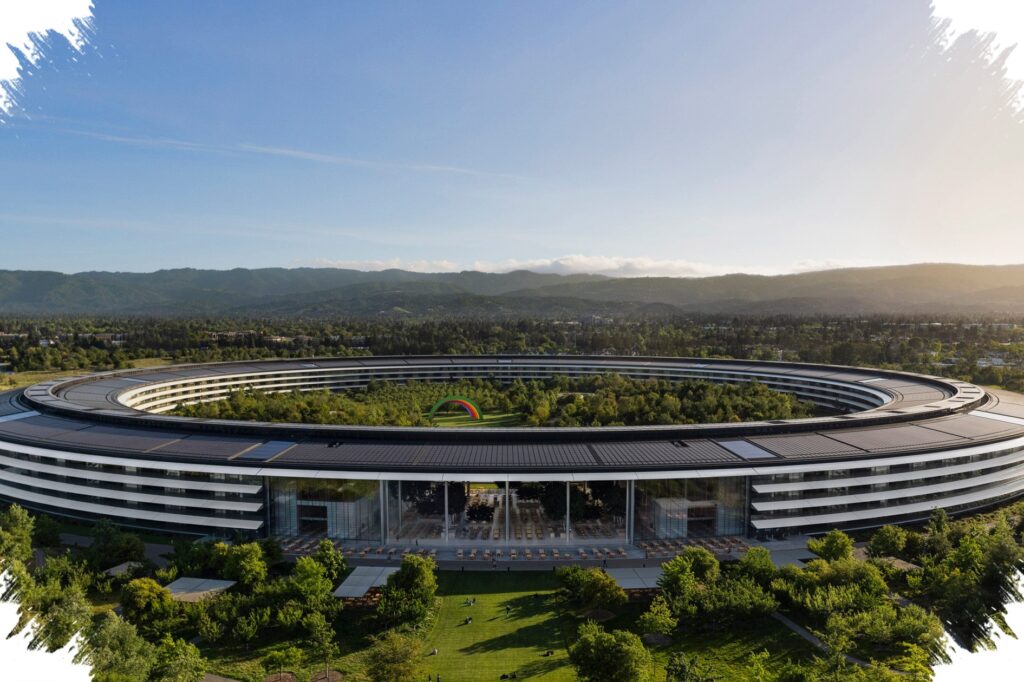
Apple Park shows that a corporate headquarters can be designed as both a workplace and a statement about what modern green architecture can look like. In Cupertino, California, Apple built a vast circular campus that blends sustainability, technology, and visual impact without making the site feel stripped down or purely utilitarian.
The complex covers 175 hectares and houses thousands of employees. Rather than separating departments into rigid zones, the layout was intended to encourage interaction across teams and make collaboration feel more natural.
A vision shaped by Steve Jobs
The project was closely tied to Steve Jobs’ ambition to create the best headquarters in the world. He presented the plan to the Cupertino City Council only four months before his death and personally contacted architect Norman Foster to bring the idea to life.
The location also carried personal meaning for Jobs. It reminded him of his teenage years working at Hewlett-Packard, while the design concept drew inspiration from the atmosphere of Stanford University and memories of California orchards.
Jobs even imagined Apple Park becoming a study subject for architecture students from around the world. To honor that vision, Apple included a 1,000-seat underground theater inside the complex.
Glass as a defining feature
One of the most recognizable elements of Apple Park is its enormous curved glass façade. More than 3,000 large curved panels wrap the outer wall of the 1.6-kilometer ring-shaped structure and create the building’s distinctive transparent look.
Apple has described the panels as the world’s largest curved glass panels. Their role goes beyond appearance, since the transparency helps maximize natural light and reduce dependence on artificial lighting.
Floor-to-ceiling glass also opens wide views toward the green landscape surrounding the building. That design choice narrows the visual divide between the workplace and the outdoors, giving the campus a more open atmosphere.
A circular layout with a social purpose
The ring shape was not chosen simply to stand out. It reflects ideas of unity, equality, and a flow of work that does not depend on traditional spatial hierarchy.
The circular structure also removes the idea of a “corner office” for senior executives. Every workstation is positioned at a similar distance from the center, which makes the environment feel more even across the organization.
That arrangement also supports spontaneous meetings between departments. In practice, the open configuration works much like a co-working space and helps ideas move more freely.
Green design built into daily operations
Apple Park runs on renewable energy across the entire facility. The main roof carries a 17-megawatt solar installation, which is among the largest in the world, and excess power can even be sent back to the public grid during busy midday hours.
About 80 percent of the site is open green space, with around 9,000 drought-tolerant trees planted across the campus. Apple also applied a biophilic concept through walking paths that pass orchards and meadows.
Natural systems help support the building’s efficiency as well. Air circulation reduces the need for mechanical cooling, while rainwater use supports long-term operations.
Built for the future and for earthquakes
Despite its futuristic appearance, Apple Park was also engineered to withstand severe earthquake risk. Its foundation rests on hundreds of giant steel discs so the structure can move safely during strong shaking.
That combination of structural technology, renewable energy, and landscape design has made Apple Park a reference point for modern office architecture. It presents a model in which efficiency, comfort, and ecological responsibility can exist within a single integrated campus.