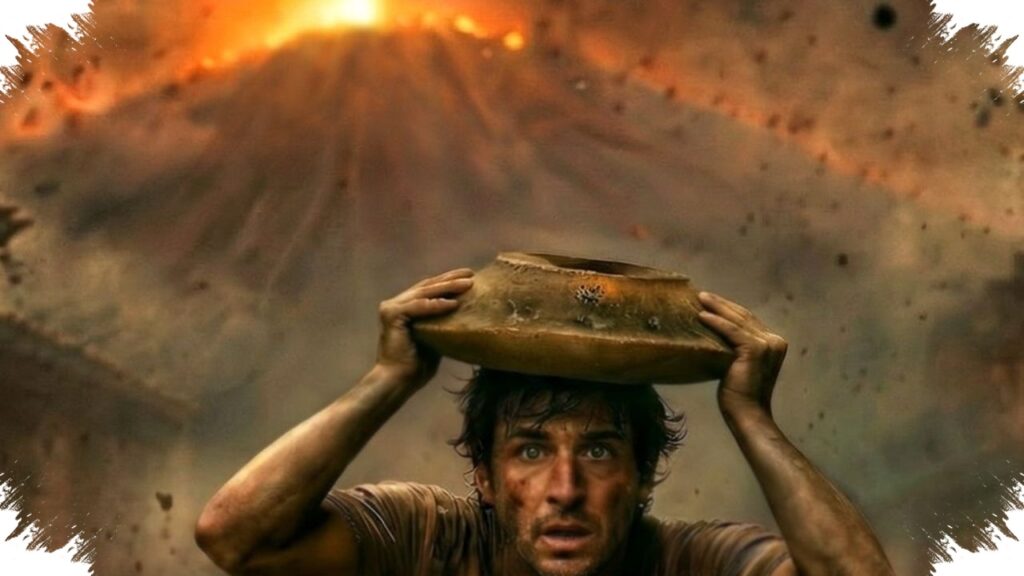
A single set of scattered remains from Pompeii is now being read in a more human way, thanks to artificial intelligence. The digital reconstruction does not simply show bones and debris; it presents a fleeing adult man, bent forward and lifting a large terracotta container above his head while volcanic material falls around him and Vesuvius erupts behind him.
The image is not a historical photograph. It is a scientific interpretation built from excavation data, skeletal analysis, and objects found near the body, giving researchers a clearer way to visualize the final moments of a victim of the eruption.
Reading the escape route from the body
The man’s remains were found outside one of Pompeii’s southern gates, close to Porta Stabia and the necropolis outside the city walls. Archaeologists believe he was trying to reach the coast on the second day of the eruption, when volcanic material was raining down on the area.
He was not alone at the site, as other bodies were also found nearby. Even so, the position of his body and the objects around him suggest the panic that spread as the disaster overtook the city.
Among the most significant objects beside the skeleton was a terracotta mortar, a vessel typically used for grinding grain or mixing food ingredients. Researchers think he may have grabbed it in haste and raised it over his head as a makeshift shield against falling stones or debris.
Everyday objects become part of the story
Other items found near the remains included an oil lamp, a small iron ring, and ten bronze coins. Those ordinary possessions support the idea that he fled in a hurry, carrying whatever he could reach before the eruption closed in.
The reconstruction was developed with the University of Padua and combines archaeological survey data with AI tools that translate physical evidence into a more vivid visual scene. Its purpose is not only to show how the man may have died, but also to suggest how he lived and how his body may have reacted in the middle of widespread panic.
For archaeologists, that shift matters because it turns separate traces into a more complete human narrative. Bones, body position, and small objects that once appeared as isolated evidence can now be understood as one moment in a larger tragedy.
Pompeii was buried after Mount Vesuvius erupted in 79 AD. The disaster killed thousands of people and preserved many signs of daily life, from streets and buildings to human remains uncovered centuries later.
AI as a tool for archaeology, not a replacement
Gabriel Zuchtriegel, director of the Pompeii Archaeological Park, stressed that AI is not meant to replace traditional archaeology. He described it as an extension of existing methods, especially as the amount of archaeological data has grown too large to preserve and use properly without technological help.
He also said that the careful use of AI can contribute to the renewal of classical studies. In that sense, the value of the reconstruction is not in a dramatic “face reveal,” but in the way science, location data, skeletal placement, and modest personal belongings are brought together to recover one human story from one of history’s best-known disasters.