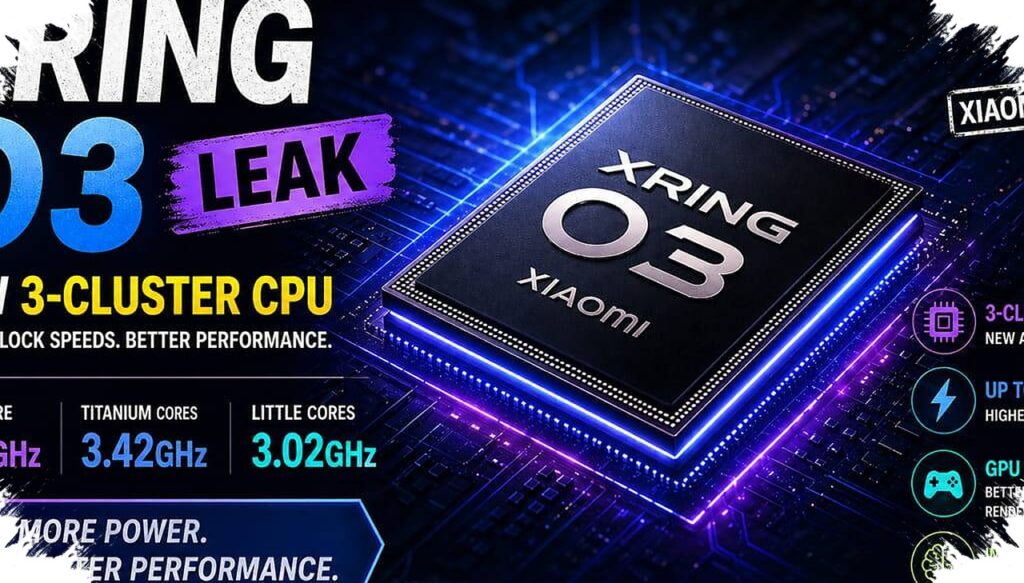
A new Xiaomi chip is starting to take shape in HyperOS code, and the early signal points to a notable shift in how the company may design its next premium silicon. The name Xring O3 has surfaced, and the leak suggests Xiaomi is preparing more power while moving away from its older CPU core layout.
That matters because Xiaomi only recently introduced its in-house chipset ambitions through the Xiaomi 15S Pro. That model marked the debut of the company’s self-made ARM chip and placed Xiaomi closer to Qualcomm, MediaTek, and Apple’s approach to controlling more of the core hardware inside its devices.
A foldable appears to be the likely target
The strongest sign so far is that Xring O3 does not seem intended to replace Snapdragon across the entire Xiaomi lineup. Most Xiaomi products are still expected to continue using Snapdragon chips, so Xring looks more like a parallel path for selected devices.
The device most often linked to the chip is the Mix Fold 5. Some reports also point to a possible launch under the Xiaomi 17 Fold name, although the foldable itself remains the clearest candidate for the new silicon.
Core layout points to a different direction
HyperOS code has not yet confirmed the exact cluster setup or the ARM architecture behind Xring O3. Even so, the current clues point toward the Lumex generation, with C1 Ultra and C1 Pro cores seen as the most likely fit.
The leak also indicates Xiaomi is moving away from the old “big cores” concept. In its place, the chip is said to use a Prime core running at 4.05 GHz, which is claimed to be about 4 percent faster than the previous version.
Alongside that is a “Titanium Core” operating at nearly 3.42 GHz. The small cores are also said to receive a major uplift, reaching 3 GHz instead of the earlier 1.79 GHz figure.
GPU gains may be the most visible jump
The graphics side of the chip appears to be getting a meaningful boost as well. The GPU frequency is reported to rise to 1.49 GHz from 1.2 GHz.
If that detail proves accurate, the increase would be close to 25 percent. That would make the graphics section one of the clearest performance gains in the new design.
Why this matters for Xiaomi’s premium lineup
A Xiaomi foldable with Xring O3 would land in a market where Snapdragon 8 Elite Gen 5 devices already dominate the premium segment. That makes any in-house alternative especially notable, since it would offer a different option inside a category that is usually built around Qualcomm silicon.
The leak also suggests Xiaomi is not treating this as a one-off experiment. Instead, the company appears to be building a longer-term foundation for ARM chips and foldable devices, with a second generation planned for 2026.
That trajectory gives the Xiaomi 15S Pro a larger role than just a first appearance. It now looks like an early step toward a broader strategy, where performance gains and a revised CPU structure could help Xiaomi compete more directly at the flagship level.