


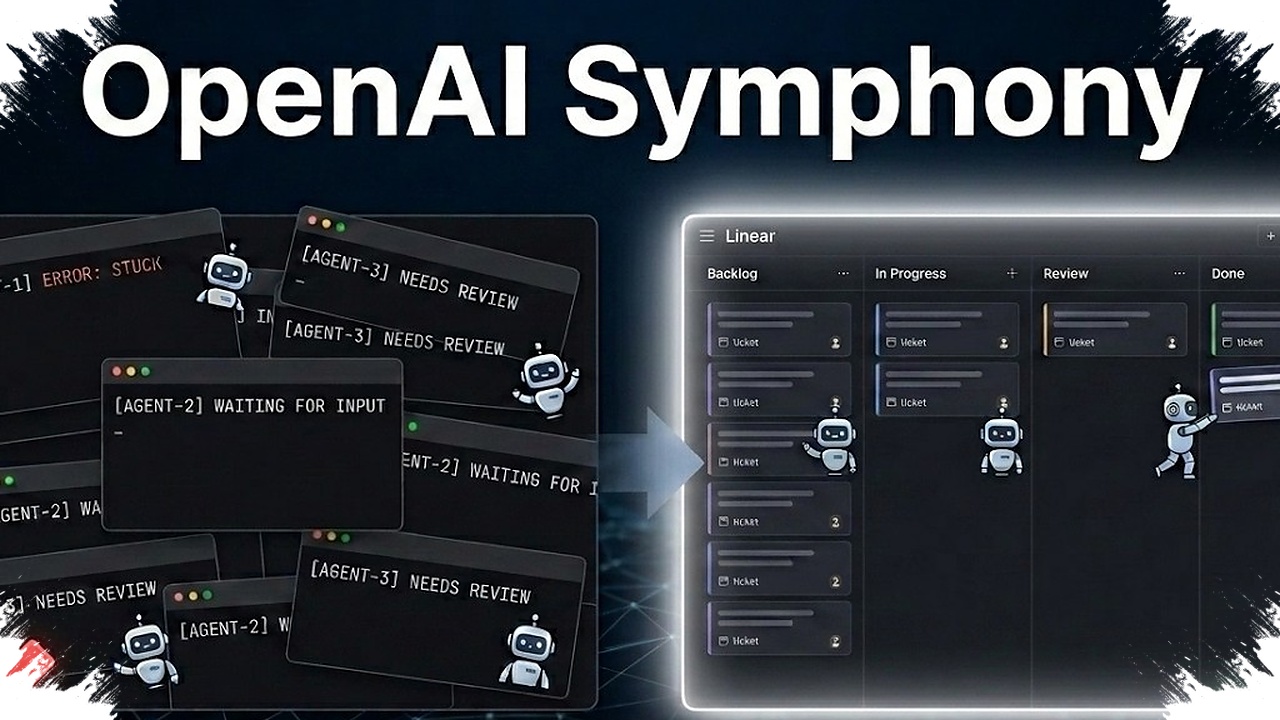
OpenAI Symphony is pushing software teams toward a more task-centered way of working, where a ticket becomes the main unit of execution instead of a long coding session. The shift matters because modern development work is often scattered across multiple tickets, tools, and people, which makes small operational steps consume time and attention.
At the center of that change are autonomous coding agents that can carry a task from start to finish. They are designed to prepare a workspace, track progress, validate the work, and report the outcome back to external systems.
Tickets become the workflow anchor
In the traditional model, much of development still depends on individual work sessions. Symphony changes that by letting the ticket drive the process, so progress can be tracked directly through ticketing systems.
That approach reduces manual intervention in routine administrative and operational steps. It also keeps teams working within systems they already use instead of forcing a move to a new workflow foundation.
OpenAI Symphony connects with Linear, Trello, and Jira. Those integrations help task validation and status reporting stay aligned with existing team processes.
Automation is built around a few core components
AI Jason describes several internal elements that shape how Symphony operates. One of them is a scheduler that handles ticket tracking, workspace preparation, and the coding session lifecycle.
Another key piece is workflow.md, a central configuration file stored inside the code repository. Because it lives in the repository, it benefits from version control and gives teams a clearer way to track changes to working rules and agent setup.
Symphony also uses spec.md to adapt the workflow to specific project goals. That gives the system room to match agent behavior and execution details to different project needs.
How a task moves through the system
When a task is marked “to-do,” Symphony can create a workspace automatically and launch an agent right away. That cuts down waiting time at the start of the work cycle.
The system also supports isolated workspaces for each task. This makes it possible to run multiple tasks in parallel without interfering with each task’s dependencies.
Parallel execution becomes especially useful in complex projects. Teams can split work more aggressively while keeping the risk of workspace conflicts under control.
Symphony also offers configurable settings that shape how agents behave. Those settings include task validation protocols and the point at which human review should happen.
Validation and reporting stay part of the process
For autonomous work to stay reliable, the agent environment needs to be set up carefully. Symphony emphasizes tools that can verify themselves for debugging and end-to-end testing.
Support for tools such as Playwright CRI is used to validate tasks and record proof of completion. That helps maintain accountability even when work is not watched continuously by a person.
Integration with external systems also keeps validation and reporting consistent. Status and results remain visible in the tools that the team already uses.
Designed for different teams and codebases
Symphony is described as adaptable across programming languages and ticketing systems. That makes it relevant for smaller teams as well as larger enterprise projects.
The main customization path runs through workflow.md, which defines the agent flow and behavior. spec.md then helps shape solutions for the specific requirements of each project.
An Elixir-based implementation example also shows that Symphony is not limited to one language ecosystem. For Linear integration, the setup includes an API key and task status configuration so the workflow stays synchronized with the existing process.
What this means for developers
The main effect of this model is a lower cognitive load for developers. When administrative and operational work shifts to agents, human time can move toward higher-level problem solving.
Productivity can improve because bottlenecks shrink and task progress becomes easier to follow. Development also becomes more outcome-oriented, with clearer deliverables attached to each ticket.
Symphony is also expected to grow through community contributions. Developers are encouraged to build and share add-on tools, including task-based TUI support and Cloud Code support, so the ecosystem can keep evolving with changing software development needs.