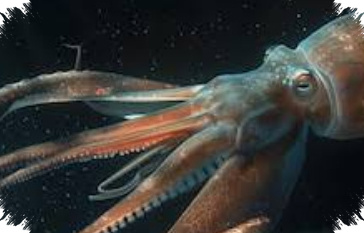
The deep waters off Western Australia have revealed an unexpected trace of one of the ocean’s most elusive animals. Scientists detected signs of a giant squid at a depth of about 4,500 meters near Nyinggulu, or Ningaloo, even though no one actually saw the animal itself.
The finding matters because the species had not been recorded in that area for more than 25 years. Instead of a direct sighting, the evidence came from environmental DNA, or eDNA, which allowed researchers to pick up genetic material left in seawater.
How the squid was detected
The expedition used the RV Falkor, a research vessel operated by the Schmidt Ocean Institute. During the voyage, the team collected more than 1,000 seawater samples from submarine canyons.
Those samples revealed traces of 226 marine species. The result suggests that the deep ocean holds a far richer record of life than what surface observation can show.
eDNA is especially useful in places that are dark, deep, and difficult to reach. It gives scientists a way to detect organisms without catching them or watching them directly.
Why the result stands out
Georgia Nester, the lead author of the research, described the discovery as an important moment for deep-sea science. She said that finding evidence of a giant squid “really can capture the imagination.”
Lisa Kirkendale also noted that this is the first eDNA record of a giant squid off the coast of Western Australia. She added that it is also the northernmost record of Architeuthis dux in the eastern Indian Ocean.
For marine researchers, data like this do more than add a name to a list. It helps expand maps of species distribution, including rare animals that almost never appear at the surface.
A creature built for the dark
The giant squid, or Architeuthis dux, is among the ocean’s most mysterious animals. It can grow to around 13 meters, or 43 feet, making it longer than a school bus.
It also has the largest eyes of any living creature, a trait that helps it survive in the dim light of the deep sea. The species lives in the twilight zone at depths of around 600 meters to more than 1,000 meters below the surface.
Direct sightings remain extremely rare because its habitat is so dark. The first footage of a live giant squid was only obtained in 2004.
Other deep-sea life in the same waters
The same survey also picked up DNA from other deep-diving marine animals. Among them were Cuvier’s beaked whale and the pygmy sperm whale.
Researchers also identified several species not previously recorded in Western Australian waters. These included the sleeper shark, faceless cusk eel, and slender snaggletooth.
The team believes some of the organisms detected may even represent species not yet recognized by science. If that is confirmed, the deep waters off Western Australia may hold a much larger share of biodiversity than previously understood.
A giant squid, but not the largest invertebrate
Despite its size and fame, the giant squid is not the largest invertebrate on Earth. That title belongs to the colossal squid, which can weigh more than 500 kilograms.
A young colossal squid was recorded swimming near the Sandwich Islands in 2025. Kat Bolstad, a squid researcher at Auckland University of Technology, called that one of the most compelling observations in modern deep-sea research.
Together, these findings underline how much of the ocean floor remains unexplored. The latest trace from Western Australia adds another piece to the puzzle of a species that is still mostly known through brief hints rather than direct encounters.